My Attachment Triggers
An attachment worksheet mapping relationship triggers, underlying fears, usual reactions and more secure responses, with sources of security.
1-page fillable PDF · US Letter (prints on A4) · Attachment-informed
- Approach / concern
- Attachment
- Technique
- Attachment-informed
- Format
- Fillable PDF, 1 page (US Letter / A4)
- Access
- Pro and Advanced plans (3-day free trial)
- For
- Licensed clinicians to use with clients
- Updated
- October 2026
Key facts
What is the My Attachment Triggers?
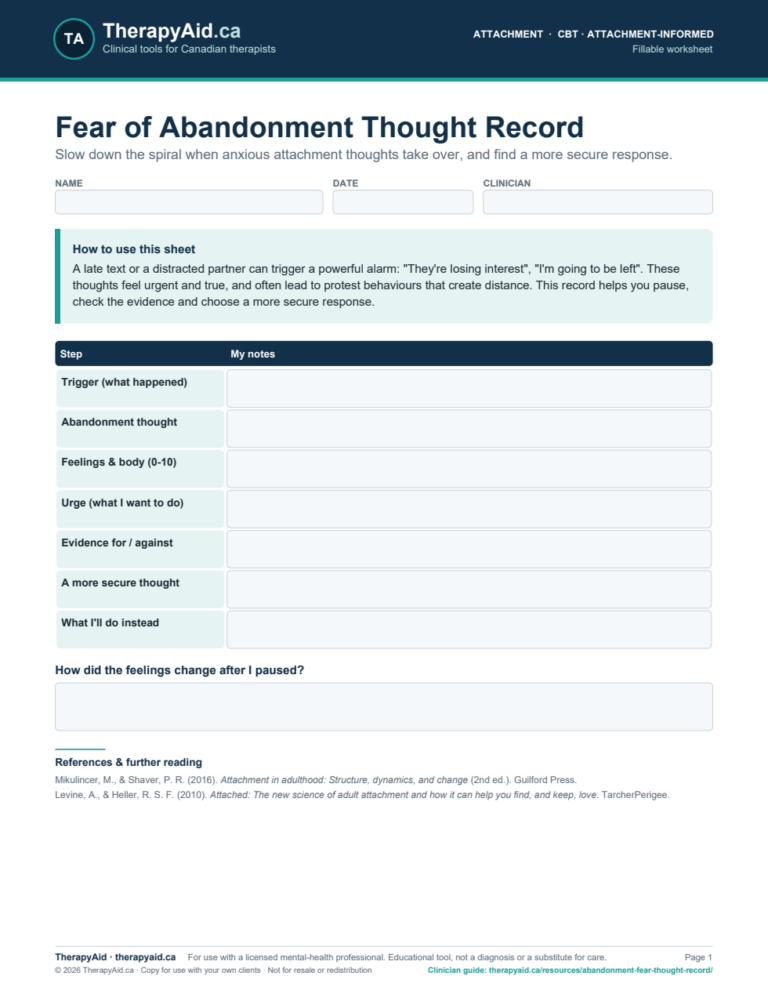
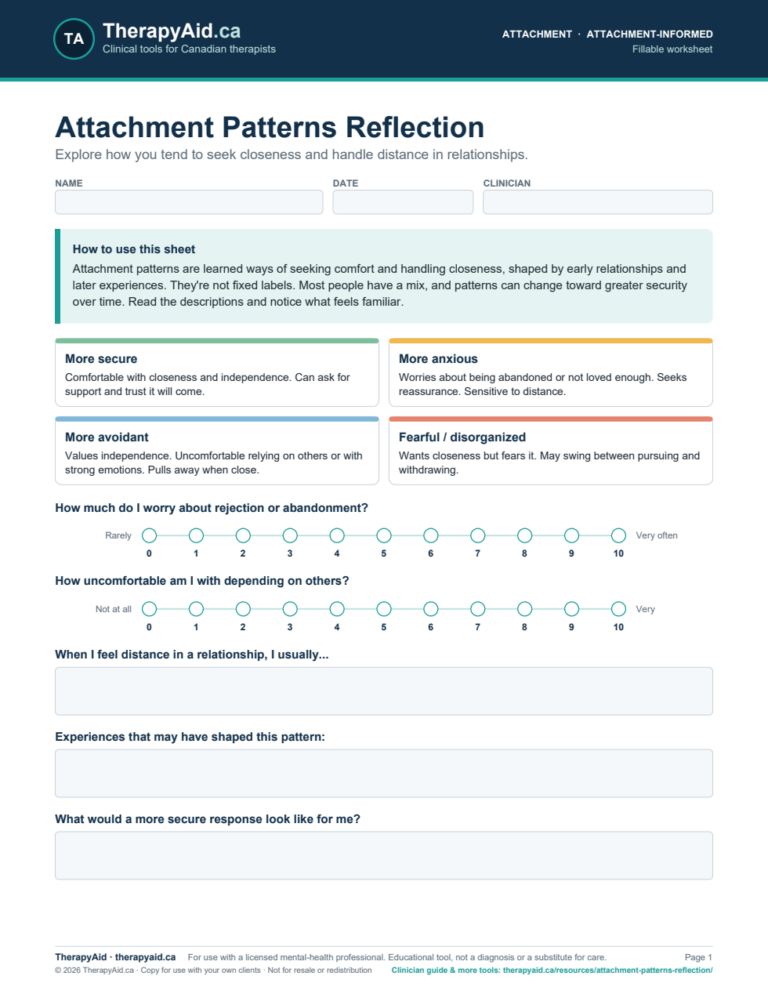
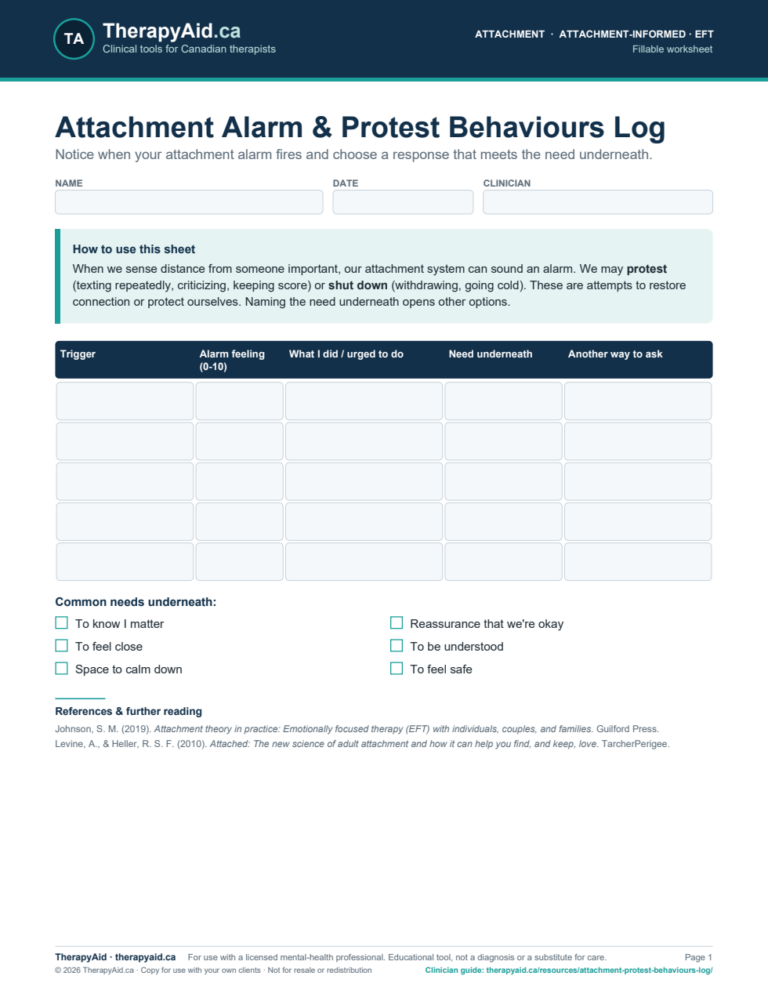
Attachment-related threats activate the attachment system, prompting hyperactivating or deactivating strategies. Recognizing triggers supports secure responses.
Why it works
Mikulincer and Shaver (2016) describe how attachment threats trigger regulatory strategies. Bowlby (1988) emphasized the role of secure bases in regulating distress.
When to use it
- Anxious and avoidant patterns
- Relationship conflict
- Couples work
- Trauma histories
How to use it in session
- List triggers.
- Identify fears.
- Note reactions.
- Plan secure responses.
- List what helps.
Clinician tips
- Link to childhood experiences gently.
- Practise secure responses in session.
- Include partners when appropriate.
Worked example
Sharing with clients
Members can download the PDF to print or email, or copy a private client link from the download box. Your client opens the link and downloads the worksheet on any device. No client account is needed, and nothing your client writes is stored on TherapyAid.
Frequently asked questions
What is an attachment trigger?
A situation that activates deep fears about closeness, rejection or abandonment.
Why are my reactions so strong?
Attachment fears are rooted in early survival needs, so they feel urgent.
References
Mikulincer, M., & Shaver, P. R. (2016). Attachment in adulthood: Structure, dynamics, and change (2nd ed.). Guilford Press.
Bowlby, J. (1988). A secure base: Parent-child attachment and healthy human development. Basic Books.
This worksheet is an educational tool for use by, or under the guidance of, a licensed or registered mental-health professional. It is not a diagnostic instrument or a substitute for clinical judgement. If a client is in crisis in Canada, call or text 9-8-8 or call 9-1-1.