Coping with Urges to Compensate
A coping plan for compensatory urges after eating with delay-and-distract strategies and a log of urges, alternatives and outcomes.
1-page fillable PDF · US Letter (prints on A4) · CBT-E · Coping
- Approach / concern
- Body Image & Eating
- Technique
- CBT-E · Coping
- Format
- Fillable PDF, 1 page (US Letter / A4)
- Access
- Pro and Advanced plans (3-day free trial)
- For
- Licensed clinicians to use with clients
- Updated
- October 2026
Key facts
What is the Coping with Urges to Compensate?
Compensatory behaviours maintain eating disorders by reinforcing restriction and binge cycles. Delaying and distracting, combined with regular eating, reduce them.
Why it works
CBT-E targets compensatory behaviours as part of the maintenance cycle (Fairburn, 2008). DBT distress tolerance skills help ride out urges (Linehan, 2015).
When to use it
- Bulimia and binge-purge presentations
- Compulsive exercise
- Post-meal distress
- Early recovery
How to use it in session
- Identify high-risk times.
- Choose delay strategies.
- Log urges.
- Review what helps.
- Combine with regular eating.
Clinician tips
- Assess medical risks of purging.
- Plan support after meals.
- For eating disorders, use alongside specialist care and medical monitoring.
Worked example
Sharing with clients
Members can download the PDF to print or email, or copy a private client link from the download box. Your client opens the link and downloads the worksheet on any device. No client account is needed, and nothing your client writes is stored on TherapyAid.
Frequently asked questions
Do urges really pass?
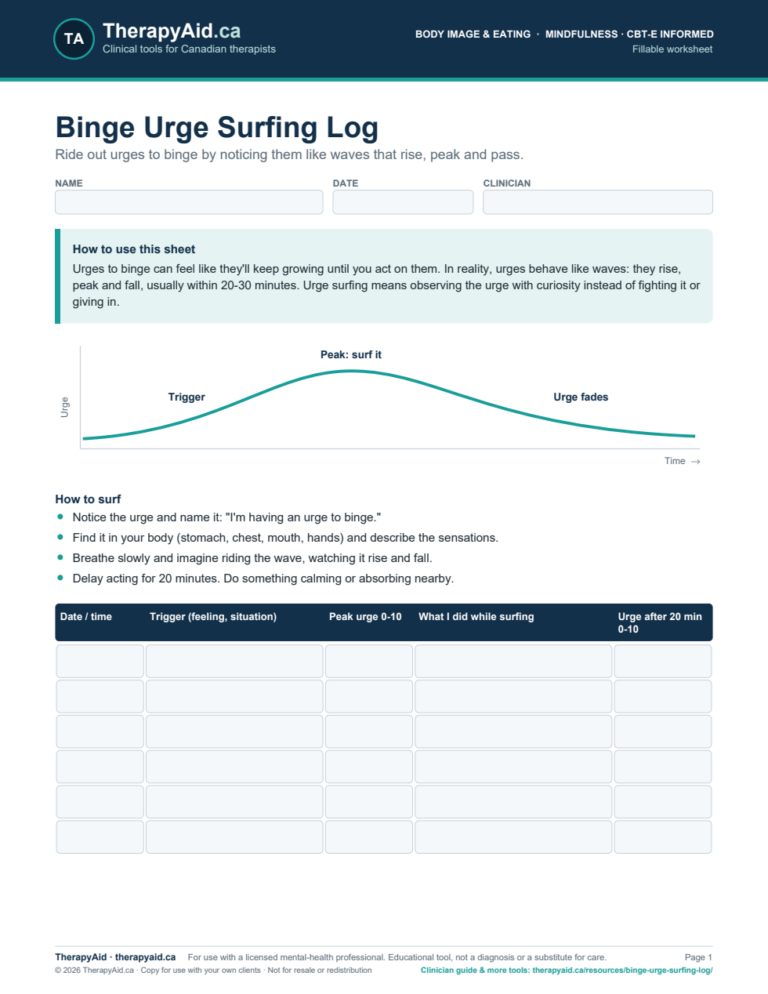
Yes. Urges rise, peak and fall, usually within 30-60 minutes.
What if I act on the urge?
Be kind to yourself, return to regular eating, and share it with your team.
References
Fairburn, C. G. (2008). Cognitive behavior therapy and eating disorders. Guilford Press.
Linehan, M. M. (2015). DBT skills training manual (2nd ed.). Guilford Press.
This worksheet is an educational tool for use by, or under the guidance of, a licensed or registered mental-health professional. It is not a diagnostic instrument or a substitute for clinical judgement. If a client is in crisis in Canada, call or text 9-8-8 or call 9-1-1.