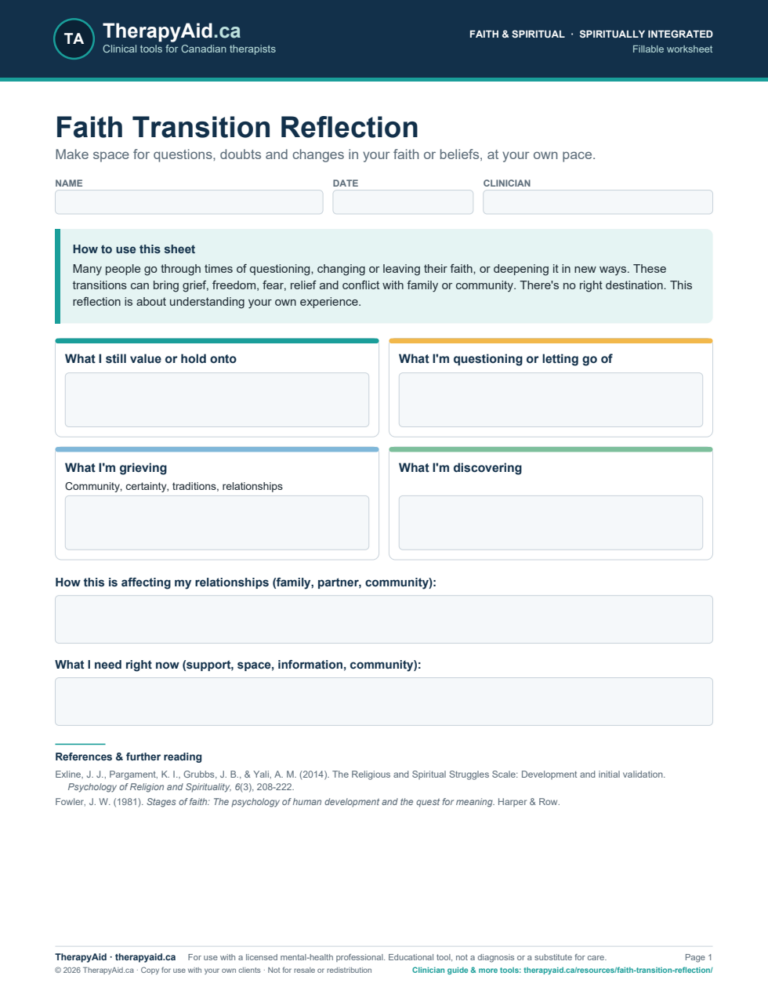
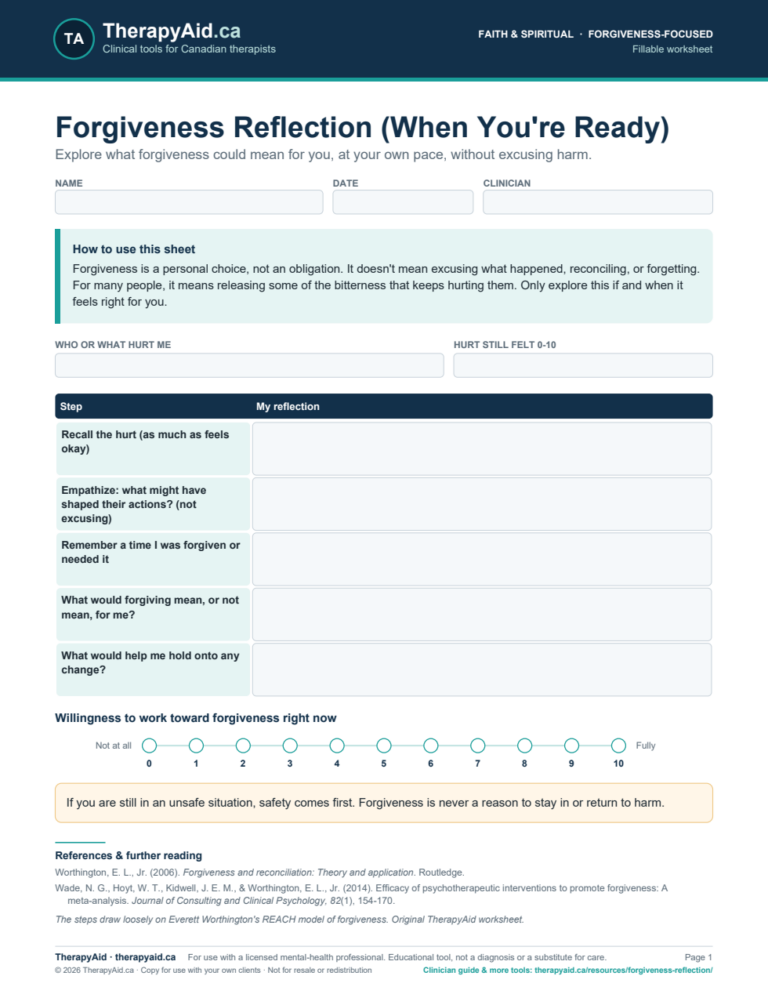
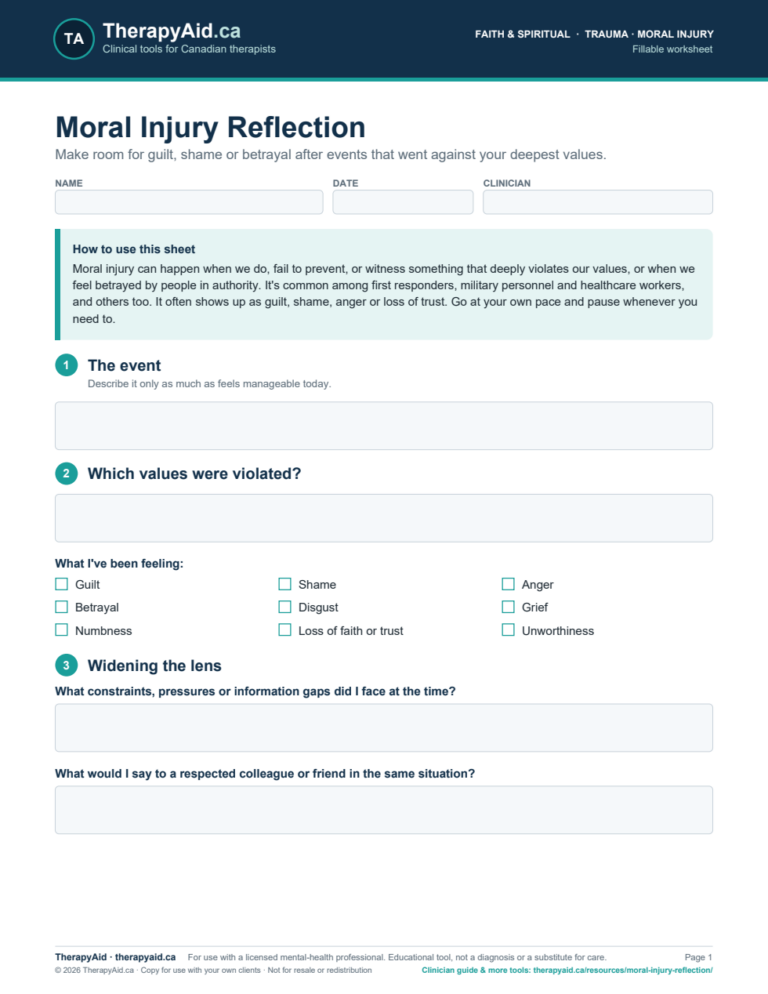
Healing from Religious Harm: A Reflection
A trauma-informed, spiritually respectful worksheet identifying effects of religious harm, harmful messages, current values, grief and sources of support.
1-page fillable PDF · US Letter (prints on A4) · Spiritually integrated · Trauma-informed
- Approach / concern
- Faith & Spiritual
- Technique
- Spiritually integrated · Trauma-informed
- Format
- Fillable PDF, 1 page (US Letter / A4)
- Access
- Pro and Advanced plans (3-day free trial)
- For
- Licensed clinicians to use with clients
- Updated
- October 2026
Key facts
What is the Healing from Religious Harm: A Reflection?
Religious harm (often called religious trauma) refers to distress resulting from experiences in religious contexts, such as fear-based teachings, shame, control or abuse. Effects may include anxiety, shame, scrupulosity and identity struggles.
Why it works
Religious and spiritual struggles are associated with distress and can be addressed in therapy (Exline et al., 2014). Spiritually integrated psychotherapy offers a respectful framework for addressing the sacred in therapy (Pargament, 2007).
When to use it
- Clients leaving or questioning faith
- Shame and scrupulosity
- Religious abuse
- Clients integrating faith and healing
How to use it in session
- Take a neutral, respectful stance.
- Identify effects.
- Name harmful messages.
- Clarify current values.
- Grieve losses and build supports.
Clinician tips
- Avoid disparaging the client’s faith tradition.
- Assess for abuse and safety.
- Pace emotional processing carefully.
Worked example
Sharing with clients
Members can download the PDF to print or email, or copy a private client link from the download box. Your client opens the link and downloads the worksheet on any device. No client account is needed, and nothing your client writes is stored on TherapyAid.
Frequently asked questions
Is religious trauma a diagnosis?
No. It’s a description of harm experienced in religious contexts, which may include PTSD or other symptoms.
Do I have to leave my faith to heal?
No. Many people heal while keeping, changing or leaving their faith.
References
Exline, J. J., Pargament, K. I., Grubbs, J. B., & Yali, A. M. (2014). The Religious and Spiritual Struggles Scale: Development and initial validation. Psychology of Religion and Spirituality, 6(3), 208-222.
Pargament, K. I. (2007). Spiritually integrated psychotherapy: Understanding and addressing the sacred. Guilford Press.
This worksheet is an educational tool for use by, or under the guidance of, a licensed or registered mental-health professional. It is not a diagnostic instrument or a substitute for clinical judgement. If a client is in crisis in Canada, call or text 9-8-8 or call 9-1-1.