Understanding Dissociation
A client handout explaining dissociation as a protective response, common experiences, early warning signs, triggers and grounding strategies.
1-page fillable PDF · US Letter (prints on A4) · Psychoeducation
- Approach / concern
- Trauma & PTSD
- Technique
- Psychoeducation
- Format
- Fillable PDF, 1 page (US Letter / A4)
- Access
- Pro and Advanced plans (3-day free trial)
- For
- Licensed clinicians to use with clients
- Updated
- October 2026
Key facts
What is the Understanding Dissociation?
Dissociation is a disruption in the normal integration of consciousness, memory, identity, emotion, perception and body awareness. It ranges from everyday absorption to dissociative disorders, and is common after trauma.
Why it works
DSM-5 describes dissociation as a disruption of integration across psychological functions (Spiegel et al., 2011). Phase-oriented treatment of trauma-related dissociation emphasizes understanding and stabilization (Steele et al., 2017).
When to use it
- Trauma and PTSD
- Clients who ‘zone out’ in session
- Depersonalization and derealization
- Before trauma processing
How to use it in session
- Normalize dissociation as protective.
- Identify personal experiences.
- Notice early signs and triggers.
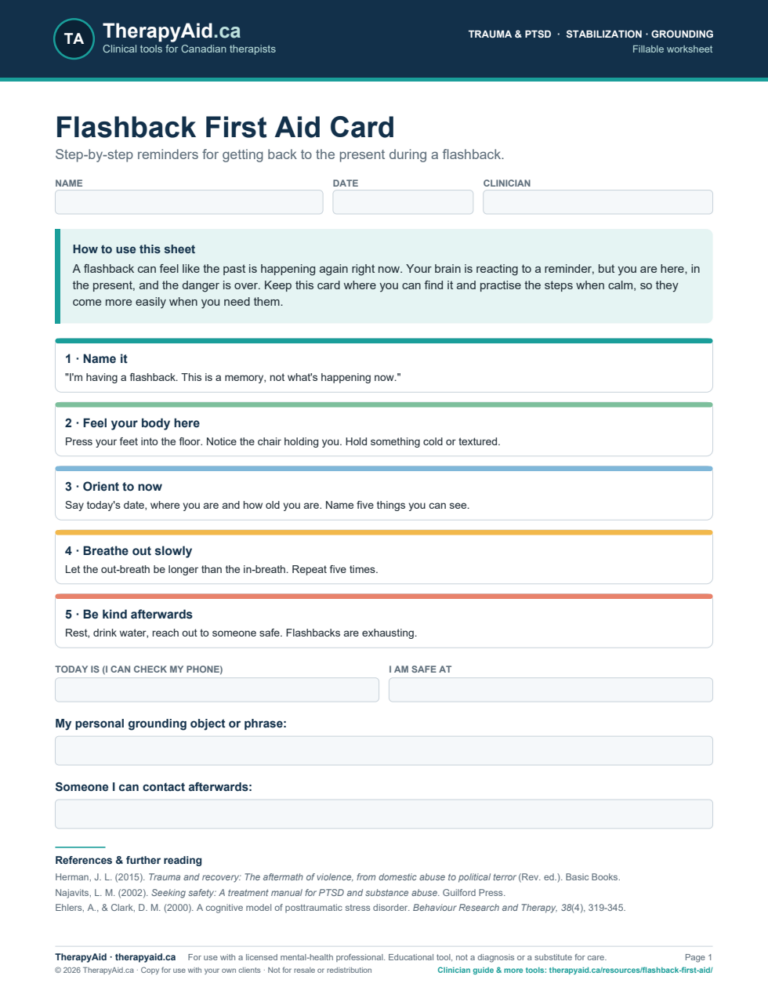
- Practise grounding skills.
- Agree an in-session signal.
Clinician tips
- Screen for dissociative disorders when indicated.
- Pace sessions to stay within the window of tolerance.
- Avoid shaming language.
Worked example
Sharing with clients
Members can download the PDF to print or email, or copy a private client link from the download box. Your client opens the link and downloads the worksheet on any device. No client account is needed, and nothing your client writes is stored on TherapyAid.
Frequently asked questions
Is dissociation dangerous?
It’s a protective response, but frequent or severe dissociation should be assessed by a professional.
Can dissociation be treated?
Yes. Grounding skills and trauma-informed therapy can reduce dissociation.
References
Spiegel, D., Loewenstein, R. J., Lewis-Fernández, R., Sar, V., Simeon, D., Vermetten, E., Cardeña, E., & Dell, P. F. (2011). Dissociative disorders in DSM-5. Depression and Anxiety, 28(9), 824-852.
Steele, K., Boon, S., & van der Hart, O. (2017). Treating trauma-related dissociation: A practical, integrative approach. W. W. Norton.
This worksheet is an educational tool for use by, or under the guidance of, a licensed or registered mental-health professional. It is not a diagnostic instrument or a substitute for clinical judgement. If a client is in crisis in Canada, call or text 9-8-8 or call 9-1-1.