IBS and the Gut-Brain Connection
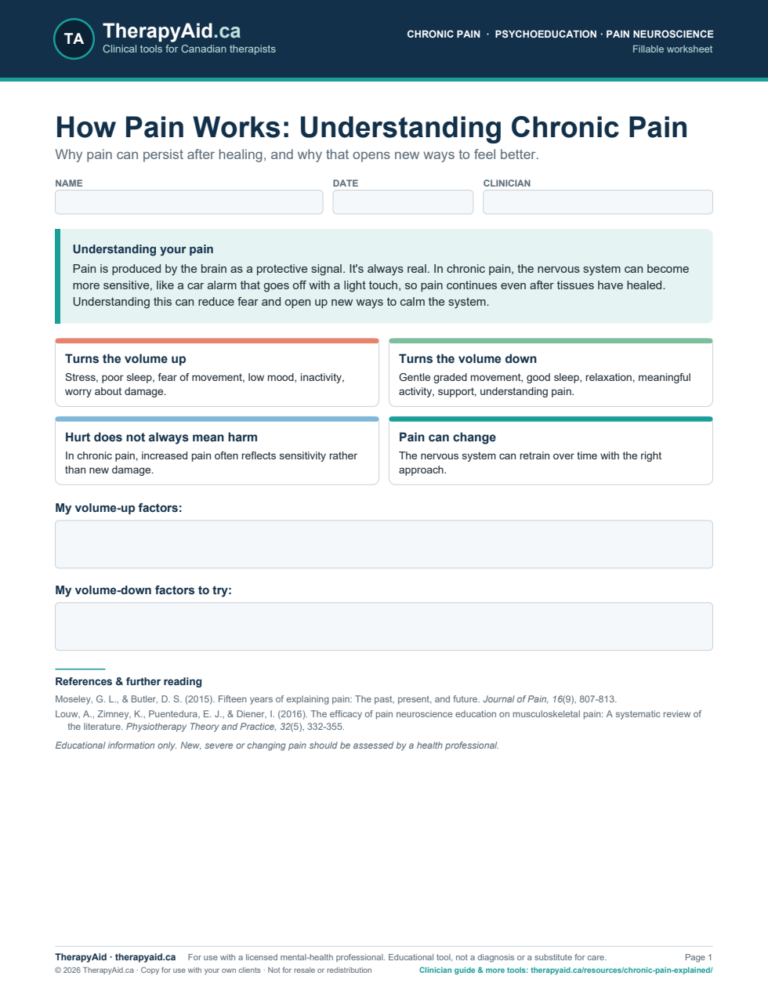
A client handout explaining IBS as a disorder of gut-brain interaction, volume-up and volume-down factors, with a weekly gut symptom and stress diary.
1-page fillable PDF · US Letter (prints on A4) · Psychoeducation
- Approach / concern
- Chronic Pain
- Technique
- Psychoeducation
- Format
- Fillable PDF, 1 page (US Letter / A4)
- Access
- Pro and Advanced plans (3-day free trial)
- For
- Licensed clinicians to use with clients
- Updated
- October 2026
Key facts
What is the IBS and the Gut-Brain Connection?
IBS is a disorder of gut-brain interaction involving abdominal pain and altered bowel habits. Visceral hypersensitivity and the gut-brain axis are central, and psychological factors can amplify symptoms.
Why it works
Rome IV reframed functional GI disorders as disorders of gut-brain interaction (Drossman, 2016). A network meta-analysis found CBT and gut-directed hypnotherapy effective for IBS (Black et al., 2020).
When to use it
- Clients with IBS diagnosis
- Gut symptoms linked to anxiety
- Health anxiety about gut
- Integrated care
How to use it in session
- Explain the gut-brain loop.
- Identify volume factors.
- Track symptoms and stress.
- Introduce relaxation or CBT strategies.
- Coordinate with medical care.
Clinician tips
- Ensure medical assessment first.
- Address avoidance of food and places.
- Consider gut-directed hypnotherapy referral.
Worked example
Sharing with clients
Members can download the PDF to print or email, or copy a private client link from the download box. Your client opens the link and downloads the worksheet on any device. No client account is needed, and nothing your client writes is stored on TherapyAid.
Frequently asked questions
Is IBS caused by stress?
Stress doesn’t cause IBS alone, but it can worsen symptoms through the gut-brain connection.
Can therapy help IBS?
Yes. CBT and gut-directed hypnotherapy have good evidence for IBS.
References
Drossman, D. A. (2016). Functional gastrointestinal disorders: History, pathophysiology, clinical features, and Rome IV. Gastroenterology, 150(6), 1262-1279.
Black, C. J., Thakur, E. R., Houghton, L. A., Quigley, E. M. M., Moayyedi, P., & Ford, A. C. (2020). Efficacy of psychological therapies for irritable bowel syndrome: Systematic review and network meta-analysis. Gut, 69(8), 1441-1451.
This worksheet is an educational tool for use by, or under the guidance of, a licensed or registered mental-health professional. It is not a diagnostic instrument or a substitute for clinical judgement. If a client is in crisis in Canada, call or text 9-8-8 or call 9-1-1.