My Secure Base & Safe Haven
An attachment-informed worksheet identifying safe havens, secure bases, signs of safety and an inner secure base, plus reflection on reaching out under stress.
1-page fillable PDF · US Letter (prints on A4) · Attachment-informed
- Approach / concern
- Attachment
- Technique
- Attachment-informed
- Format
- Fillable PDF, 1 page (US Letter / A4)
- Access
- Pro and Advanced plans (3-day free trial)
- For
- Licensed clinicians to use with clients
- Updated
- October 2026
Key facts
What is the My Secure Base & Safe Haven?
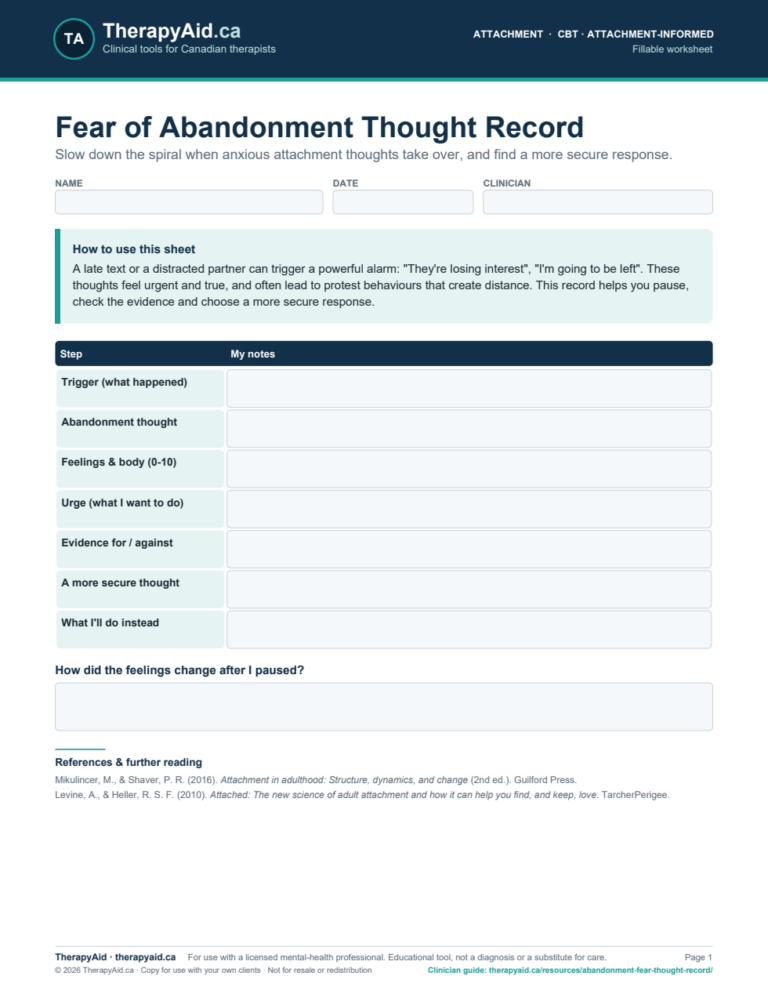
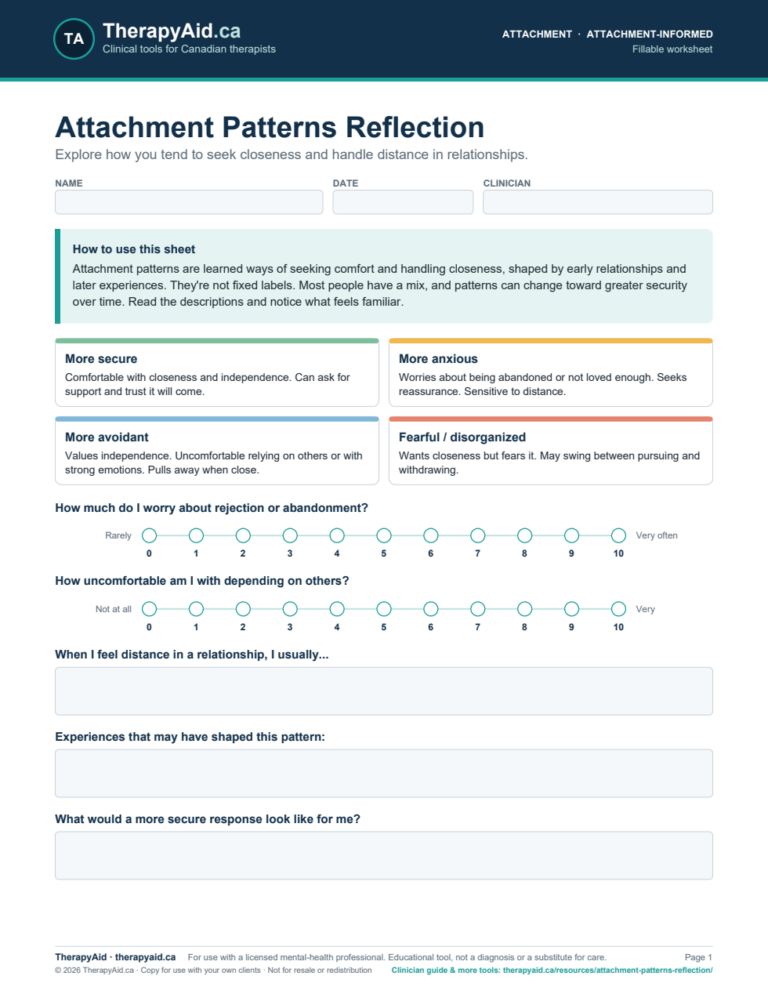
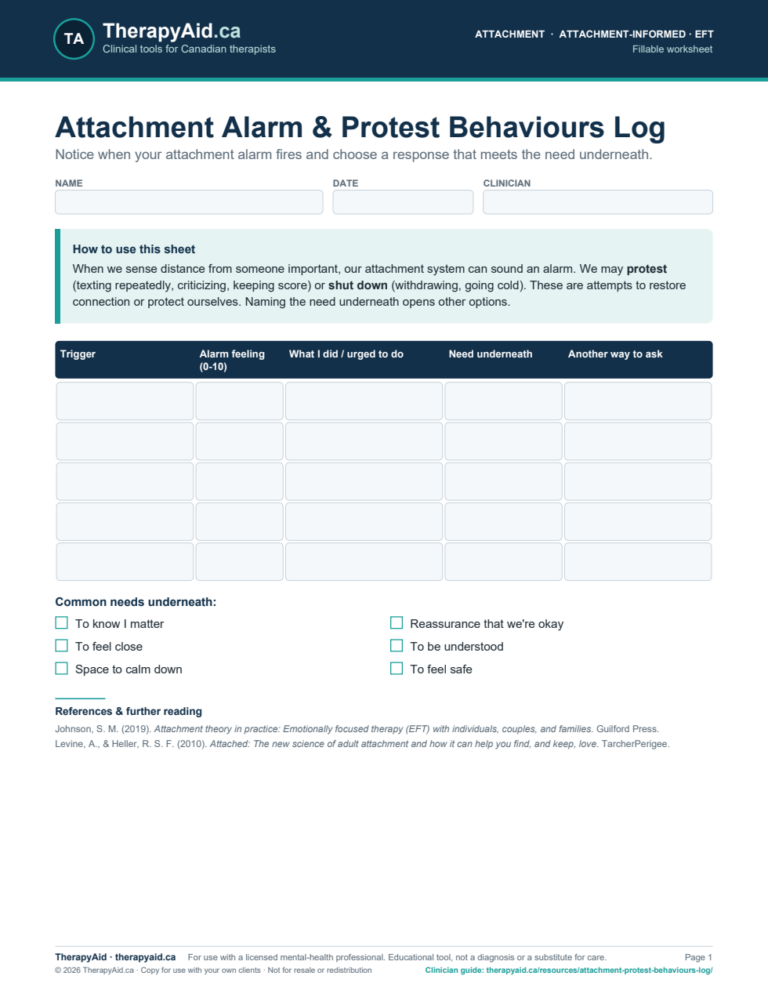
Safe haven and secure base are core functions of attachment relationships. A safe haven provides comfort in distress; a secure base supports confident exploration. Adults can draw on many attachment figures and develop an internal sense of security.
Why it works
Bowlby (1988) described the secure base as central to healthy development across the lifespan. Research shows that activating mental representations of security improves emotion regulation and prosocial behaviour in adults (Mikulincer & Shaver, 2016).
When to use it
- Insecure attachment patterns
- Loneliness and isolation
- Early therapy to identify resources
- Before trauma or grief work
How to use it in session
- Explain safe haven and secure base.
- Identify current figures and resources.
- Explore what makes them feel safe.
- Develop an inner secure base.
- Plan one connection step.
Clinician tips
- Include non-human and spiritual sources.
- The therapy relationship can serve as a secure base.
- Go gently if the client identifies few figures.
Worked example
Sharing with clients
Members can download the PDF to print or email, or copy a private client link from the download box. Your client opens the link and downloads the worksheet on any device. No client account is needed, and nothing your client writes is stored on TherapyAid.
Frequently asked questions
Can adults develop secure attachment?
Yes. Supportive relationships and therapy can help people develop ‘earned’ security.
What if I don’t have anyone?
Start with any source of comfort, including pets, nature or the therapy relationship, and build from there.
References
Bowlby, J. (1988). A secure base: Parent-child attachment and healthy human development. Basic Books.
Mikulincer, M., & Shaver, P. R. (2016). Attachment in adulthood: Structure, dynamics, and change (2nd ed.). Guilford Press.
This worksheet is an educational tool for use by, or under the guidance of, a licensed or registered mental-health professional. It is not a diagnostic instrument or a substitute for clinical judgement. If a client is in crisis in Canada, call or text 9-8-8 or call 9-1-1.