Adult Attachment Styles Explained
A psychoeducation handout describing secure, anxious, avoidant and fearful adult attachment patterns with reflection on personal patterns and goals.
1-page fillable PDF · US Letter (prints on A4) · Psychoeducation
- Approach / concern
- Attachment
- Technique
- Psychoeducation
- Format
- Fillable PDF, 1 page (US Letter / A4)
- Access
- Pro and Advanced plans (3-day free trial)
- For
- Licensed clinicians to use with clients
- Updated
- October 2026
Key facts
What is the Adult Attachment Styles Explained?
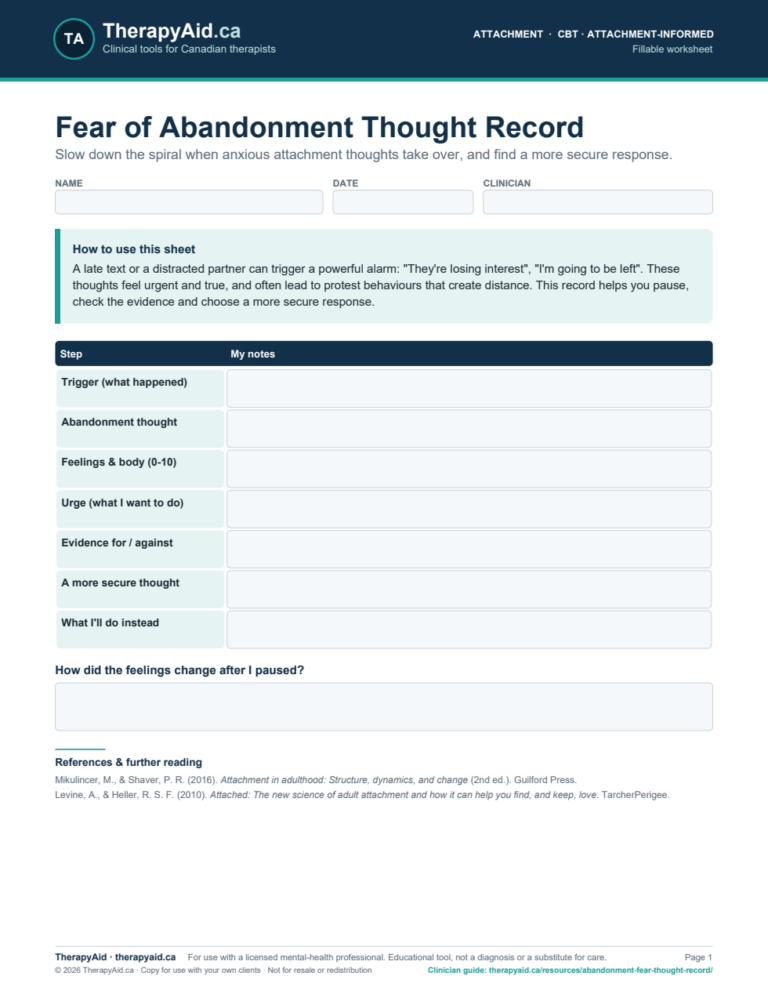
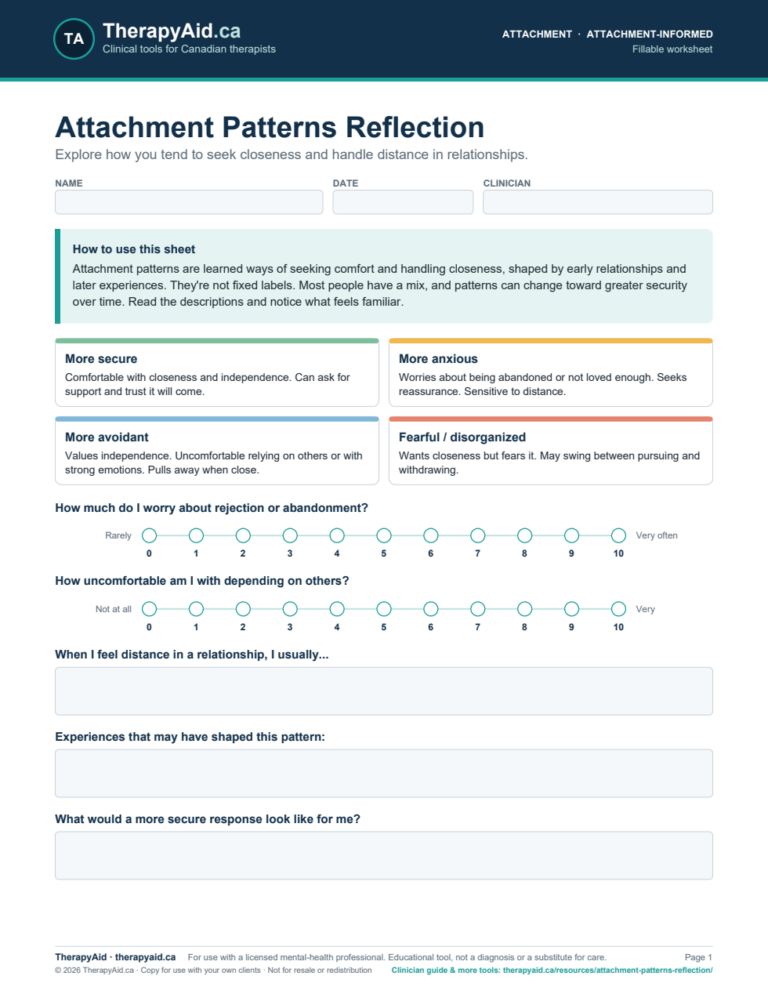
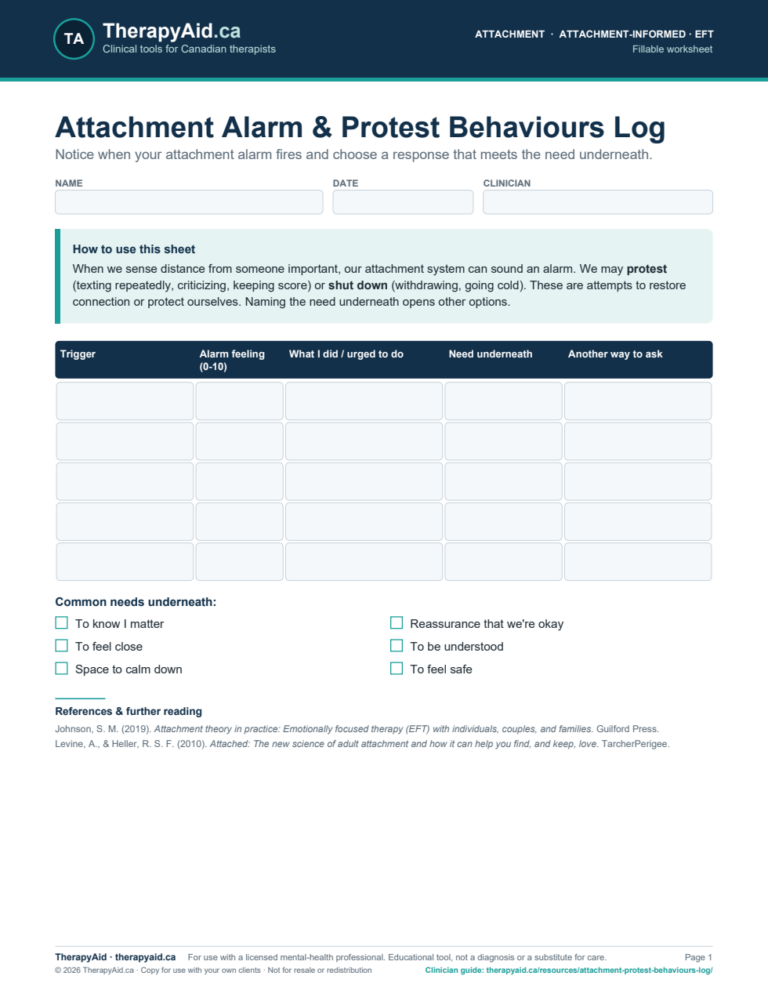
Adult attachment theory applies Bowlby’s work to adult relationships. Attachment can be described along two dimensions, anxiety and avoidance, producing secure, preoccupied (anxious), dismissing (avoidant) and fearful patterns.
Why it works
Hazan and Shaver (1987) first conceptualized romantic love as an attachment process. Bartholomew and Horowitz (1991) proposed a four-category model of adult attachment based on views of self and others.
When to use it
- Relationship difficulties
- Couples therapy
- Insecure attachment patterns
- Psychoeducation groups
How to use it in session
- Introduce attachment and its origins.
- Describe dimensions rather than labels.
- Reflect on personal patterns.
- Normalize change.
- Link to goals.
Clinician tips
- Avoid pathologizing or labelling partners.
- Patterns can differ by relationship.
- Online quizzes aren’t diagnostic.
Worked example
Sharing with clients
Members can download the PDF to print or email, or copy a private client link from the download box. Your client opens the link and downloads the worksheet on any device. No client account is needed, and nothing your client writes is stored on TherapyAid.
Frequently asked questions
Can my attachment style change?
Yes. Attachment patterns can shift through secure relationships and therapy.
Is one style better than another?
Secure attachment is linked with better relationship outcomes, but all patterns are understandable adaptations.
References
Hazan, C., & Shaver, P. (1987). Romantic love conceptualized as an attachment process. Journal of Personality and Social Psychology, 52(3), 511-524.
Bartholomew, K., & Horowitz, L. M. (1991). Attachment styles among young adults: A test of a four-category model. Journal of Personality and Social Psychology, 61(2), 226-244.
This worksheet is an educational tool for use by, or under the guidance of, a licensed or registered mental-health professional. It is not a diagnostic instrument or a substitute for clinical judgement. If a client is in crisis in Canada, call or text 9-8-8 or call 9-1-1.