Quieting the Racing Mind at Bedtime
A CBT-I worksheet offering four absorbing mental techniques (imagery journey, alphabet categories, random word imagery, body scan) for racing thoughts at bedtime, with a 7-night log.
1-page fillable PDF · US Letter (prints on A4) · Cognitive refocusing
- Approach / concern
- Sleep / CBT-I
- Technique
- Cognitive refocusing
- Format
- Fillable PDF, 1 page (US Letter / A4)
- Access
- Pro and Advanced plans (3-day free trial)
- For
- Licensed clinicians to use with clients
- Updated
- October 2026
Key facts
What is the Quieting the Racing Mind at Bedtime?
Cognitive refocusing techniques give the mind a neutral, absorbing focus at bedtime to reduce pre-sleep cognitive arousal. Imagery-based distraction has been studied as a way to manage unwanted pre-sleep thoughts.
Why it works
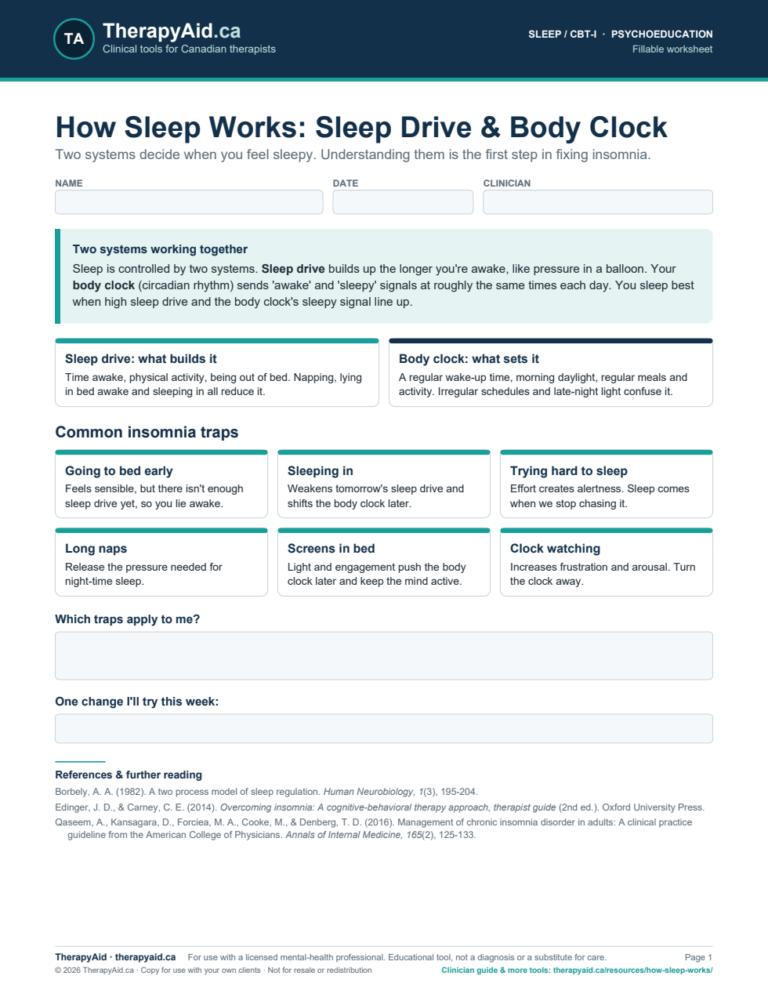
An experimental study found imagery distraction reduced pre-sleep cognitive activity and sleep onset latency compared with general distraction (Harvey & Payne, 2002). Cognitive arousal is a key maintaining factor in insomnia (Harvey, 2002).
When to use it
- Insomnia with racing thoughts
- Night-time worry and rumination
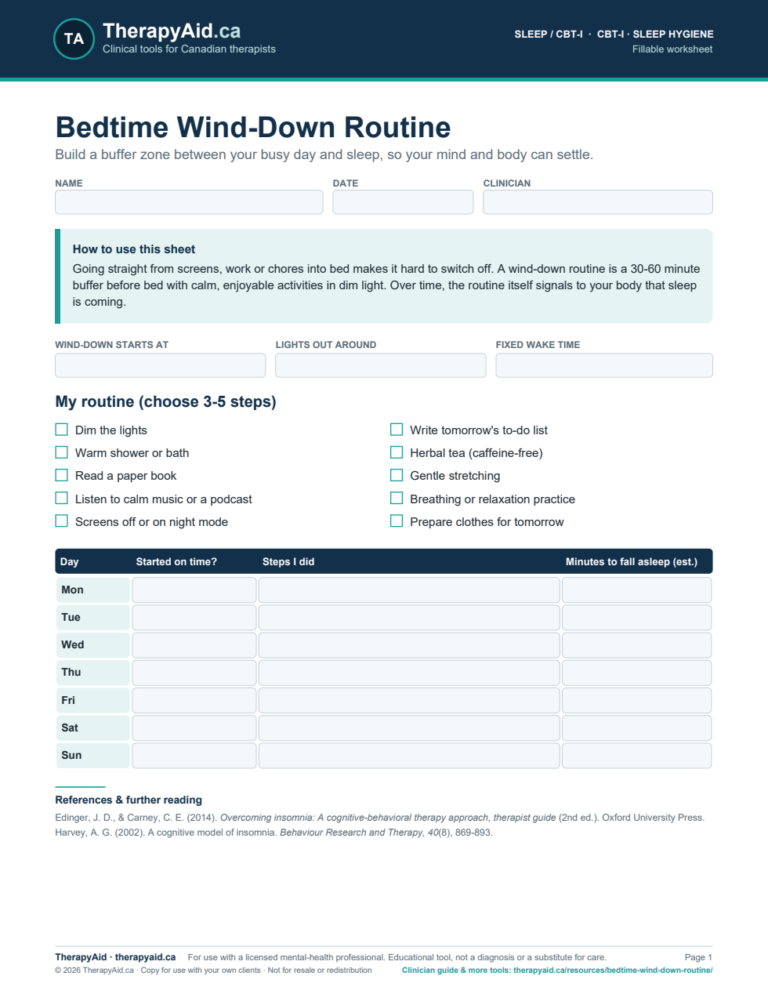
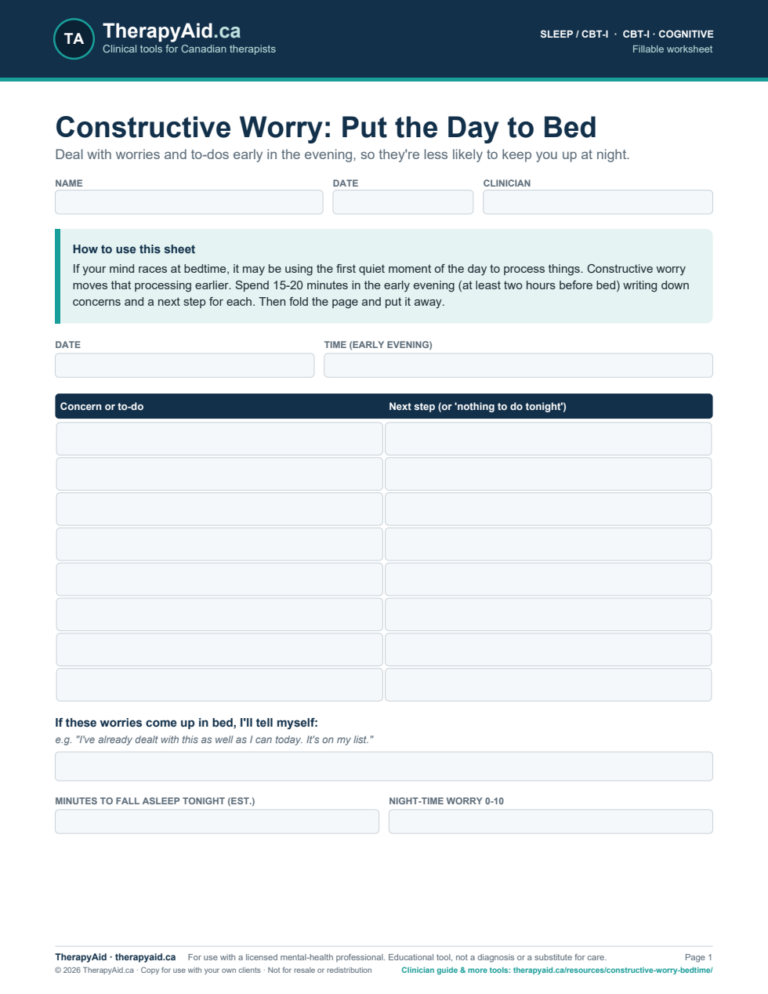
- Alongside constructive worry and CBT-I
- Teens and adults
How to use it in session
- Explain why trying to stop thoughts backfires.
- Choose one or two techniques.
- Practise in bed when the mind is busy.
- Log sleep onset estimates.
- Combine with stimulus control if awake a long time.
Clinician tips
- Pick moderately engaging, not exciting, tasks.
- Avoid checking the clock.
- If awake for what feels like 20 minutes, get up briefly.
Worked example
Sharing with clients
Members can download the PDF to print or email, or copy a private client link from the download box. Your client opens the link and downloads the worksheet on any device. No client account is needed, and nothing your client writes is stored on TherapyAid.
Frequently asked questions
Why not just try harder to clear my mind?
Trying not to think often increases thoughts. A gentle alternative focus works better.
What if these don’t work?
Combine with stimulus control and constructive worry, and consider full CBT-I with a clinician.
References
Harvey, A. G., & Payne, S. (2002). The management of unwanted pre-sleep thoughts in insomnia: Distraction with imagery versus general distraction. Behaviour Research and Therapy, 40(3), 267-277.
Harvey, A. G. (2002). A cognitive model of insomnia. Behaviour Research and Therapy, 40(8), 869-893.
This worksheet is an educational tool for use by, or under the guidance of, a licensed or registered mental-health professional. It is not a diagnostic instrument or a substitute for clinical judgement. If a client is in crisis in Canada, call or text 9-8-8 or call 9-1-1.