Telehealth Session Readiness Checklist
A client-facing checklist for online therapy covering privacy and space, technology and safety, plus a connection-drop plan and location and emergency contact fields.
1-page fillable PDF · US Letter (prints on A4) · Telehealth
- Approach / concern
- Clinician Tools
- Technique
- Telehealth
- Format
- Fillable PDF, 1 page (US Letter / A4)
- Access
- Advanced plan
- For
- Licensed clinicians to use with clients
- Updated
- October 2026
Key facts
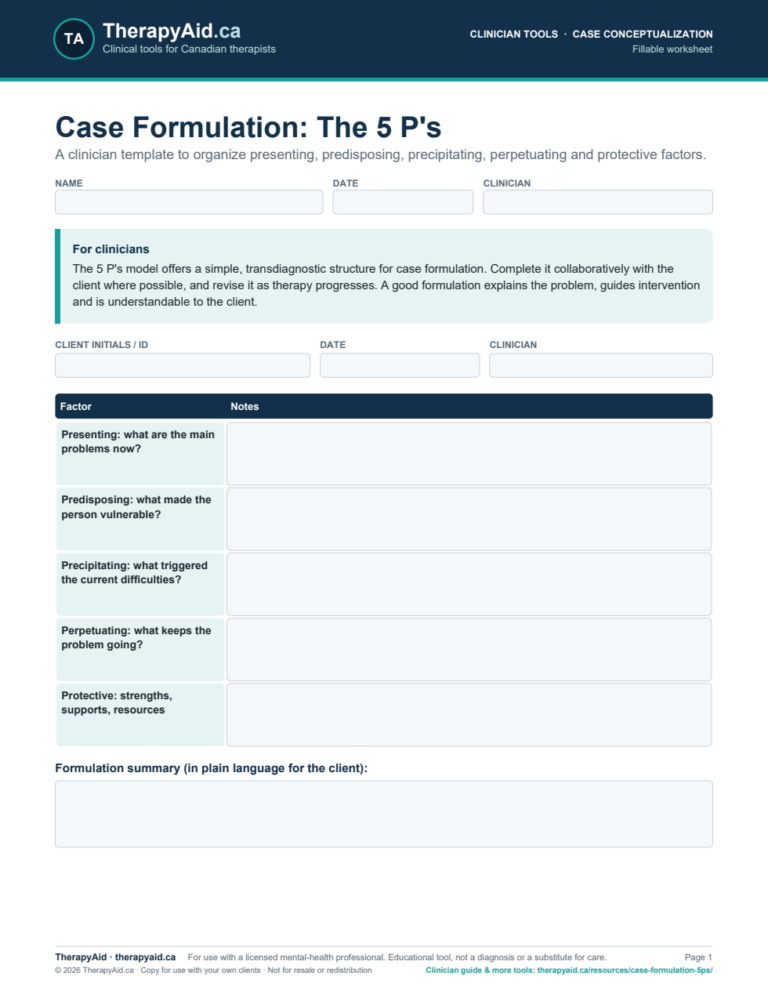
What is the Telehealth Session Readiness Checklist?
Telehealth (videoconferencing) therapy requires attention to privacy, technology and safety planning, including knowing the client’s location and having an emergency plan.
Why it works
Videoconferencing psychotherapy is feasible and associated with good satisfaction and outcomes comparable to in-person care in many studies (Backhaus et al., 2012). Professional guidelines emphasize privacy, security and emergency planning (Joint Task Force, 2013).
When to use it
- Starting online therapy
- Clients moving between locations
- Group telehealth sessions
- Updating safety plans for remote care
How to use it in session
- Share the checklist before the first session.
- Review it together at the start.
- Confirm location and emergency contact each session.
- Agree on a connection-drop plan.
- Revisit if circumstances change.
Clinician tips
- Check your jurisdiction’s licensing rules for clients in other provinces.
- Use secure, privacy-compliant platforms.
- Have a backup phone number.
Worked example
Sharing with clients
Members can download the PDF to print or email, or copy a private client link from the download box. Your client opens the link and downloads the worksheet on any device. No client account is needed, and nothing your client writes is stored on TherapyAid.
Frequently asked questions
Is online therapy as effective as in-person therapy?
For many concerns, research suggests similar outcomes, though some clients prefer in-person sessions.
Why does my clinician need my location?
To arrange emergency help if needed and to comply with licensing rules.
References
Backhaus, A., Agha, Z., Maglione, M. L., Repp, A., Ross, B., Zuest, D., Rice-Thorp, N. M., Lohr, J., & Thorp, S. R. (2012). Videoconferencing psychotherapy: A systematic review. Psychological Services, 9(2), 111-131.
Joint Task Force for the Development of Telepsychology Guidelines for Psychologists. (2013). Guidelines for the practice of telepsychology. American Psychologist, 68(9), 791-800.
This worksheet is an educational tool for use by, or under the guidance of, a licensed or registered mental-health professional. It is not a diagnostic instrument or a substitute for clinical judgement. If a client is in crisis in Canada, call or text 9-8-8 or call 9-1-1.