Perfectionism: Costs & Healthier Standards
A CBT worksheet for clinical perfectionism mapping standards and costs across life areas, common perfectionist habits and a 'good enough' behavioural experiment.
1-page fillable PDF · US Letter (prints on A4) · CBT for perfectionism
- Approach / concern
- CBT
- Technique
- CBT for perfectionism
- Format
- Fillable PDF, 1 page (US Letter / A4)
- Access
- Pro and Advanced plans (3-day free trial)
- For
- Licensed clinicians to use with clients
- Updated
- October 2026
Key facts
What is the Perfectionism: Costs & Healthier Standards?
Clinical perfectionism is the over-dependence of self-evaluation on the determined pursuit of demanding standards despite adverse consequences. CBT for perfectionism examines costs, loosens rigid standards and tests predictions through experiments.
Why it works
Perfectionism is a transdiagnostic process linked to anxiety, depression and eating disorders (Egan et al., 2011). The cognitive-behavioural model of clinical perfectionism guides treatment targets (Shafran et al., 2002).
When to use it
- Perfectionism and procrastination
- Anxiety, depression and burnout
- Eating disorders
- High-achieving students and professionals
How to use it in session
- Distinguish healthy striving from perfectionism.
- Map standards and costs.
- Identify perfectionist habits.
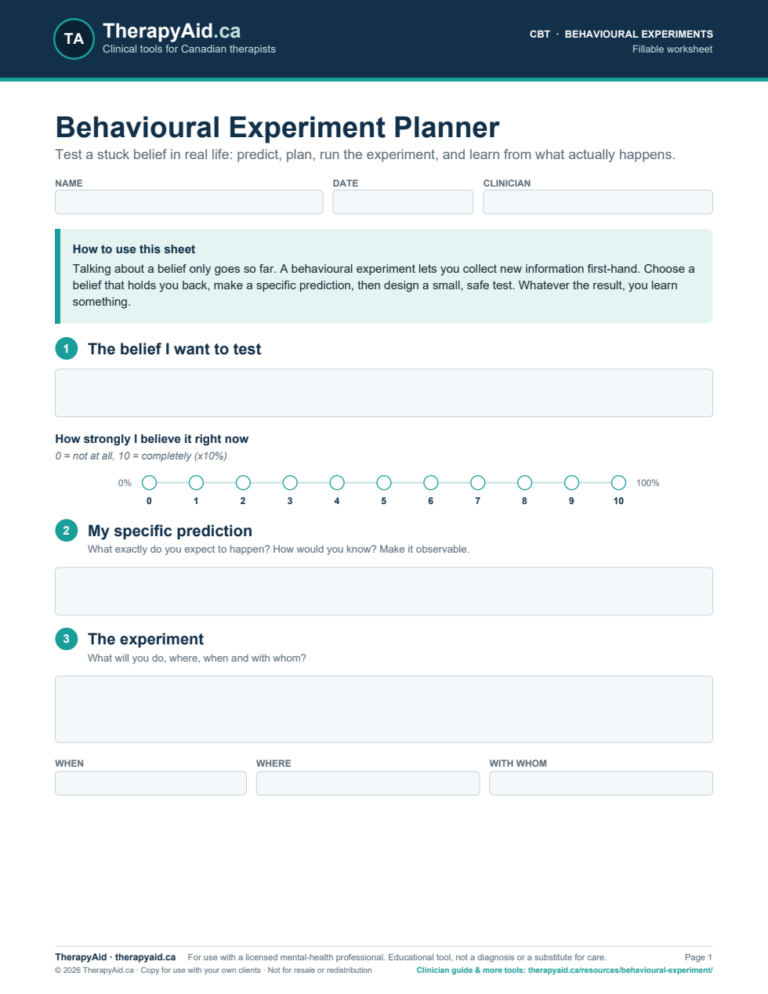
- Design a good-enough experiment.
- Review outcomes and build flexibility.
Clinician tips
- Clients often fear lowering standards means failure; test it.
- Address self-criticism alongside standards.
- Celebrate ‘good enough’ outcomes.
Worked example
Sharing with clients
Members can download the PDF to print or email, or copy a private client link from the download box. Your client opens the link and downloads the worksheet on any device. No client account is needed, and nothing your client writes is stored on TherapyAid.
Frequently asked questions
Isn’t perfectionism a good thing?
Striving for excellence can be healthy. Perfectionism becomes a problem when self-worth depends on flawless performance and it causes distress.
What does ‘good enough’ mean?
A standard that meets the actual purpose of the task, without the extra time and anxiety perfectionism adds.
References
Shafran, R., Cooper, Z., & Fairburn, C. G. (2002). Clinical perfectionism: A cognitive-behavioural analysis. Behaviour Research and Therapy, 40(7), 773-791.
Egan, S. J., Wade, T. D., & Shafran, R. (2011). Perfectionism as a transdiagnostic process: A clinical review. Clinical Psychology Review, 31(2), 203-212.
This worksheet is an educational tool for use by, or under the guidance of, a licensed or registered mental-health professional. It is not a diagnostic instrument or a substitute for clinical judgement. If a client is in crisis in Canada, call or text 9-8-8 or call 9-1-1.