The Depression Cycle Explained
An illustrated depression psychoeducation handout showing the cycle of low mood, withdrawal, fewer rewards and negative thinking, with space to map a personal cycle and a change point.
1-page fillable PDF · US Letter (prints on A4) · Psychoeducation
- Approach / concern
- Depression
- Technique
- Psychoeducation
- Format
- Fillable PDF, 1 page (US Letter / A4)
- Access
- Pro and Advanced plans (3-day free trial)
- For
- Licensed clinicians to use with clients
- Updated
- October 2026
Key facts
What is the The Depression Cycle Explained?
Behavioural and cognitive models describe depression as maintained by interacting cycles: low mood leads to withdrawal and inactivity, which reduce rewarding experiences, while negative thinking deepens hopelessness. Mapping this cycle helps clients see where change can start.
Why it works
Lewinsohn’s behavioural model links reduced positive reinforcement with depression (Lewinsohn, 1974), forming the basis of behavioural activation (Martell et al., 2010). Cognitive models add the role of negative thinking (Beck, 2021).
When to use it
- Early sessions of depression treatment
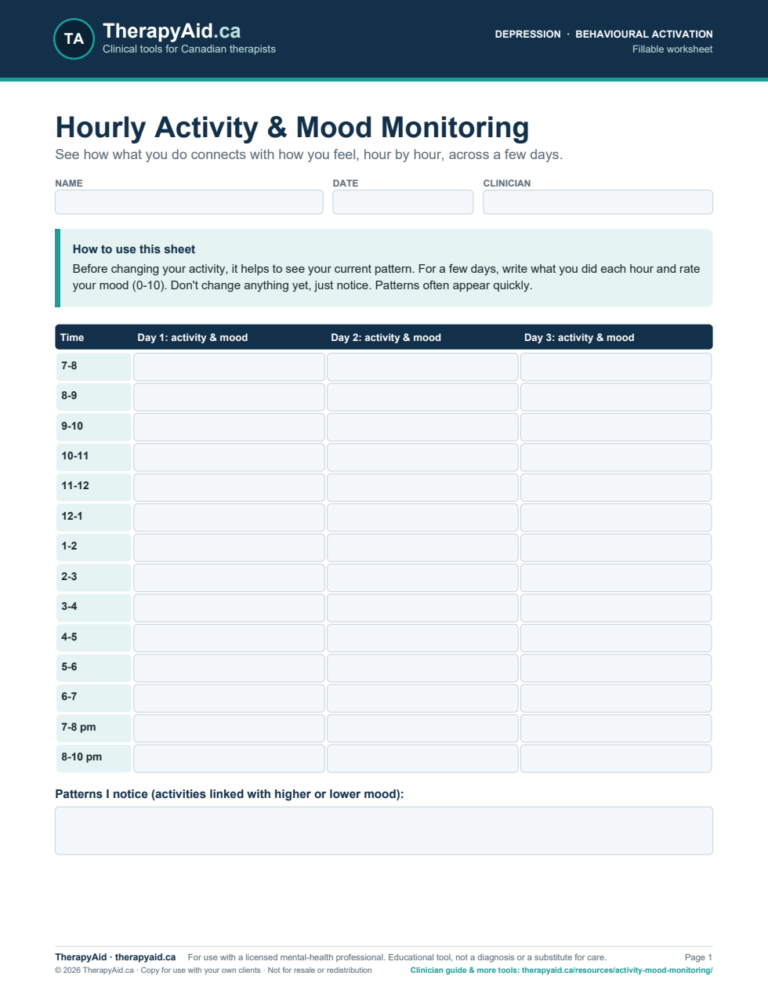
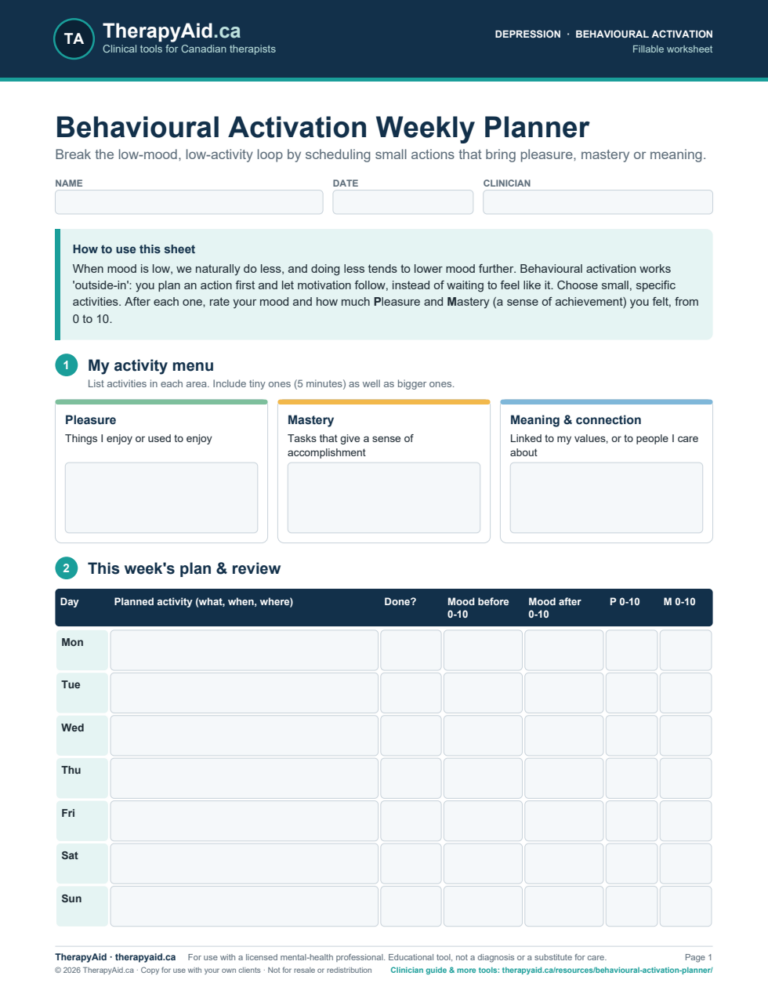
- Before behavioural activation
- Psychoeducation for families
- Groups and primary care
How to use it in session
- Walk through the cycle with the client.
- Map their personal version.
- Identify the easiest point to intervene.
- Plan one small change.
- Link to behavioural activation or thought records.
Clinician tips
- Emphasize that depression isn’t a personal failing.
- Behaviour change is often the easiest entry point.
- Screen for suicide risk.
Worked example
Sharing with clients
Members can download the PDF to print or email, or copy a private client link from the download box. Your client opens the link and downloads the worksheet on any device. No client account is needed, and nothing your client writes is stored on TherapyAid.
Frequently asked questions
Why do I feel worse when I rest more?
In depression, resting and withdrawing can reduce rewarding experiences and leave more time for rumination, which can deepen low mood.
What’s the first step to breaking the cycle?
Often a small, planned activity, even when motivation is low. Motivation tends to follow action.
References
Lewinsohn, P. M. (1974). A behavioral approach to depression. In R. J. Friedman & M. M. Katz (Eds.), The psychology of depression: Contemporary theory and research (pp. 157-178). Wiley.
Martell, C. R., Dimidjian, S., & Herman-Dunn, R. (2010). Behavioral activation for depression: A clinician’s guide. Guilford Press.
Beck, J. S. (2021). Cognitive behavior therapy: Basics and beyond (3rd ed.). Guilford Press.
This worksheet is an educational tool for use by, or under the guidance of, a licensed or registered mental-health professional. It is not a diagnostic instrument or a substitute for clinical judgement. If a client is in crisis in Canada, call or text 9-8-8 or call 9-1-1.