Fear of Abandonment Thought Record
A CBT and attachment-informed thought record for relationship anxiety that tracks trigger, abandonment thought, feelings, urge, evidence, a more secure thought and alternative action.
1-page fillable PDF · US Letter (prints on A4) · CBT · Attachment-informed
- Approach / concern
- Attachment
- Technique
- CBT · Attachment-informed
- Format
- Fillable PDF, 1 page (US Letter / A4)
- Access
- Pro and Advanced plans (3-day free trial)
- For
- Licensed clinicians to use with clients
- Updated
- October 2026
Key facts
What is the Fear of Abandonment Thought Record?
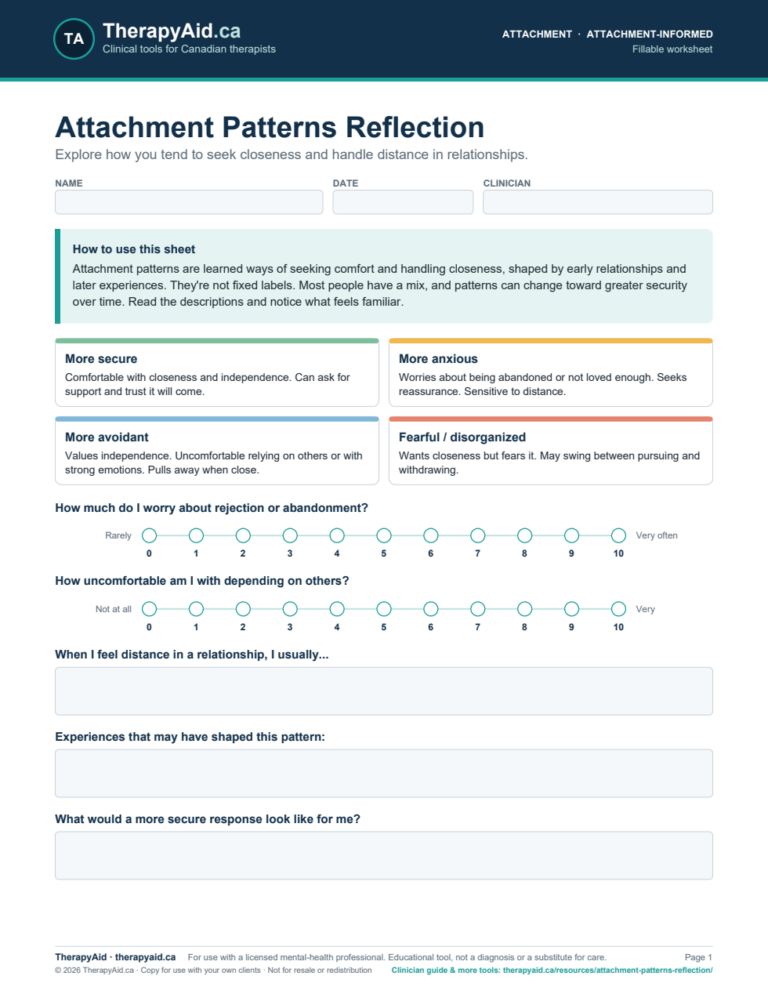
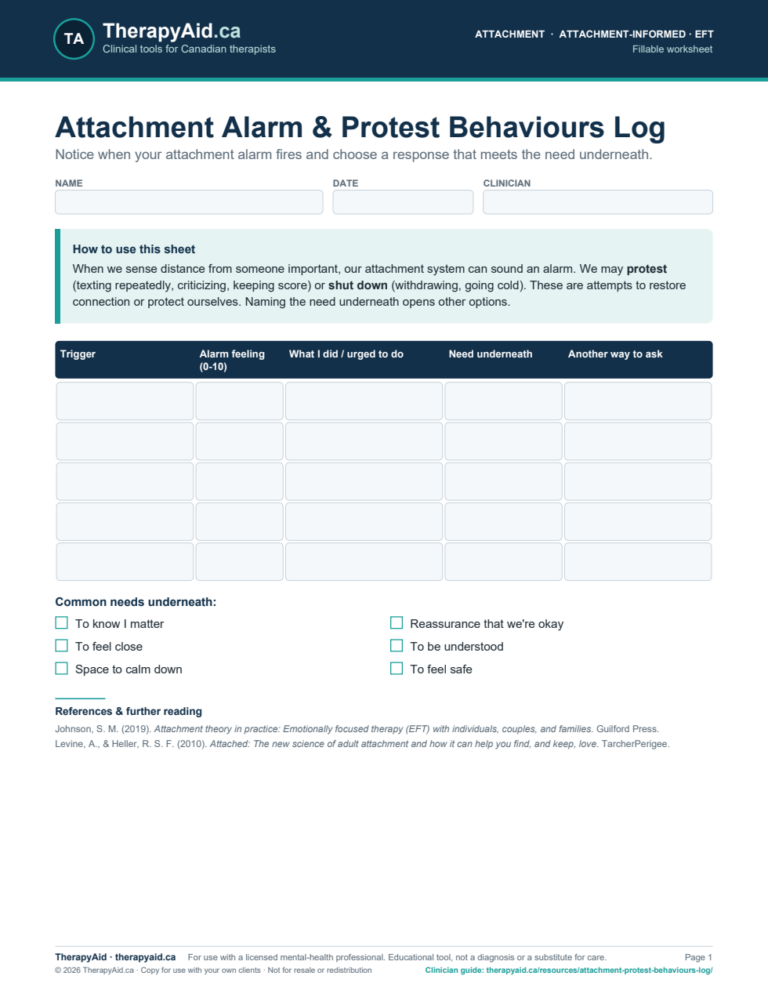
People with anxious attachment tendencies are often highly sensitive to cues of distance or rejection and may respond with ‘protest behaviours’ such as repeated texting or accusing. This worksheet combines a CBT thought record with attachment language to interrupt the spiral.
Why it works
Attachment anxiety is associated with hypervigilance to relationship threat and hyperactivating strategies (Mikulincer & Shaver, 2016). Slowing down and examining evidence supports more secure, effective responses (Levine & Heller, 2010).
When to use it
- Anxious attachment and relationship anxiety
- Jealousy and reassurance-seeking in relationships
- Early dating anxiety
- After betrayal, once safety is re-established
How to use it in session
- Use a recent episode of relationship anxiety.
- Separate trigger, thought, feelings and urge.
- Weigh the evidence gently.
- Develop a more secure thought.
- Plan an alternative to protest behaviour.
Clinician tips
- Validate that the fear is real and often rooted in past experiences.
- Self-soothing skills help before reasoning.
- Distinguish anxiety from genuine red flags in a relationship.
Worked example
Sharing with clients
Members can download the PDF to print or email, or copy a private client link from the download box. Your client opens the link and downloads the worksheet on any device. No client account is needed, and nothing your client writes is stored on TherapyAid.
Frequently asked questions
Is fear of abandonment the same as anxious attachment?
They overlap. Fear of abandonment is a central feature of attachment anxiety, but anyone can experience it at times.
What if my fears are based on real problems?
Then the worksheet can help you notice genuine concerns and raise them calmly rather than through protest behaviour.
References
Mikulincer, M., & Shaver, P. R. (2016). Attachment in adulthood: Structure, dynamics, and change (2nd ed.). Guilford Press.
Levine, A., & Heller, R. S. F. (2010). Attached: The new science of adult attachment and how it can help you find, and keep, love. TarcherPerigee.
This worksheet is an educational tool for use by, or under the guidance of, a licensed or registered mental-health professional. It is not a diagnostic instrument or a substitute for clinical judgement. If a client is in crisis in Canada, call or text 9-8-8 or call 9-1-1.