PLEASE Skills: Body Care Tracker
A DBT emotion regulation tracker for the PLEASE skills, logging physical illness care, eating, substance use, sleep, exercise and mood across a week.
1-page fillable PDF · US Letter (prints on A4) · Emotion regulation
- Approach / concern
- DBT
- Technique
- Emotion regulation
- Format
- Fillable PDF, 1 page (US Letter / A4)
- Access
- Pro and Advanced plans (3-day free trial)
- For
- Licensed clinicians to use with clients
- Updated
- October 2026
Key facts
What is the PLEASE Skills: Body Care Tracker?
PLEASE is a DBT emotion regulation skill that reduces vulnerability to negative emotions by attending to physical health: treating Physical iLlness, balanced Eating, Avoiding mood-altering substances, balanced Sleep and Exercise.
Why it works
Physical states strongly influence emotional reactivity. The PLEASE skills are part of the DBT emotion regulation module (Linehan, 2015), helping clients see how body care reduces the frequency and intensity of emotional storms.
When to use it
- Emotion dysregulation
- Clients with chaotic routines
- Depression and anxiety with poor self-care
- DBT skills groups
How to use it in session
- Explain how body states affect emotions.
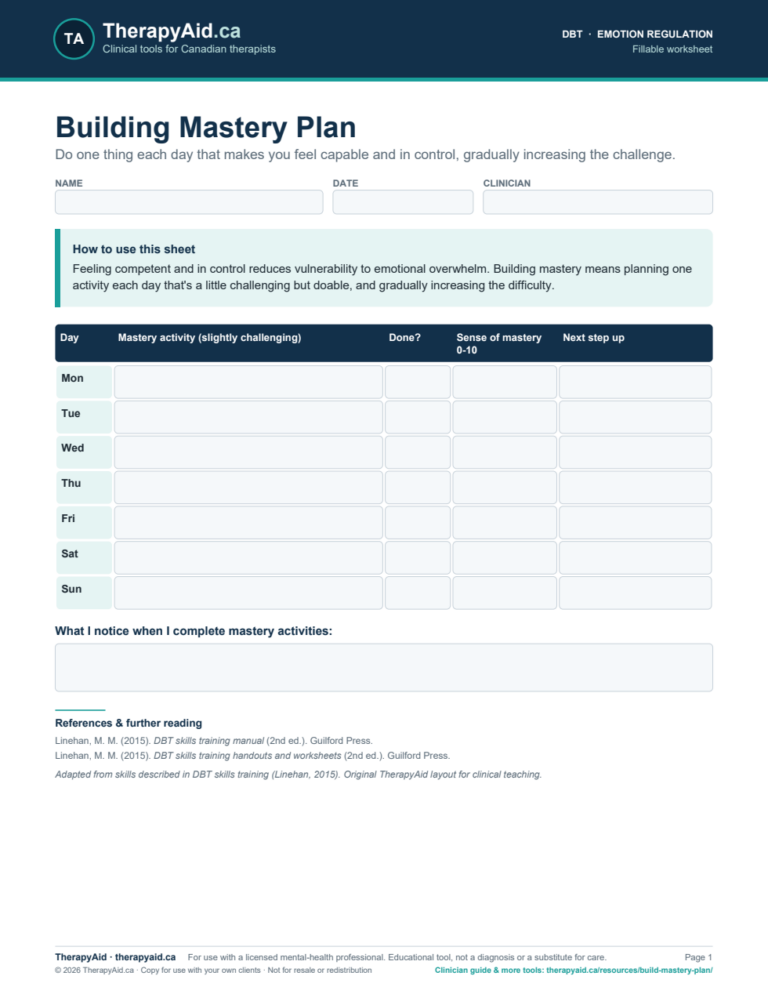
- Track all five areas for a week.
- Look for links between gaps and mood dips.
- Choose one area to improve.
- Review progress and add another area.
Clinician tips
- Keep tracking simple: ticks are fine.
- Address barriers like shift work or finances practically.
- Link to sleep and activity worksheets for more depth.
Worked example
Sharing with clients
Members can download the PDF to print or email, or copy a private client link from the download box. Your client opens the link and downloads the worksheet on any device. No client account is needed, and nothing your client writes is stored on TherapyAid.
Frequently asked questions
Why is it called PLEASE?
It’s an acronym: PhysicaL illness, Eating, Avoid mood-altering substances, Sleep, Exercise.
Is this just self-care?
It’s a specific, structured form of self-care aimed at reducing emotional vulnerability.
References
Linehan, M. M. (2015). DBT skills training manual (2nd ed.). Guilford Press.
Linehan, M. M. (2015). DBT skills training handouts and worksheets (2nd ed.). Guilford Press.
This worksheet is an educational tool for use by, or under the guidance of, a licensed or registered mental-health professional. It is not a diagnostic instrument or a substitute for clinical judgement. If a client is in crisis in Canada, call or text 9-8-8 or call 9-1-1.