Decatastrophizing: Worst, Best & Most Likely
A CBT worksheet for catastrophic thinking that compares worst, best and most likely outcomes with likelihood ratings, plans coping for the worst case and builds a balanced view.
1-page fillable PDF · US Letter (prints on A4) · Cognitive restructuring
- Approach / concern
- CBT
- Technique
- Cognitive restructuring
- Format
- Fillable PDF, 1 page (US Letter / A4)
- Access
- Pro and Advanced plans (3-day free trial)
- For
- Licensed clinicians to use with clients
- Updated
- October 2026
Key facts
What is the Decatastrophizing: Worst, Best & Most Likely?
Decatastrophizing is a cognitive restructuring technique for catastrophic predictions. It involves estimating the realistic likelihood of feared outcomes, considering the full range of possibilities and reviewing one’s capacity to cope.
Why it works
Catastrophizing is a common cognitive distortion in anxiety, depression and chronic pain. Decatastrophizing is a standard CBT intervention that reduces overestimation of threat and underestimation of coping (Beck, 2021; Leahy, 2017).
When to use it
- Generalized anxiety and worry
- Health anxiety
- Performance and social anxiety
- Catastrophic pain-related thinking
How to use it in session
- Identify the feared situation and rate anxiety.
- Describe worst, best and most likely outcomes.
- Estimate likelihood honestly.
- Plan coping for the worst case.
- Write a balanced view and re-rate anxiety.
Clinician tips
- Coping planning is often more powerful than probability estimates.
- Use the time-perspective question to build distance.
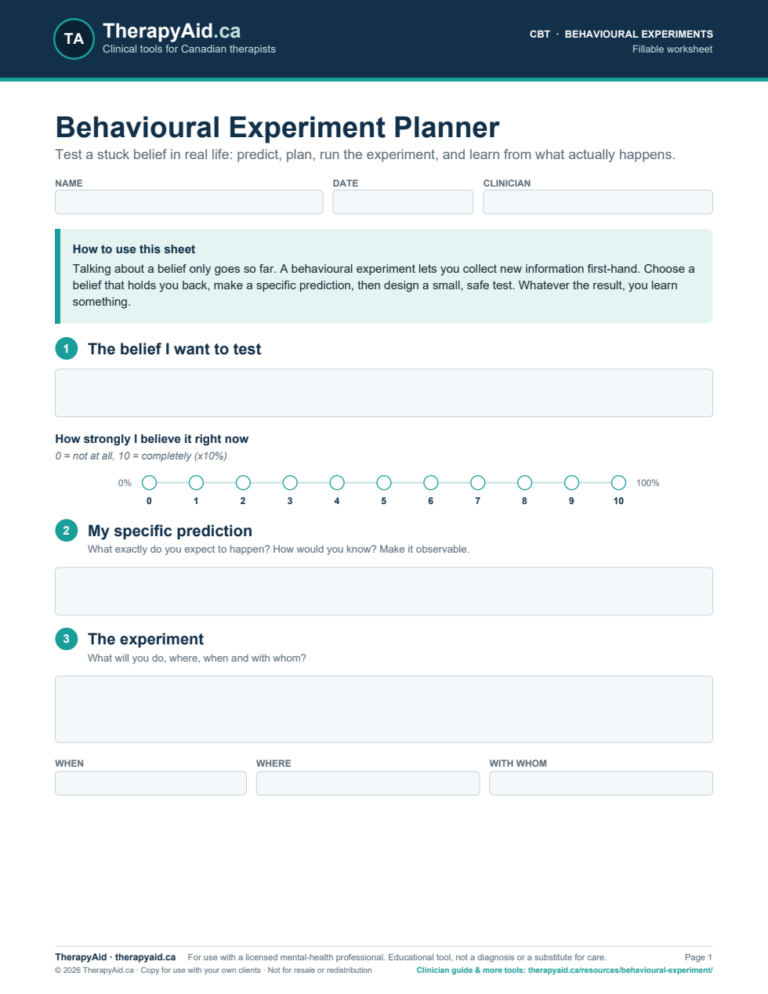
- Pair with behavioural experiments to test predictions.
Worked example
Sharing with clients
Members can download the PDF to print or email, or copy a private client link from the download box. Your client opens the link and downloads the worksheet on any device. No client account is needed, and nothing your client writes is stored on TherapyAid.
Frequently asked questions
Isn’t thinking about the worst case going to make me more anxious?
Briefly, perhaps. But examining it calmly, with a coping plan, usually reduces its power.
What if the worst case is really likely?
Then shift to problem-solving and support. The exercise still helps clarify what you can do.
References
Beck, J. S. (2021). Cognitive behavior therapy: Basics and beyond (3rd ed.). Guilford Press.
Leahy, R. L. (2017). Cognitive therapy techniques: A practitioner’s guide (2nd ed.). Guilford Press.
Greenberger, D., & Padesky, C. A. (2015). Mind over mood (2nd ed.). Guilford Press.
This worksheet is an educational tool for use by, or under the guidance of, a licensed or registered mental-health professional. It is not a diagnostic instrument or a substitute for clinical judgement. If a client is in crisis in Canada, call or text 9-8-8 or call 9-1-1.