Stuck Points Log
A CPT-informed worksheet for identifying trauma-related stuck points, sorting them into five themes and rating belief strength, to guide cognitive work on PTSD.
2-page fillable PDF · US Letter (prints on A4) · CPT-informed
- Approach / concern
- Trauma & PTSD
- Technique
- CPT-informed
- Format
- Fillable PDF, 2 pages (US Letter / A4)
- Access
- Pro and Advanced plans (3-day free trial)
- For
- Licensed clinicians to use with clients
- Updated
- October 2026
Key facts
What is the Stuck Points Log?
In Cognitive Processing Therapy, stuck points are rigid, often extreme beliefs that develop in an attempt to make sense of trauma and that keep PTSD symptoms going. They commonly involve self-blame (assimilation) or overgeneralized beliefs about safety, trust, power and control, esteem and intimacy (overaccommodation).
Why it works
CPT is a first-line, evidence-based treatment for PTSD that centres on identifying and examining stuck points (Resick et al., 2017). Cognitive models also highlight how negative appraisals of trauma maintain a sense of current threat (Ehlers & Clark, 2000).
When to use it
- PTSD treatment using cognitive approaches
- Self-blame and guilt after trauma
- Generalized mistrust or feeling unsafe
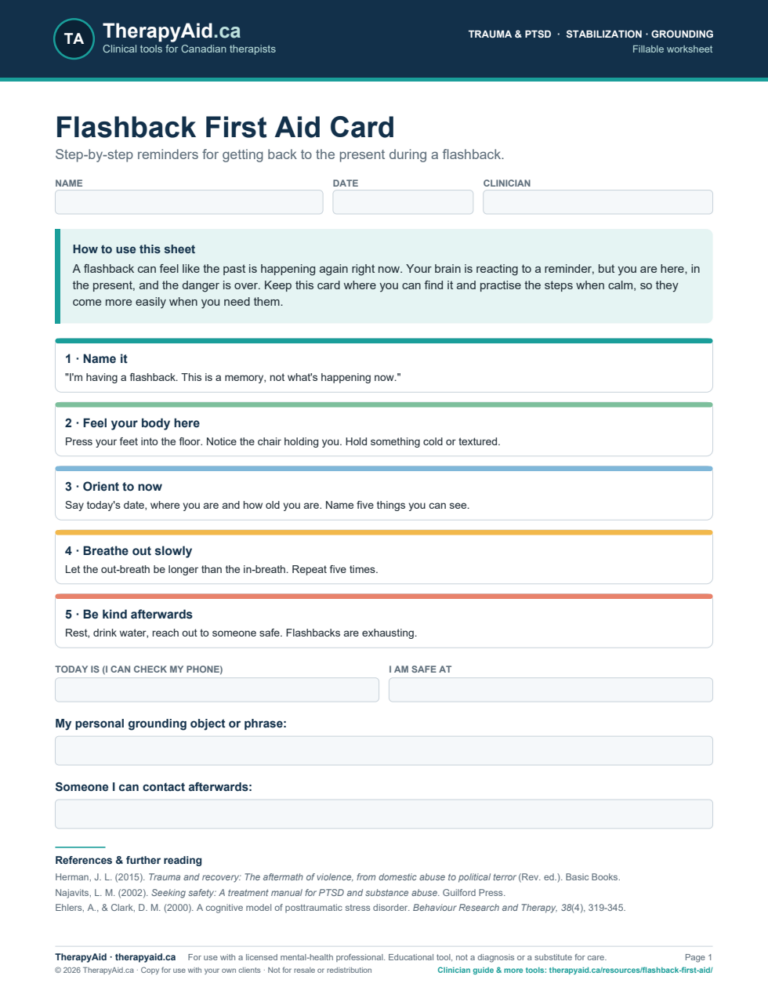
- Preparation for cognitive restructuring
How to use it in session
- Explain stuck points and the five themes.
- Help the client phrase beliefs as short statements.
- Rate how strongly each is believed.
- Choose the most impactful stuck point to examine first.
- Use challenging-questions worksheets in later sessions.
Clinician tips
- Distinguish beliefs from facts and feelings.
- Self-blame stuck points are often addressed first.
- Clinicians using CPT should follow the full manual and training.
Worked example
Sharing with clients
Members can download the PDF to print or email, or copy a private client link from the download box. Your client opens the link and downloads the worksheet on any device. No client account is needed, and nothing your client writes is stored on TherapyAid.
Frequently asked questions
What makes a good stuck point statement?
A short, clear belief, not a question or a feeling. For example, “I can’t trust my judgement” rather than “Why did I trust him?”
Is this the official CPT worksheet?
No. It’s an original TherapyAid resource informed by CPT concepts. Clinicians delivering CPT should use the official manual.
References
Resick, P. A., Monson, C. M., & Chard, K. M. (2017). Cognitive processing therapy for PTSD: A comprehensive manual. Guilford Press.
Ehlers, A., & Clark, D. M. (2000). A cognitive model of posttraumatic stress disorder. Behaviour Research and Therapy, 38(4), 319-345.
This worksheet is an educational tool for use by, or under the guidance of, a licensed or registered mental-health professional. It is not a diagnostic instrument or a substitute for clinical judgement. If a client is in crisis in Canada, call or text 9-8-8 or call 9-1-1.