PHQ-9 & Mood Tracking Sheet
The Patient Health Questionnaire-9 (PHQ-9) in a fillable, clinic-ready format, with a severity guide, item 9 safety prompt and a progress tracker for repeated administration.
2-page fillable PDF · US Letter (prints on A4) · Measurement-based care
- Approach / concern
- Depression
- Technique
- Measurement-based care
- Format
- Fillable PDF, 2 pages (US Letter / A4)
- Access
- Pro and Advanced plans (3-day free trial)
- For
- Licensed clinicians to use with clients
- Updated
- October 2026
Key facts
What is the PHQ-9 & Mood Tracking Sheet?
The PHQ-9 is a nine-item self-report questionnaire based on the DSM criteria for major depression. Each item is rated from 0 (not at all) to 3 (nearly every day) over the past two weeks, for a total of 0-27. It was developed by Kroenke, Spitzer and Williams (2001), is free to use, and is one of the most widely used depression measures in primary care and mental-health settings.
Why it works
The PHQ-9 is reliable, valid and sensitive to change. A cut-off of 10 or above gives a good balance of sensitivity and specificity for major depression (Levis et al., 2019). Repeating it regularly supports measurement-based care and makes it easier to spot clients who are not improving.
When to use it
- Intake screening for depression
- Every 2-4 weeks during treatment
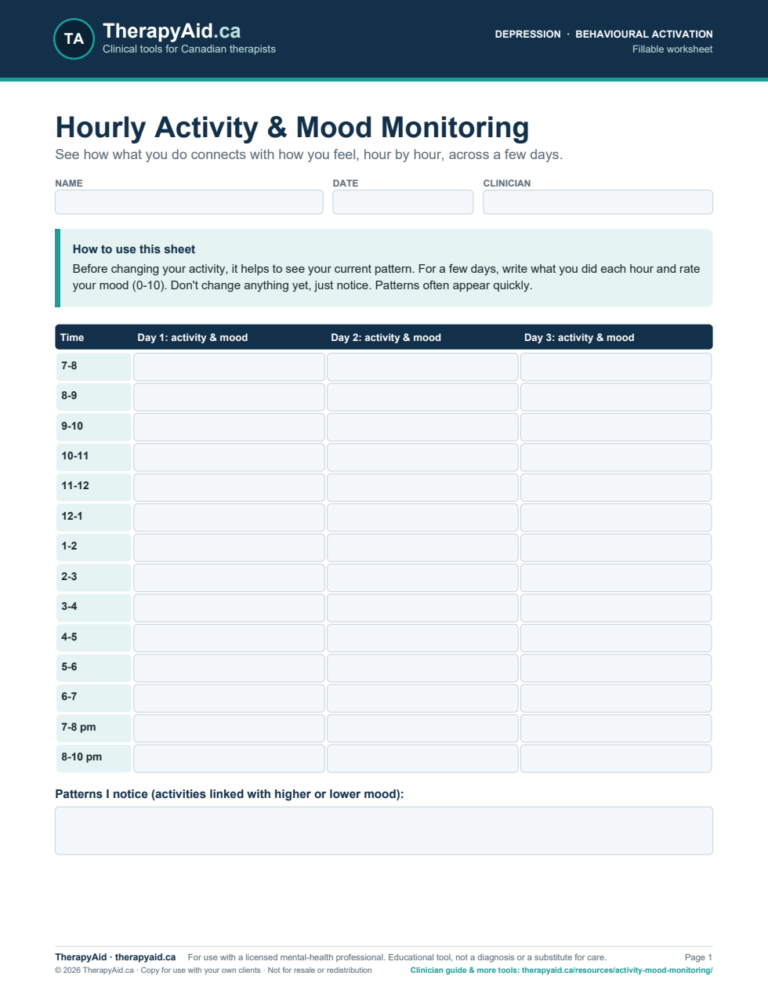
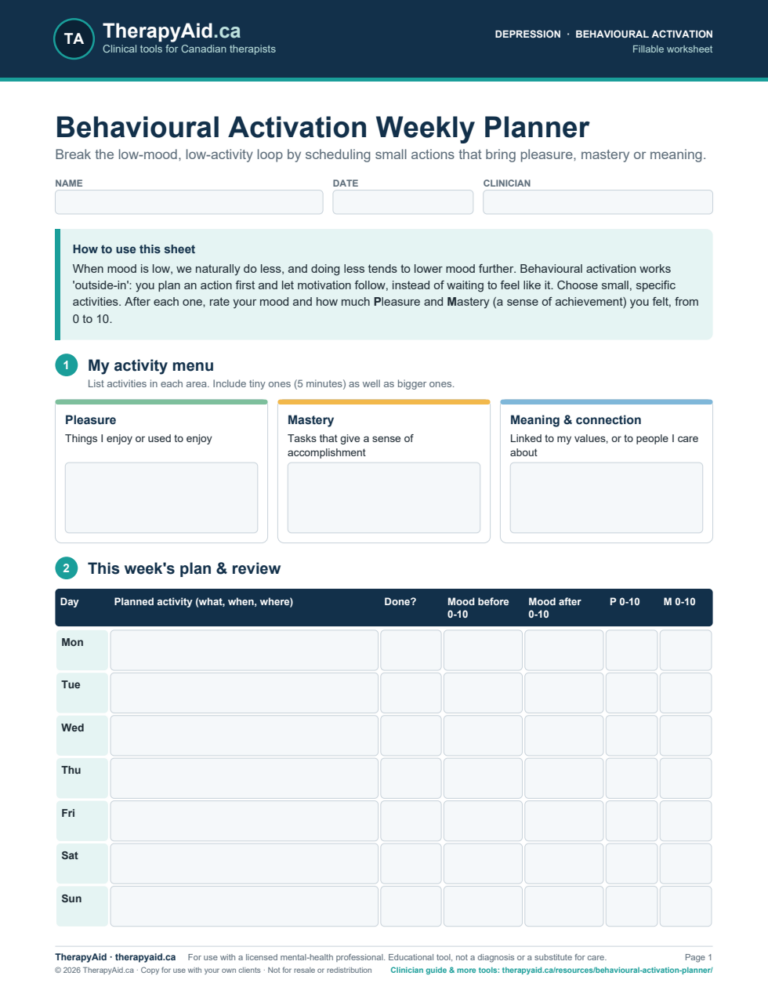
- Before and after structured programs such as behavioural activation
- Collaborative care with family physicians
How to use it in session
- Ask the client to complete page 1 before or at the start of the session.
- Add item scores for a total of 0-27 and use the severity guide.
- Always review item 9 and follow up on any positive response.
- Record totals on the tracker to show change over time.
- Discuss results collaboratively with the client.
Clinician tips
- Look at individual items, such as sleep or concentration, to guide treatment targets.
- A 5-point drop is generally considered clinically meaningful.
- Pair with the GAD-7 because anxiety and depression often co-occur.
Worked example
Sharing with clients
Members can download the PDF to print or email, or copy a private client link from the download box. Your client opens the link and downloads the worksheet on any device. No client account is needed, and nothing your client writes is stored on TherapyAid.
Frequently asked questions
Is the PHQ-9 free to use?
Yes. The developers state that no permission is required to reproduce, translate, display or distribute it.
Can the PHQ-9 diagnose depression?
No. It is a screening and monitoring tool. Diagnosis requires a clinical assessment.
References
Kroenke, K., Spitzer, R. L., & Williams, J. B. W. (2001). The PHQ-9: Validity of a brief depression severity measure. Journal of General Internal Medicine, 16(9), 606-613.
Levis, B., Benedetti, A., & Thombs, B. D. (2019). Accuracy of Patient Health Questionnaire-9 (PHQ-9) for screening to detect major depression: Individual participant data meta-analysis. BMJ, 365, l1476.
This worksheet is an educational tool for use by, or under the guidance of, a licensed or registered mental-health professional. It is not a diagnostic instrument or a substitute for clinical judgement. If a client is in crisis in Canada, call or text 9-8-8 or call 9-1-1.