Attachment Patterns Reflection
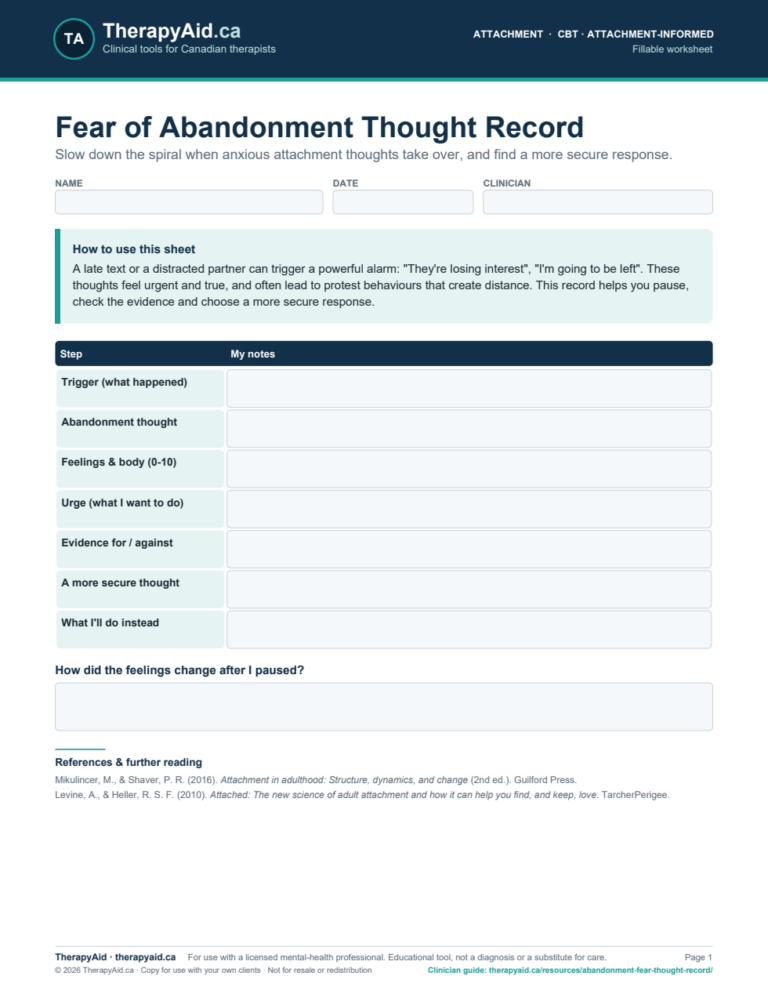
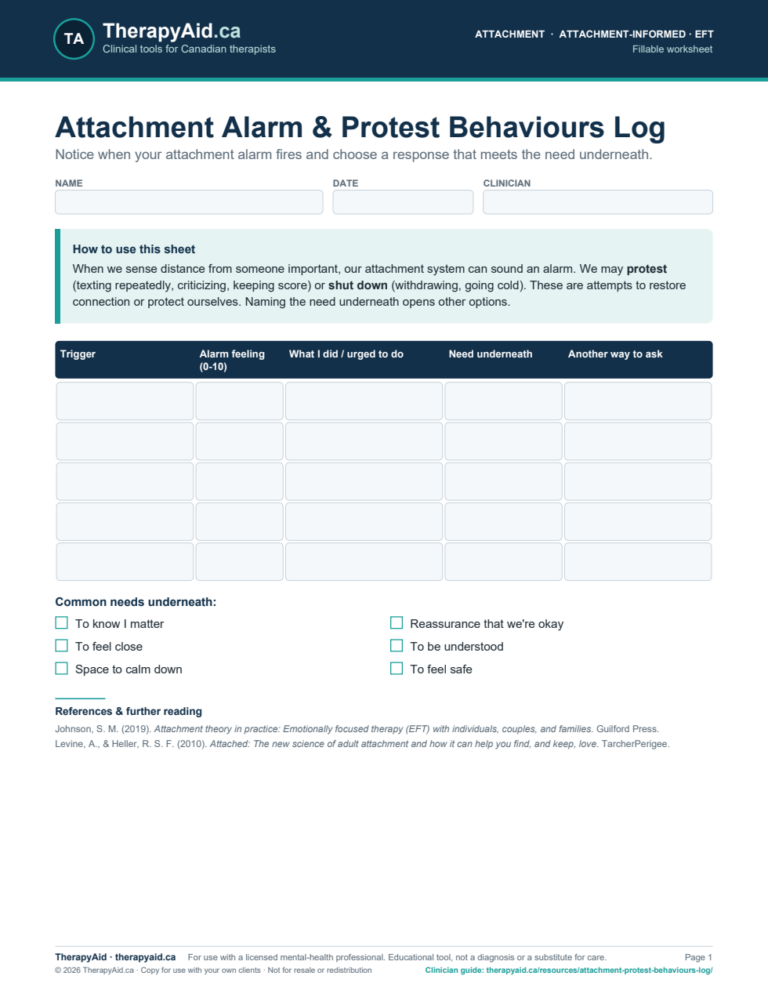
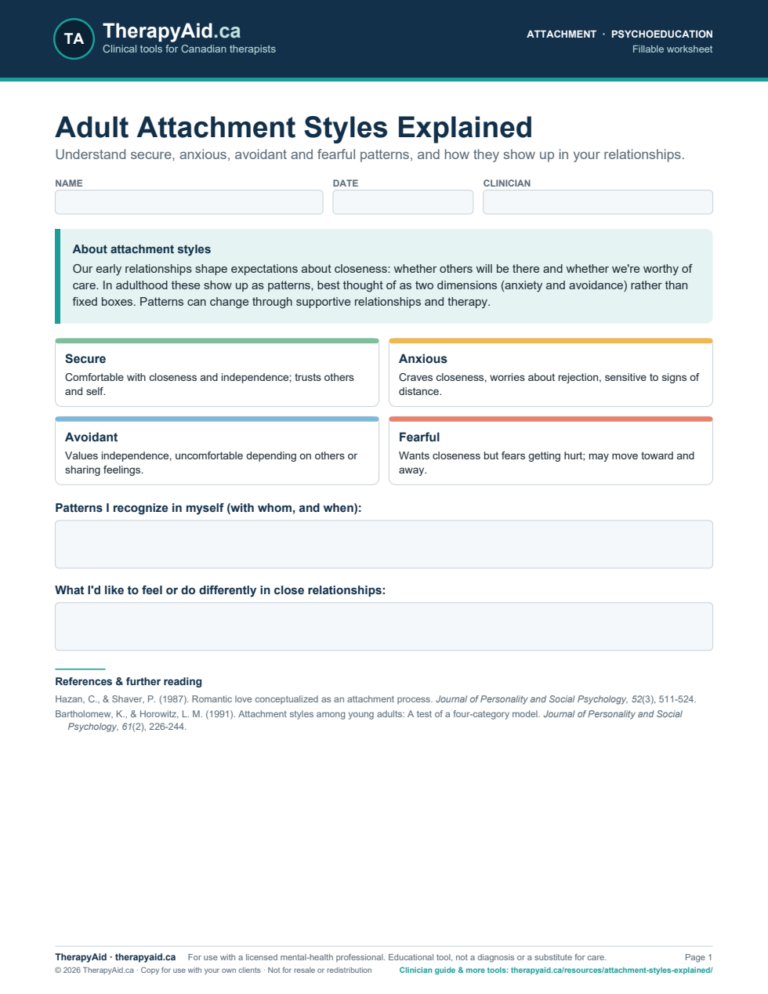
A reflective worksheet introducing secure, anxious, avoidant and fearful attachment patterns, with rating scales and prompts to explore origins and practise more secure responses.
2-page fillable PDF · US Letter (prints on A4) · Attachment-informed
- Approach / concern
- Attachment
- Technique
- Attachment-informed
- Format
- Fillable PDF, 2 pages (US Letter / A4)
- Access
- Pro and Advanced plans (3-day free trial)
- For
- Licensed clinicians to use with clients
- Updated
- October 2026
Key facts
What is the Attachment Patterns Reflection?
Adult attachment theory extends Bowlby’s work to adult relationships, describing individual differences along two dimensions: attachment anxiety (fear of rejection) and avoidance (discomfort with closeness). This worksheet introduces common patterns in plain language and invites reflection rather than labelling.
Why it works
Attachment patterns influence emotion regulation, relationship satisfaction and responses to conflict (Mikulincer & Shaver, 2016). Research since Hazan and Shaver (1987) shows that attachment security can increase through supportive relationships and therapy.
When to use it
- Relationship difficulties and recurring conflict patterns
- Couples work
- Grief, breakups and loneliness
- Exploring the impact of early experiences
How to use it in session
- Introduce attachment as a spectrum, not a diagnosis.
- Read the descriptions together and invite reactions.
- Use the two scales to explore anxiety and avoidance.
- Reflect on origins with compassion.
- Practise one ‘more secure’ response in daily life.
Clinician tips
- Avoid using attachment labels to blame partners.
- Normalize mixed patterns and context-dependence.
- Validated questionnaires (e.g., ECR-R) can supplement this reflection.
Worked example
Sharing with clients
Members can download the PDF to print or email, or copy a private client link from the download box. Your client opens the link and downloads the worksheet on any device. No client account is needed, and nothing your client writes is stored on TherapyAid.
Frequently asked questions
Can attachment styles change?
Yes. Patterns can shift toward greater security through consistent, supportive relationships and therapeutic work, a process sometimes called earned security.
Is this a diagnostic test?
No. It’s a reflection tool. Validated questionnaires are available if a formal measure is needed.
References
Hazan, C., & Shaver, P. (1987). Romantic love conceptualized as an attachment process. Journal of Personality and Social Psychology, 52(3), 511-524.
Mikulincer, M., & Shaver, P. R. (2016). Attachment in adulthood: Structure, dynamics, and change (2nd ed.). Guilford Press.
This worksheet is an educational tool for use by, or under the guidance of, a licensed or registered mental-health professional. It is not a diagnostic instrument or a substitute for clinical judgement. If a client is in crisis in Canada, call or text 9-8-8 or call 9-1-1.