Activity Pacing Plan for Chronic Pain
A chronic pain and fatigue worksheet to establish activity baselines, plan time-based activity with rest breaks, and gradually increase tolerance while tracking pain and fatigue.
2-page fillable PDF · US Letter (prints on A4) · Pacing · CBT for pain
- Approach / concern
- Chronic Pain
- Technique
- Pacing · CBT for pain
- Format
- Fillable PDF, 2 pages (US Letter / A4)
- Access
- Pro and Advanced plans (3-day free trial)
- For
- Licensed clinicians to use with clients
- Updated
- October 2026
Key facts
What is the Activity Pacing Plan for Chronic Pain?
Activity pacing is a self-management strategy that involves balancing activity and rest, using time-based goals rather than pain levels, and gradually increasing activity. It addresses the ‘boom and bust’ pattern, overactivity on good days followed by forced rest, that is common in chronic pain and fatigue conditions.
Why it works
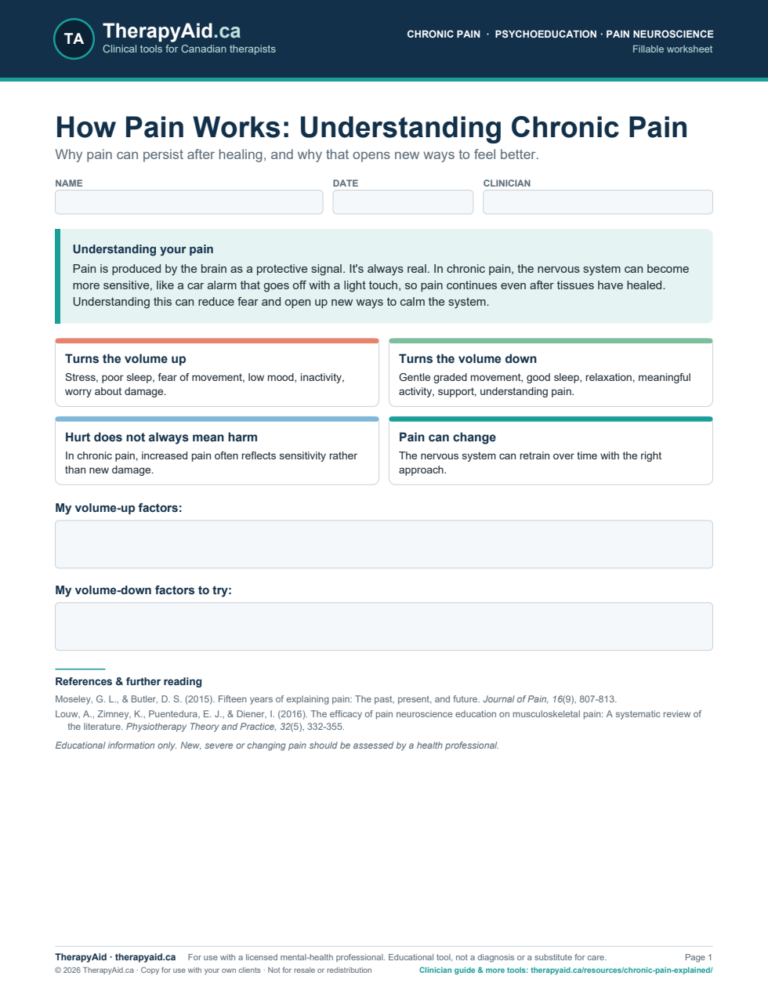
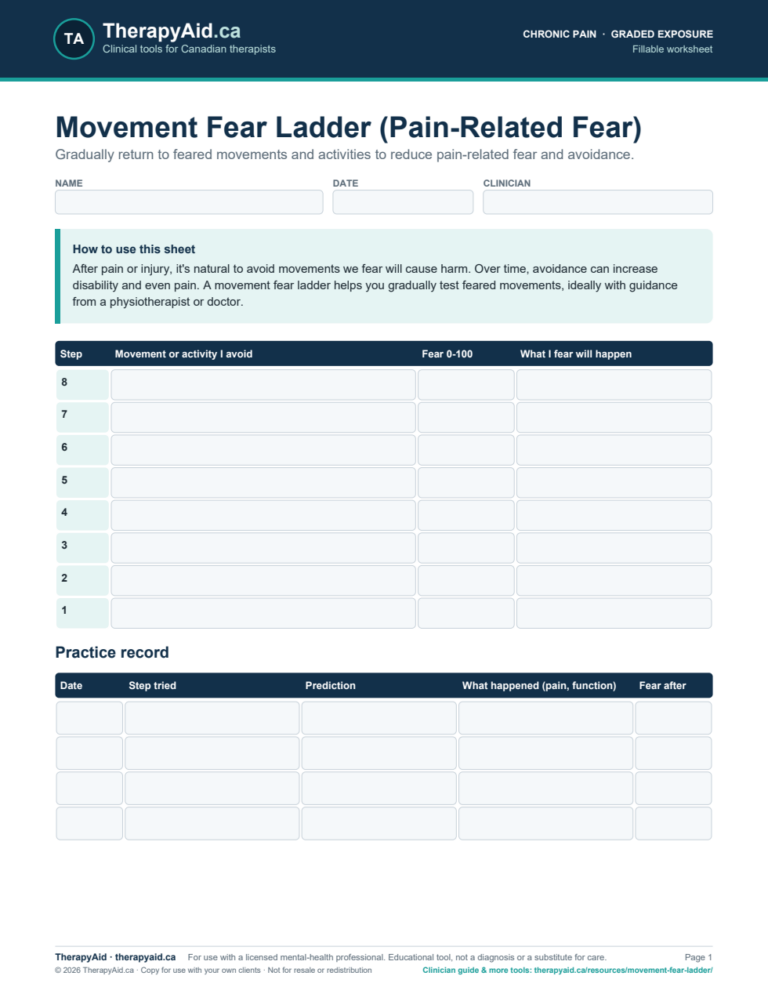
Pacing is widely recommended in multidisciplinary pain management, although definitions and evidence vary (Nielson et al., 2013). By preventing both overactivity and avoidance, it also targets the fear-avoidance cycle that can maintain disability in chronic pain (Vlaeyen & Linton, 2000).
When to use it
- Chronic musculoskeletal pain
- Fibromyalgia and persistent fatigue
- Return to activity after injury
- Alongside physiotherapy or occupational therapy
How to use it in session
- Explore the client’s boom-and-bust pattern.
- Establish time-based baselines for key activities.
- Plan daily activity with scheduled breaks.
- Increase gradually, about 10% a week if tolerated.
- Review the log and adjust collaboratively.
Clinician tips
- Base the plan on time, not pain, to avoid letting pain dictate activity.
- Include valued and enjoyable activities, not just chores.
- Coordinate with the client’s physician or physiotherapist.
Worked example
Sharing with clients
Members can download the PDF to print or email, or copy a private client link from the download box. Your client opens the link and downloads the worksheet on any device. No client account is needed, and nothing your client writes is stored on TherapyAid.
Frequently asked questions
Isn’t rest the best thing for pain?
Short-term rest can help acute pain, but long-term inactivity often worsens chronic pain and fitness. Pacing finds a sustainable middle ground.
What if I have a flare anyway?
Flares happen. Reduce to a lower baseline briefly, then build up again rather than stopping completely.
References
Nielson, W. R., Jensen, M. P., Karsdorp, P. A., & Vlaeyen, J. W. S. (2013). Activity pacing in chronic pain: Concepts, evidence, and future directions. The Clinical Journal of Pain, 29(5), 461-468.
Vlaeyen, J. W. S., & Linton, S. J. (2000). Fear-avoidance and its consequences in chronic musculoskeletal pain: A state of the art. Pain, 85(3), 317-332.
This worksheet is an educational tool for use by, or under the guidance of, a licensed or registered mental-health professional. It is not a diagnostic instrument or a substitute for clinical judgement. If a client is in crisis in Canada, call or text 9-8-8 or call 9-1-1.