5-4-3-2-1 Grounding
A trauma-informed, fillable worksheet for the 5-4-3-2-1 sensory grounding technique, with space to record what the client notices, distress ratings, and a personal menu of other grounding strategies.
2-page fillable PDF · US Letter (prints on A4) · Grounding · Stabilization
- Approach / concern
- Trauma & PTSD
- Technique
- Grounding · Stabilization
- Format
- Fillable PDF, 2 pages (US Letter / A4)
- Access
- Pro and Advanced plans (3-day free trial)
- For
- Licensed clinicians to use with clients
- Updated
- October 2026
Key facts
What is the 5-4-3-2-1 Grounding?
5-4-3-2-1 is a sensory grounding technique that guides attention outward to the present environment: five things you see, four you feel, three you hear, two you smell and one you taste. Using several senses at once competes with intrusive memories, panic or numbness and helps reorient the person to the here and now.
Why it works
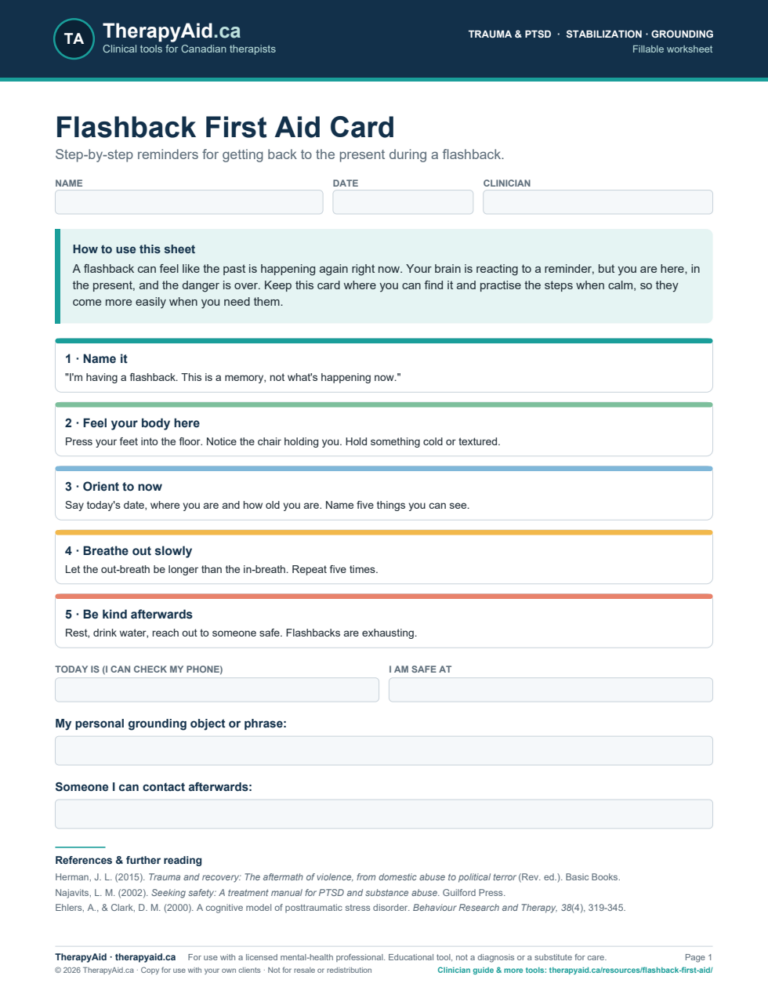
Grounding is a cornerstone of phase-one (stabilization) trauma treatment (Herman, 2015) and a core skill in integrated treatments such as Seeking Safety (Najavits, 2002). Orienting to the environment is also central to body-based approaches such as sensorimotor psychotherapy (Ogden et al., 2006). The structured countdown makes it easy to use even when thinking is foggy.
When to use it
- Flashbacks and intrusive memories
- Panic attacks
- Dissociation or feeling unreal
- Before ending a session where distress was high
- Children and teens (simplified version)
How to use it in session
- Introduce grounding when the client is calm, explaining why it works.
- Practise together in session, slowly, with the client naming items aloud.
- Rate distress and presence before and after.
- Help the client build a personal menu from the checklist.
- Encourage regular practice, plus a phone photo of the sheet for use in the moment.
Clinician tips
- Some clients find certain senses triggering, such as smell. Offer substitutions freely.
- Keep your own voice slow and warm. Co-regulation matters.
- If a client dissociates in session, add movement: stand, push hands together, or walk.
- Pair with the Window of Tolerance sheet to help clients notice when they need to ground.
Worked example
Sharing with clients
Members can download the PDF to print or email, or copy a private client link from the download box. Your client opens the link and downloads the worksheet on any device. No client account is needed, and nothing your client writes is stored on TherapyAid.
Frequently asked questions
Is grounding the same as mindfulness?
They overlap. Grounding is usually more active and outward-focused, and is designed for high-distress moments. Mindfulness practice is broader.
What if the client can’t think of answers?
Simplify. Even naming one thing per sense, or just the colours in the room, is grounding.
References
Najavits, L. M. (2002). Seeking safety: A treatment manual for PTSD and substance abuse. Guilford Press.
Ogden, P., Minton, K., & Pain, C. (2006). Trauma and the body: A sensorimotor approach to psychotherapy. W. W. Norton.
Herman, J. L. (2015). Trauma and recovery: The aftermath of violence, from domestic abuse to political terror (Rev. ed.). Basic Books.
This worksheet is an educational tool for use by, or under the guidance of, a licensed or registered mental-health professional. It is not a diagnostic instrument or a substitute for clinical judgement. If a client is in crisis in Canada, call or text 9-8-8 or call 9-1-1.