Behavioural Activation Weekly Planner
A fillable weekly planner for behavioural activation (BA). Clients build an activity menu across pleasure, mastery and meaning, schedule specific actions, and rate their mood before and after.
2-page fillable PDF · US Letter (prints on A4) · Behavioural activation
- Approach / concern
- Depression
- Technique
- Behavioural activation
- Format
- Fillable PDF, 2 pages (US Letter / A4)
- Access
- Pro and Advanced plans (3-day free trial)
- For
- Licensed clinicians to use with clients
- Updated
- October 2026
Key facts
What is the Behavioural Activation Weekly Planner?
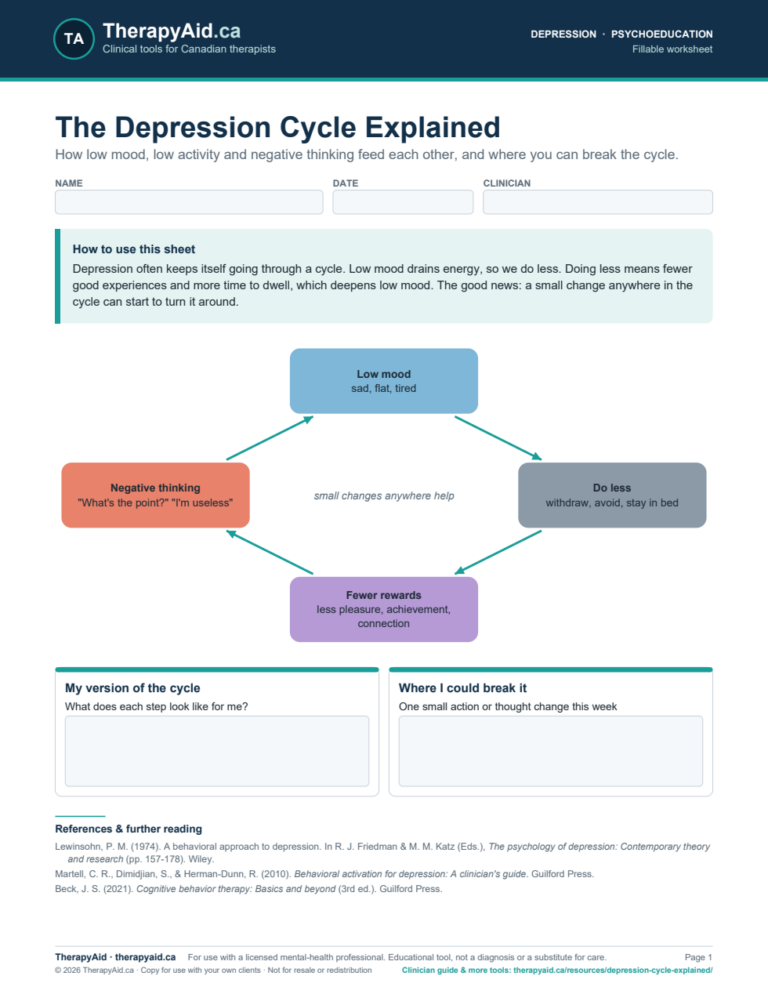
Behavioural activation is a structured, evidence-based treatment for depression that focuses on what people do rather than on what they think. It comes from Lewinsohn’s behavioural model of depression and was developed into a full treatment by Martell, Dimidjian and colleagues. Low mood leads to withdrawal and avoidance, which reduces access to positive experiences and keeps the depression going. BA reverses this by planning activities that reconnect the person with reward, achievement and their values.
Why it works
Meta-analyses show that BA is as effective as full cognitive therapy for depression, and more effective than control conditions (Ekers et al., 2014). It is simple to deliver and easy for clients to understand, and it works well in brief and stepped-care formats.
When to use it
- Mild to severe depression
- Low mood after loss, burnout or illness
- Clients with low motivation who find cognitive work too effortful at first
- Withdrawal and avoidance in anxiety
- Relapse prevention after recovery from depression
How to use it in session
- Explain the cycle of low mood and low activity, and the idea of acting ‘outside-in’.
- Build the activity menu together across all three areas.
- Schedule two to four small activities for the coming week, with a day, time and place.
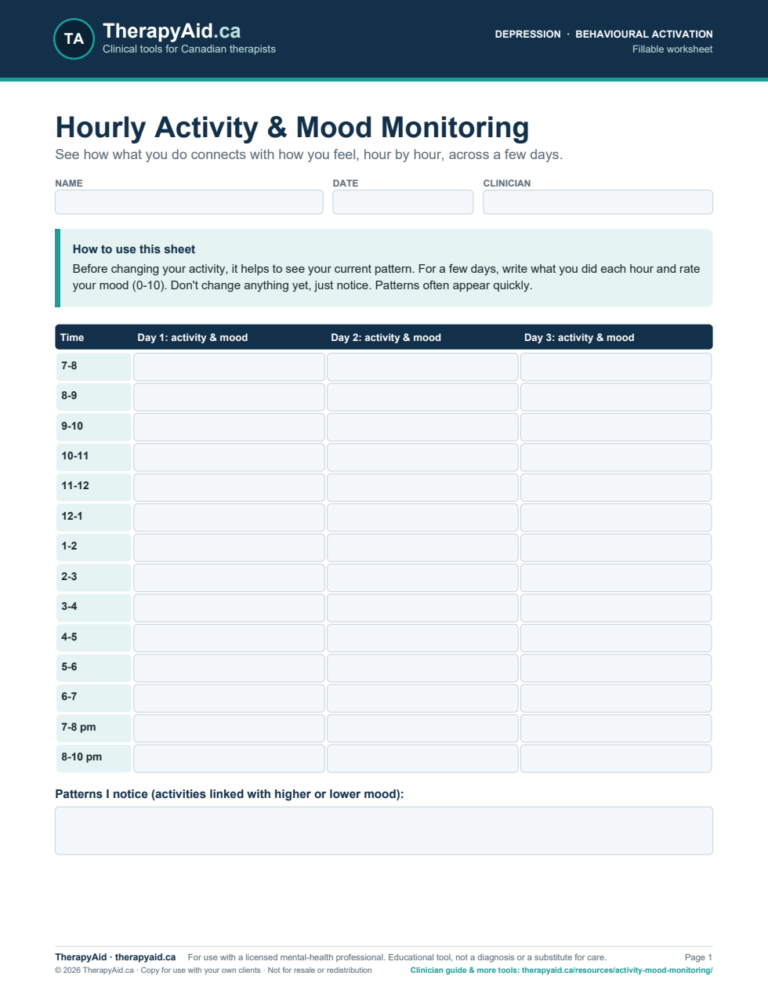
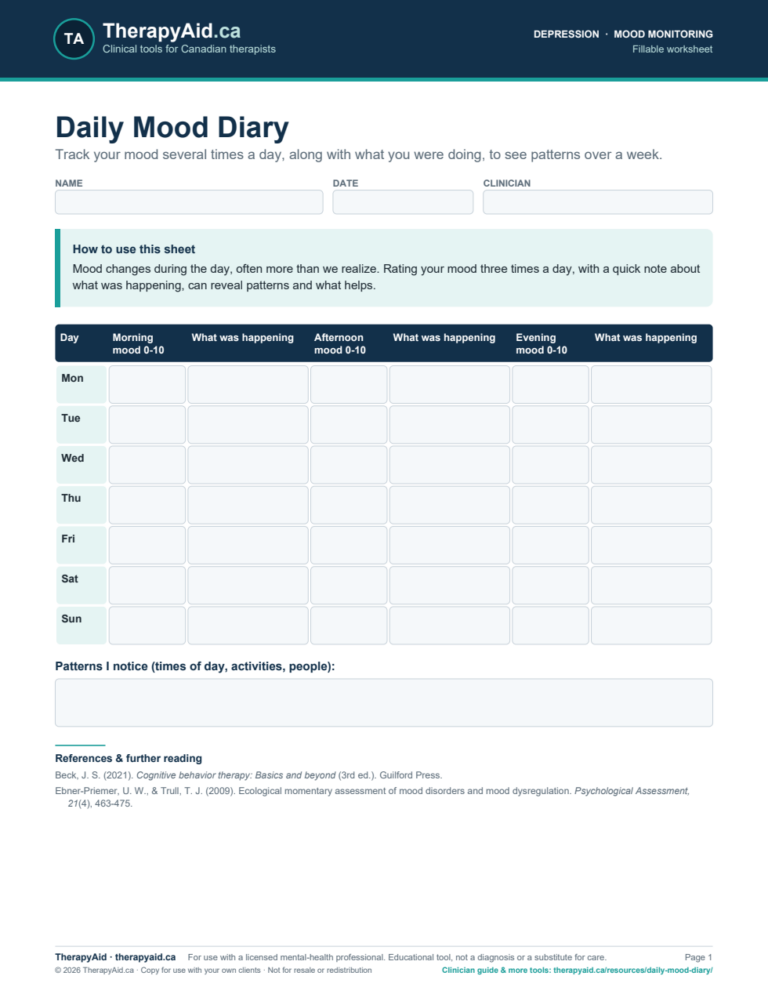
- Ask the client to rate mood before and after, plus pleasure and mastery.
- Review the planner each session. Strengthen what helped and troubleshoot obstacles.
- Gradually increase the number and challenge of activities.
Clinician tips
- Make activities specific: “Walk to the mailbox at 10 a.m.” not “Exercise more”.
- Don’t overlook mastery. Small chores often lift mood as much as fun activities.
- Expect pleasure ratings to be low at first. Anhedonia lifts after activity, not before.
- Link activities to values so they feel worthwhile, not just busy.
Worked example
Sharing with clients
Members can download the PDF to print or email, or copy a private client link from the download box. Your client opens the link and downloads the worksheet on any device. No client account is needed, and nothing your client writes is stored on TherapyAid.
Frequently asked questions
What if the client doesn’t complete any activities?
Treat it as information, not failure. Explore the barriers (task too big, unclear timing, avoidance) and make the next step smaller.
Is BA only for depression?
It was designed for depression, but activity scheduling is also helpful for anxiety, grief, chronic pain and burnout.
References
Martell, C. R., Dimidjian, S., & Herman-Dunn, R. (2010). Behavioral activation for depression: A clinician’s guide. Guilford Press.
Ekers, D., Webster, L., Van Straten, A., Cuijpers, P., Richards, D., & Gilbody, S. (2014). Behavioural activation for depression: An update of meta-analysis of effectiveness and sub group analysis. PLoS ONE, 9(6), e100100.
Lewinsohn, P. M. (1974). A behavioral approach to depression. In R. J. Friedman & M. M. Katz (Eds.), The psychology of depression: Contemporary theory and research (pp. 157-178). Wiley.
This worksheet is an educational tool for use by, or under the guidance of, a licensed or registered mental-health professional. It is not a diagnostic instrument or a substitute for clinical judgement. If a client is in crisis in Canada, call or text 9-8-8 or call 9-1-1.