Understanding Bipolar Disorder
A client and family handout explaining mania, hypomania and depression, what helps, common triggers, plus space for early warning signs and questions.
1-page fillable PDF · US Letter (prints on A4) · Psychoeducation
- Approach / concern
- Bipolar & Mood
- Technique
- Psychoeducation
- Format
- Fillable PDF, 1 page (US Letter / A4)
- Access
- Pro and Advanced plans (3-day free trial)
- For
- Licensed clinicians to use with clients
- Updated
- October 2026
Key facts
What is the Understanding Bipolar Disorder?
Bipolar disorder involves recurrent episodes of depression and mania (bipolar I) or hypomania (bipolar II). Psychoeducation is a recommended part of treatment, helping clients and families understand the illness, recognize early signs and support adherence.
Why it works
Structured group psychoeducation reduces relapse in bipolar disorder (Colom & Vieta, 2006). The Canadian CANMAT/ISBD guidelines recommend psychoeducation as a first-line adjunctive psychosocial treatment for maintenance (Yatham et al., 2018).
When to use it
- After a new diagnosis
- Family sessions
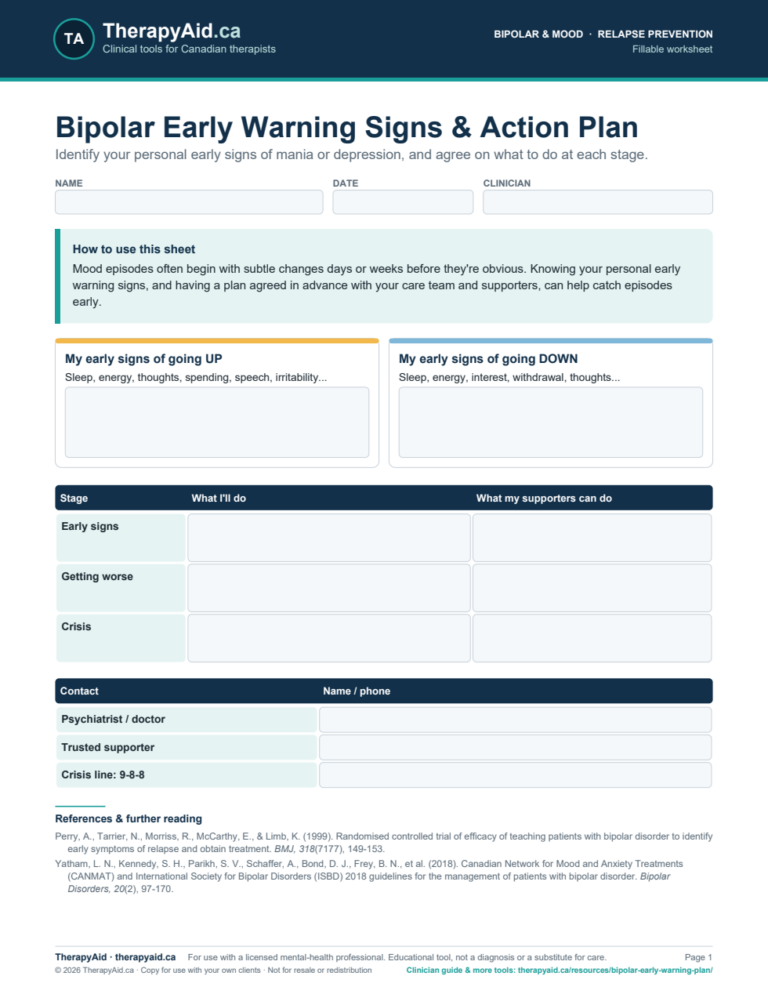
- Relapse prevention
- Inpatient-to-community transition
How to use it in session
- Review the handout together.
- Normalize the diagnosis and emphasize treatability.
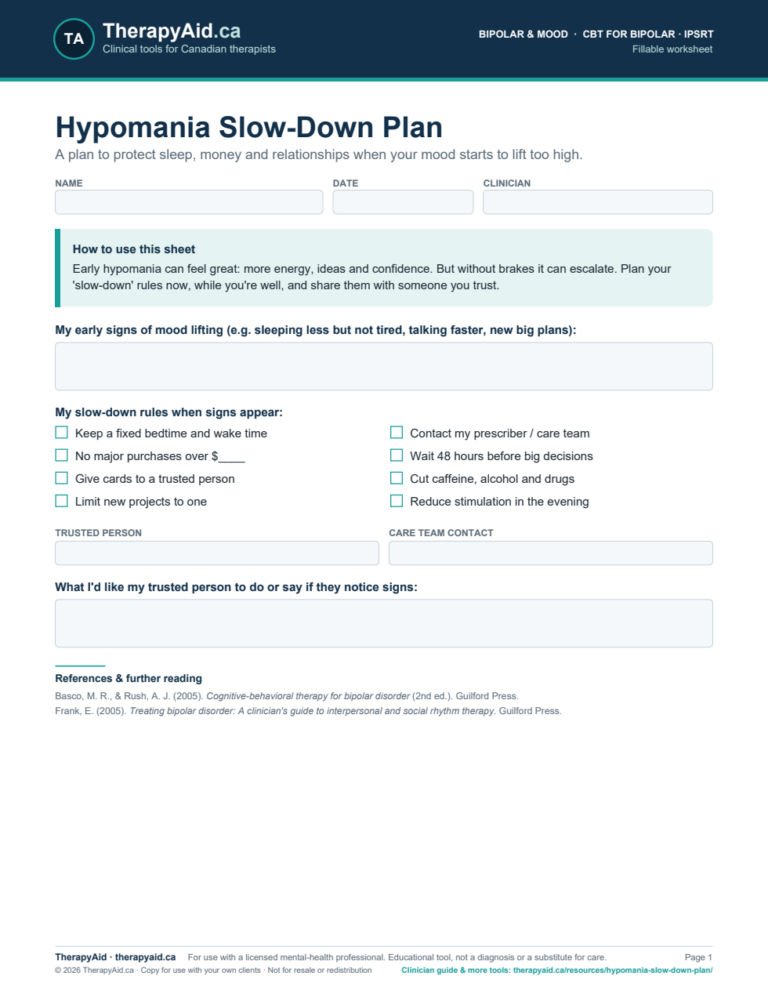
- Identify personal triggers.
- List early warning signs with family input.
- Link to a relapse prevention plan.
Clinician tips
- Use non-stigmatizing language.
- Involve family with consent.
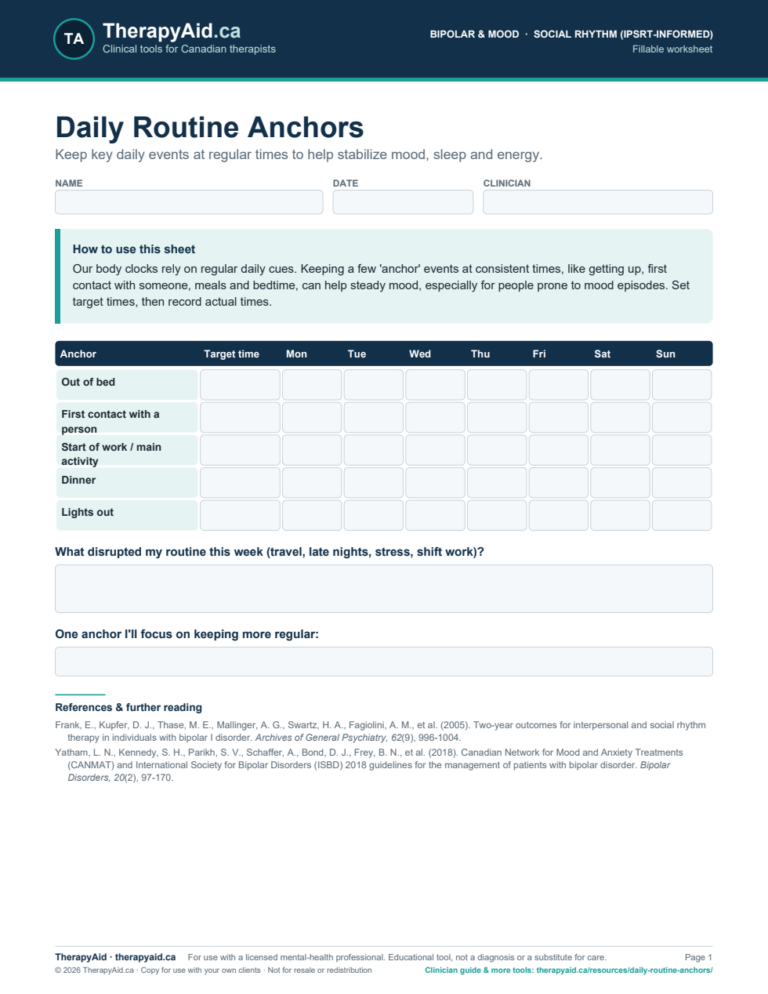
- Pair with mood and sleep tracking.
Worked example
Sharing with clients
Members can download the PDF to print or email, or copy a private client link from the download box. Your client opens the link and downloads the worksheet on any device. No client account is needed, and nothing your client writes is stored on TherapyAid.
Frequently asked questions
Is bipolar disorder curable?
It’s usually lifelong but highly treatable, and many people have long periods of stability.
What’s the difference between bipolar I and II?
Bipolar I involves at least one manic episode; bipolar II involves hypomania and major depression, without full mania.
References
Colom, F., & Vieta, E. (2006). Psychoeducation manual for bipolar disorder. Cambridge University Press.
Yatham, L. N., Kennedy, S. H., Parikh, S. V., Schaffer, A., Bond, D. J., Frey, B. N., et al. (2018). Canadian Network for Mood and Anxiety Treatments (CANMAT) and International Society for Bipolar Disorders (ISBD) 2018 guidelines for the management of patients with bipolar disorder. Bipolar Disorders, 20(2), 97-170.
This worksheet is an educational tool for use by, or under the guidance of, a licensed or registered mental-health professional. It is not a diagnostic instrument or a substitute for clinical judgement. If a client is in crisis in Canada, call or text 9-8-8 or call 9-1-1.