Substance Use Diary
A weekly substance use diary recording time, place, company, amount, preceding feelings and consequences, with space to note patterns.
1-page fillable PDF · US Letter (prints on A4) · CBT · Self-monitoring
- Approach / concern
- Recovery & Addiction
- Technique
- CBT · Self-monitoring
- Format
- Fillable PDF, 1 page (US Letter / A4)
- Access
- Pro and Advanced plans (3-day free trial)
- For
- Licensed clinicians to use with clients
- Updated
- October 2026
Key facts
What is the Substance Use Diary?
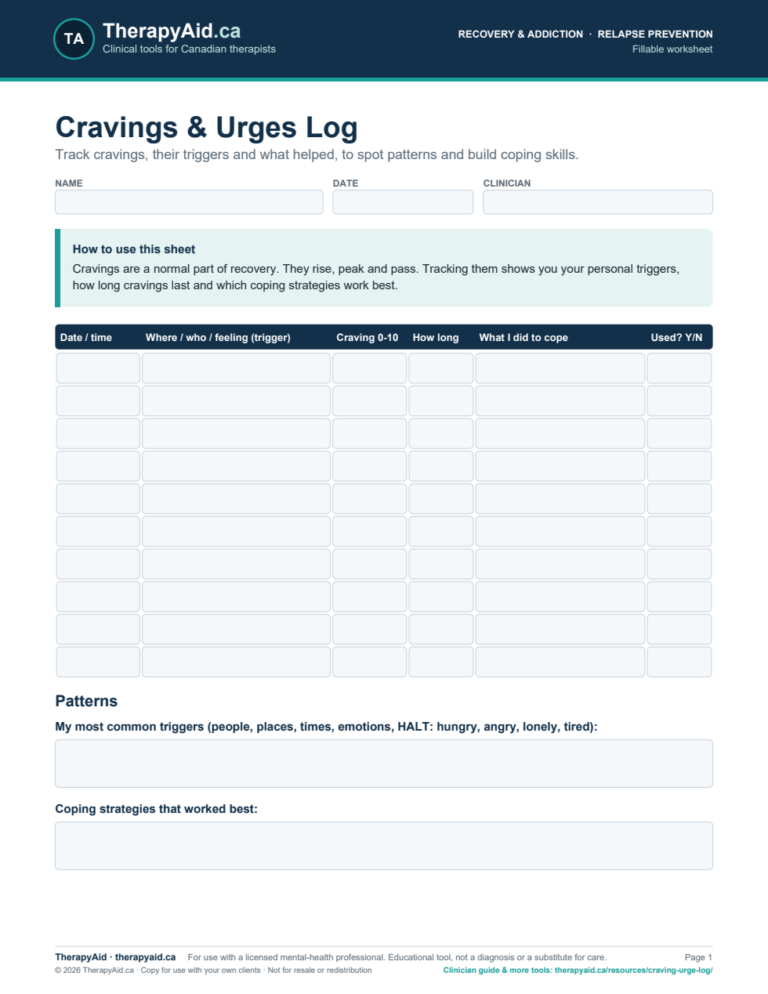
Self-monitoring of substance use increases awareness of patterns and triggers, informing goals and relapse prevention in CBT for addictions.
Why it works
Self-monitoring is a foundational relapse prevention technique (Marlatt & Donovan, 2005). Canada’s guidance on alcohol and health describes risk levels by weekly drinks (Paradis et al., 2023).
When to use it
- Alcohol and drug use assessment
- Moderation and abstinence goals
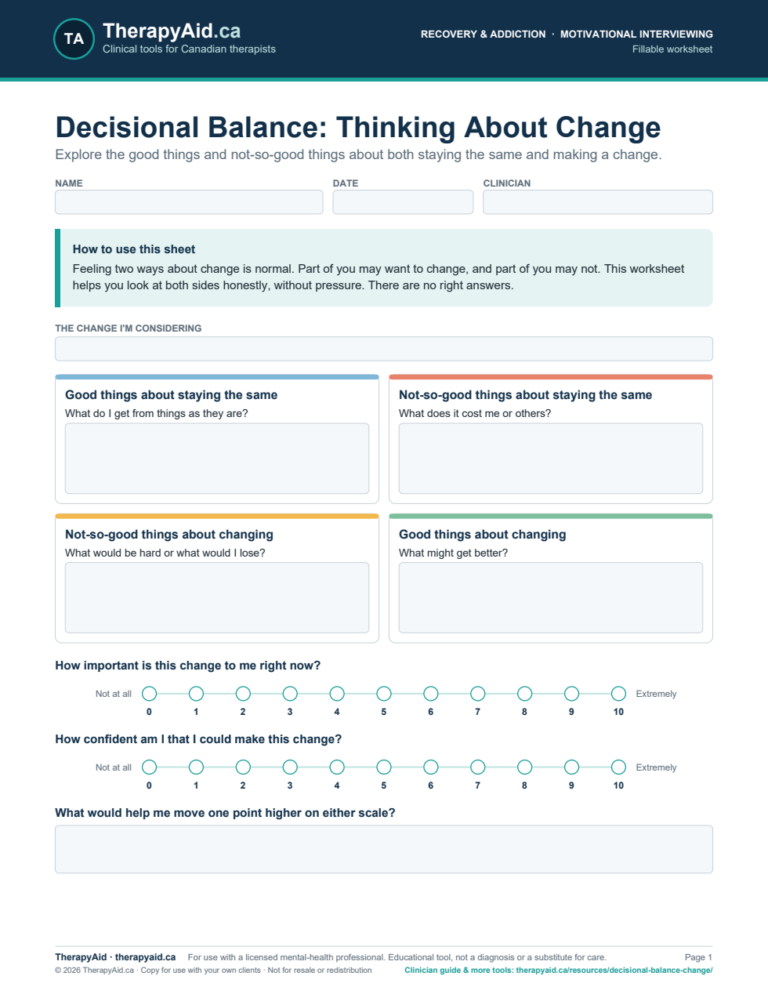
- Motivational work
- Harm reduction
How to use it in session
- Explain the purpose.
- Record soon after use.
- Review patterns.
- Link to goals.
- Repeat periodically.
Clinician tips
- Normalize under-reporting and encourage honesty.
- Use standard drink definitions.
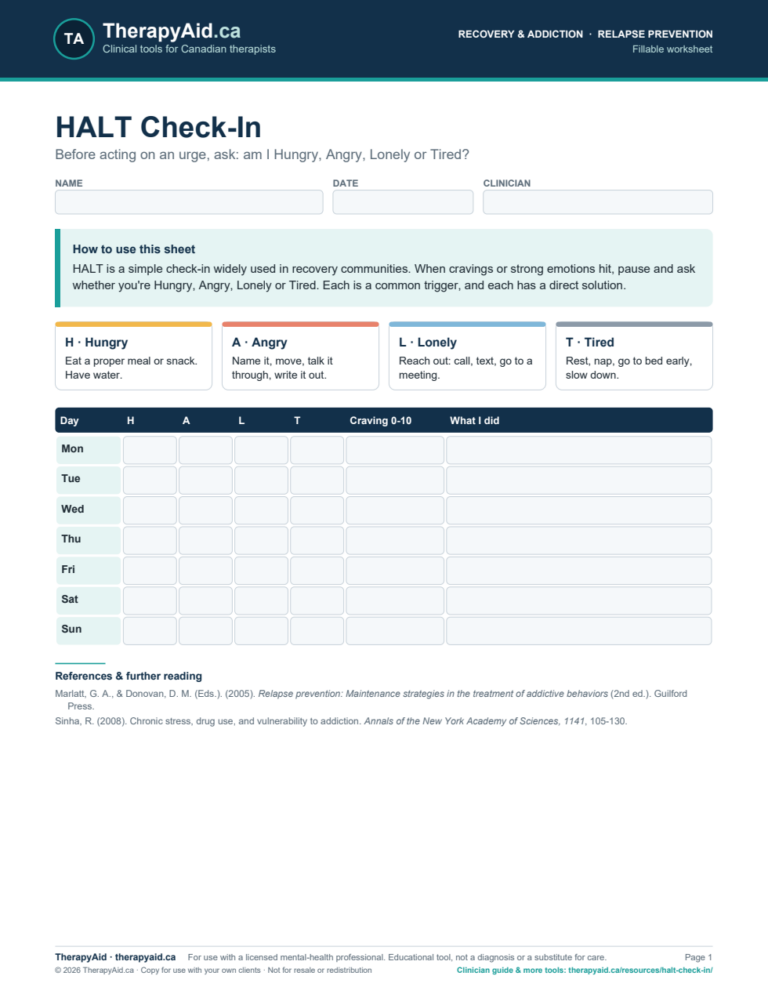
- Assess withdrawal risk.
Worked example
Sharing with clients
Members can download the PDF to print or email, or copy a private client link from the download box. Your client opens the link and downloads the worksheet on any device. No client account is needed, and nothing your client writes is stored on TherapyAid.
Frequently asked questions
Why track use?
Tracking shows patterns and helps you set realistic goals.
What counts as a standard drink in Canada?
Roughly a 341 ml bottle of 5% beer, a 142 ml glass of 12% wine or 43 ml of 40% spirits.
References
Marlatt, G. A., & Donovan, D. M. (Eds.). (2005). Relapse prevention: Maintenance strategies in the treatment of addictive behaviors (2nd ed.). Guilford Press.
Paradis, C., Butt, P., Shield, K., Poole, N., Wells, S., Naimi, T., Sherk, A., & the Low-Risk Alcohol Drinking Guidelines Scientific Expert Panels. (2023). Canada’s guidance on alcohol and health: Final report. Canadian Centre on Substance Use and Addiction.
This worksheet is an educational tool for use by, or under the guidance of, a licensed or registered mental-health professional. It is not a diagnostic instrument or a substitute for clinical judgement. If a client is in crisis in Canada, call or text 9-8-8 or call 9-1-1.