Stepfamily Loyalty Binds
A stepfamily worksheet identifying loyalty binds for children, parents and stepparents, strategies that ease them and one change to try.
1-page fillable PDF · US Letter (prints on A4) · Stepfamily therapy
- Approach / concern
- Family Therapy
- Technique
- Stepfamily therapy
- Format
- Fillable PDF, 1 page (US Letter / A4)
- Access
- Pro and Advanced plans (3-day free trial)
- For
- Licensed clinicians to use with clients
- Updated
- October 2026
Key facts
What is the Stepfamily Loyalty Binds?
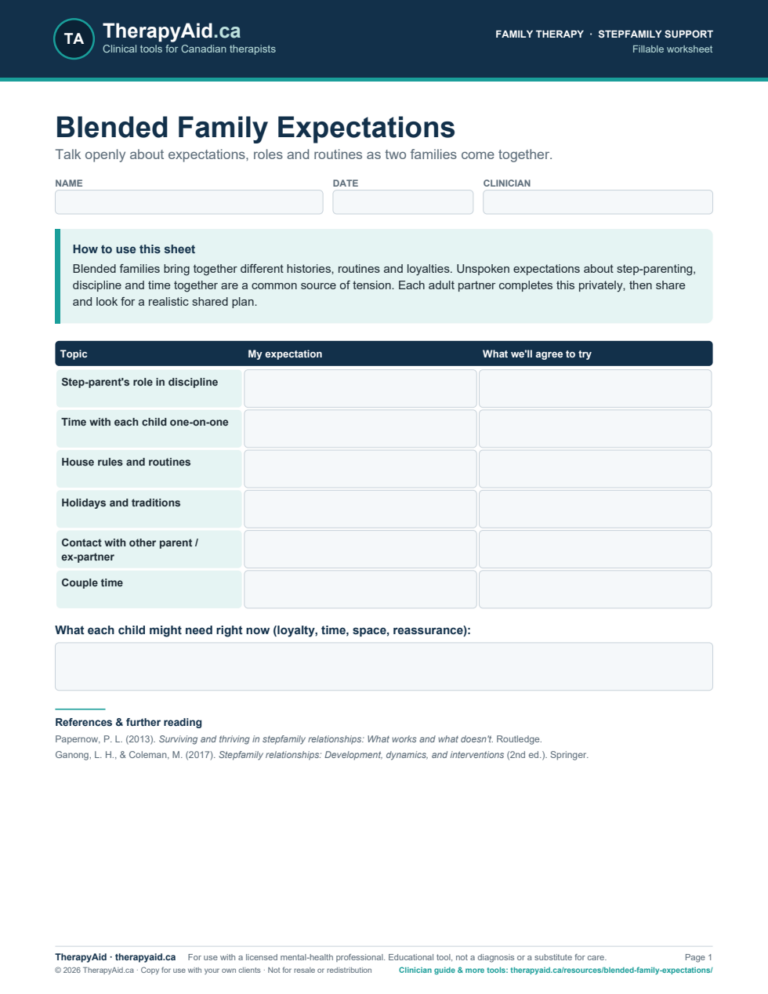
Stepfamilies face structural challenges, including loyalty binds, insider and outsider positions and differing parenting expectations. Naming these normalizes struggles.
Why it works
Papernow (2013) describes common stepfamily challenges and evidence-based strategies, including loyalty binds. Reducing inter-parental conflict supports children (Amato, 2010).
When to use it
- Blended families
- Stepparent stress
- Children struggling with transitions
- Family therapy
How to use it in session
- Explain loyalty binds.
- Map each perspective.
- Identify easing strategies.
- Choose one change.
- Review.
Clinician tips
- Stepparents should build relationships slowly.
- Biological parents usually lead discipline at first.
- Protect one-on-one parent-child time.
Worked example
Sharing with clients
Members can download the PDF to print or email, or copy a private client link from the download box. Your client opens the link and downloads the worksheet on any device. No client account is needed, and nothing your client writes is stored on TherapyAid.
Frequently asked questions
Why do kids resist a stepparent?
Liking a stepparent can feel like betraying a parent; this is a common loyalty bind.
How long does it take for a stepfamily to settle?
Often several years; a slow, patient pace helps.
References
Papernow, P. L. (2013). Surviving and thriving in stepfamily relationships: What works and what doesn’t. Routledge.
Amato, P. R. (2010). Research on divorce: Continuing trends and new developments. Journal of Marriage and Family, 72(3), 650-666.
This worksheet is an educational tool for use by, or under the guidance of, a licensed or registered mental-health professional. It is not a diagnostic instrument or a substitute for clinical judgement. If a client is in crisis in Canada, call or text 9-8-8 or call 9-1-1.