Stages of Change: Where Am I?
A transtheoretical model worksheet describing five stages of change with typical statements and helpful supports, plus fields for current stage and a matching next step.
1-page fillable PDF · US Letter (prints on A4) · Transtheoretical model
- Approach / concern
- Recovery & Addiction
- Technique
- Transtheoretical model
- Format
- Fillable PDF, 1 page (US Letter / A4)
- Access
- Pro and Advanced plans (3-day free trial)
- For
- Licensed clinicians to use with clients
- Updated
- October 2026
Key facts
What is the Stages of Change: Where Am I??
The transtheoretical model (stages of change) describes how people move through precontemplation, contemplation, preparation, action and maintenance when changing behaviour, often cycling back and forth.
Why it works
Developed by Prochaska and DiClemente (1983), the model helps match interventions to readiness. Meta-analytic work links stage to treatment outcomes and supports stage-matched approaches (Norcross et al., 2011).
When to use it
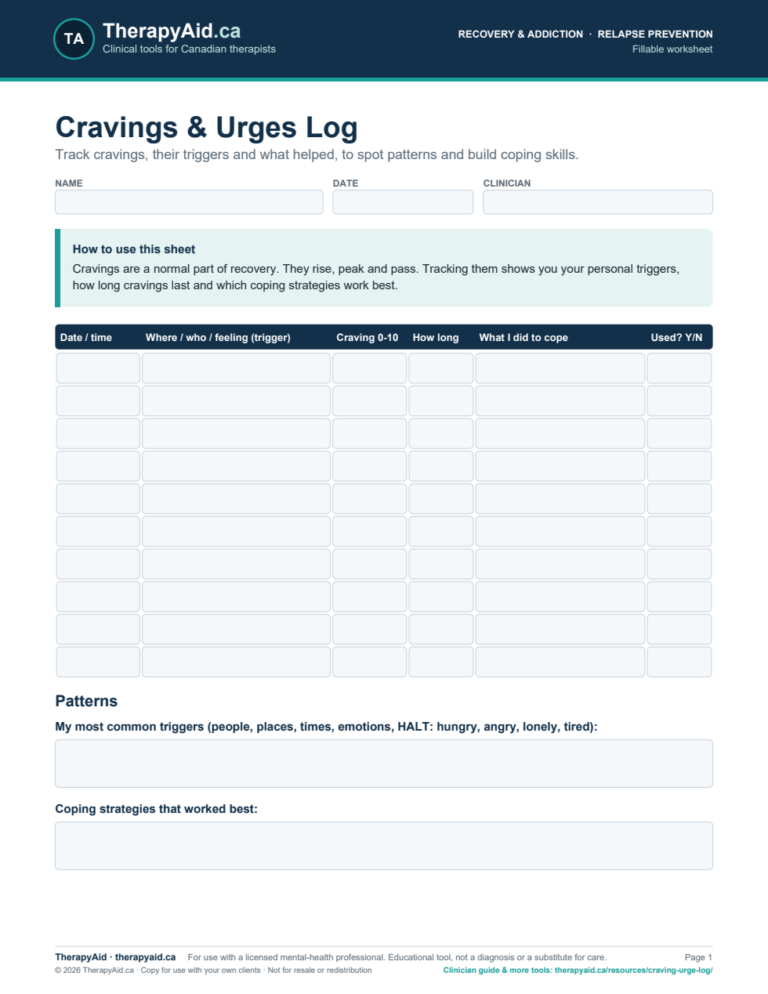
- Substance use and addictive behaviours
- Health behaviour change
- Ambivalent or mandated clients
- Treatment planning
How to use it in session
- Describe each stage without judgement.
- Help the client identify their stage.
- Normalize moving between stages.
- Choose a stage-matched next step.
- Revisit as readiness changes.
Clinician tips
- Avoid pushing action on someone in contemplation.
- Relapse is part of the cycle, not failure.
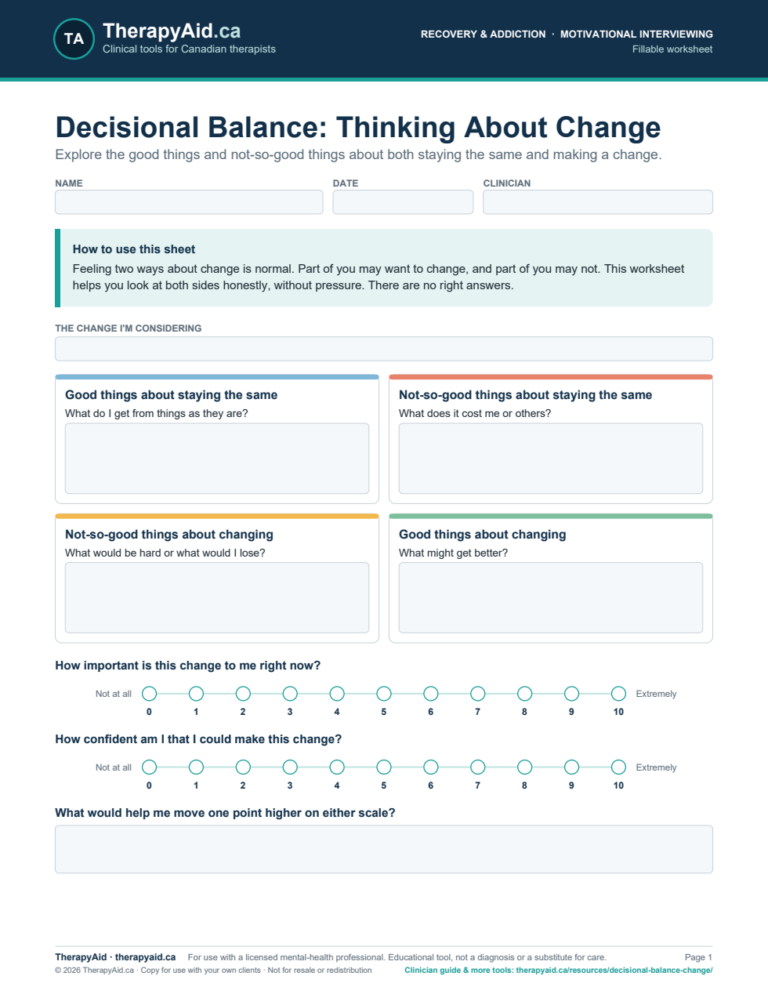
- Pair with decisional balance for contemplators.
Worked example
Sharing with clients
Members can download the PDF to print or email, or copy a private client link from the download box. Your client opens the link and downloads the worksheet on any device. No client account is needed, and nothing your client writes is stored on TherapyAid.
Frequently asked questions
Do people go through the stages in order?
Not always. People often move back and forth, and relapse is a common part of the process.
Can the stages of change apply to therapy goals beyond addiction?
Yes. They’re used for many behaviour changes, such as exercise, eating and therapy engagement.
References
Prochaska, J. O., & DiClemente, C. C. (1983). Stages and processes of self-change of smoking: Toward an integrative model of change. Journal of Consulting and Clinical Psychology, 51(3), 390-395.
Norcross, J. C., Krebs, P. M., & Prochaska, J. O. (2011). Stages of change. Journal of Clinical Psychology, 67(2), 143-154.
This worksheet is an educational tool for use by, or under the guidance of, a licensed or registered mental-health professional. It is not a diagnostic instrument or a substitute for clinical judgement. If a client is in crisis in Canada, call or text 9-8-8 or call 9-1-1.