Safety Behaviours Checklist
A CBT checklist of common safety behaviours across social anxiety, panic and worry, with a plan for practising dropping them and recording learning.
1-page fillable PDF · US Letter (prints on A4) · CBT · Exposure preparation
- Approach / concern
- Anxiety & Panic
- Technique
- CBT · Exposure preparation
- Format
- Fillable PDF, 1 page (US Letter / A4)
- Access
- Pro and Advanced plans (3-day free trial)
- For
- Licensed clinicians to use with clients
- Updated
- October 2026
Key facts
What is the Safety Behaviours Checklist?
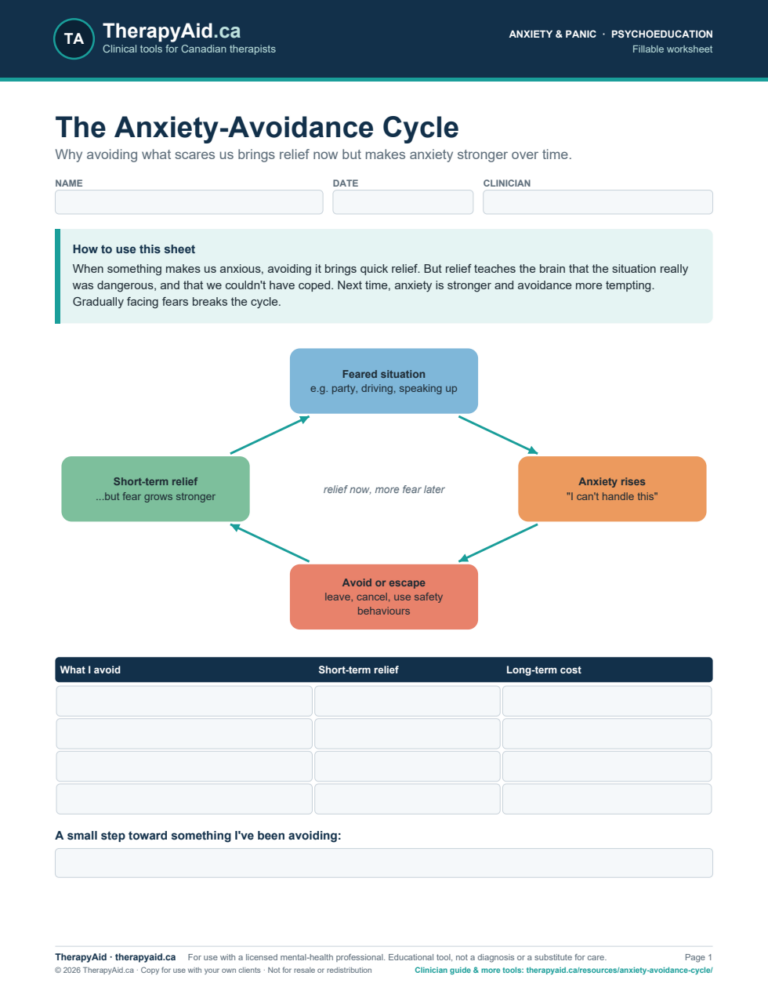
Safety behaviours are actions taken to prevent or minimize feared outcomes in anxiety. Although they reduce anxiety in the moment, they prevent disconfirmation of fears and maintain anxiety disorders.
Why it works
Cognitive models emphasize the role of safety behaviours in maintaining anxiety and panic (Salkovskis, 1991) and social anxiety (Clark & Wells, 1995). Dropping them during exposure improves outcomes.
When to use it
- Social anxiety
- Panic disorder and agoraphobia
- Health anxiety and GAD
- Before exposure work
How to use it in session
- Explain how safety behaviours maintain fear.
- Tick behaviours the client uses.
- Choose one to drop in a planned situation.
- Record what happens.
- Gradually drop others.
Clinician tips
- Subtle behaviours are easy to miss; ask in detail.
- Drop safety behaviours during exposures for best results.
- Some precautions are reasonable; focus on anxiety-driven ones.
Worked example
Sharing with clients
Members can download the PDF to print or email, or copy a private client link from the download box. Your client opens the link and downloads the worksheet on any device. No client account is needed, and nothing your client writes is stored on TherapyAid.
Frequently asked questions
Are safety behaviours always bad?
Not always, but in anxiety disorders they often keep fear going by preventing new learning.
Should I drop all of them at once?
Usually gradually, starting with one or two in planned situations.
References
Salkovskis, P. M. (1991). The importance of behaviour in the maintenance of anxiety and panic: A cognitive account. Behavioural Psychotherapy, 19(1), 6-19.
Clark, D. M., & Wells, A. (1995). A cognitive model of social phobia. In R. G. Heimberg, M. R. Liebowitz, D. A. Hope, & F. R. Schneier (Eds.), Social phobia: Diagnosis, assessment, and treatment (pp. 69-93). Guilford Press.
This worksheet is an educational tool for use by, or under the guidance of, a licensed or registered mental-health professional. It is not a diagnostic instrument or a substitute for clinical judgement. If a client is in crisis in Canada, call or text 9-8-8 or call 9-1-1.