Relapse Prevention Plan
A comprehensive, fillable relapse prevention plan for substance use and behavioural addictions, covering reasons for change, high-risk situations, early warning signs, an urge-surfing visual and a lapse plan.
2-page fillable PDF · US Letter (prints on A4) · Relapse prevention
- Approach / concern
- Recovery & Addiction
- Technique
- Relapse prevention
- Format
- Fillable PDF, 2 pages (US Letter / A4)
- Access
- Pro and Advanced plans (3-day free trial)
- For
- Licensed clinicians to use with clients
- Updated
- October 2026
Key facts
What is the Relapse Prevention Plan?
Relapse prevention (RP) is a cognitive-behavioural approach developed by G. Alan Marlatt and colleagues. It helps people anticipate and cope with situations that put them at risk of returning to substance use. A key idea is the difference between a lapse (a single slip) and a relapse (a return to the old pattern). How a person responds to a lapse, including the ‘abstinence violation effect’ of shame and giving up, strongly influences what happens next.
Why it works
Relapse prevention is one of the most widely studied interventions in addiction treatment (Witkiewitz & Marlatt, 2004). Mindfulness-based relapse prevention, which adds skills like urge surfing, has been shown to reduce heavy drinking and drug use at 12-month follow-up compared with treatment as usual (Bowen et al., 2014).
When to use it
- Alcohol and drug recovery
- Behavioural addictions (gambling, gaming)
- Discharge planning from residential treatment
- Alongside 12-step or SMART Recovery
- Recovery from eating disorders or self-harm (adapted)
How to use it in session
- Explore the client’s reasons for change in their own words.
- Map high-risk situations from past lapses and pair each with a coping strategy.
- Identify early warning signs, including the subtle ones.
- Teach urge surfing using the wave diagram.
- Write a compassionate lapse plan, including who to contact.
- Review and update the plan regularly.
Clinician tips
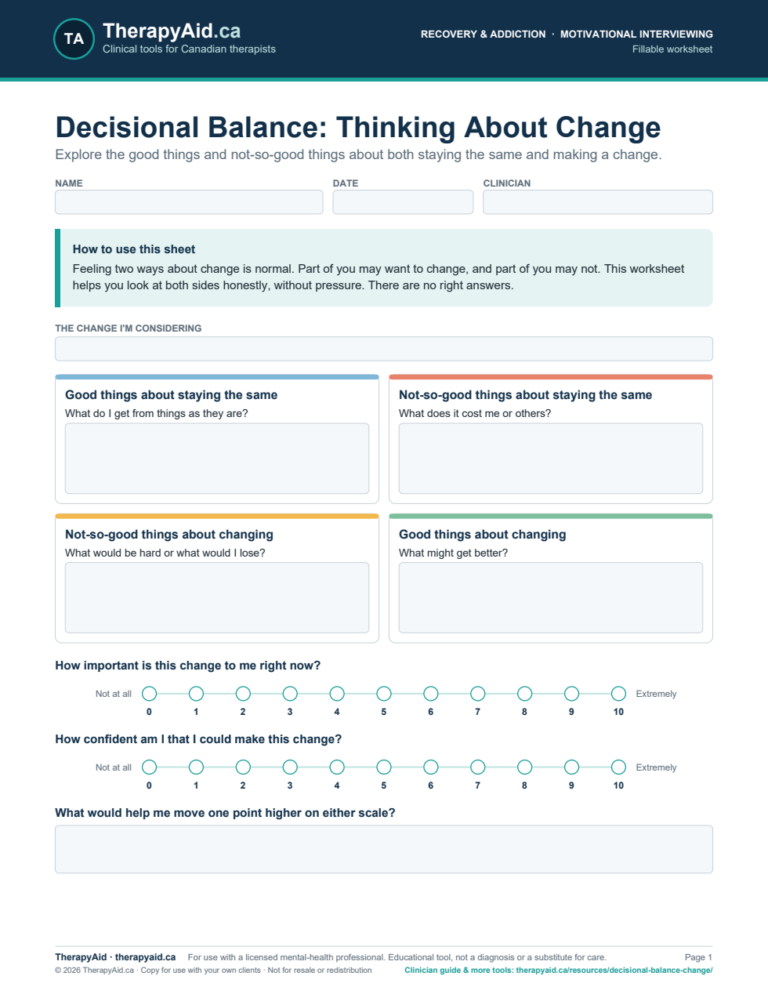
- Use motivational interviewing to strengthen reasons for change.
- Treat lapses as learning opportunities to reduce shame.
- Include positive activities and connection, not only avoidance strategies.
- Involve supports with the client’s consent.
Worked example
Sharing with clients
Members can download the PDF to print or email, or copy a private client link from the download box. Your client opens the link and downloads the worksheet on any device. No client account is needed, and nothing your client writes is stored on TherapyAid.
Frequently asked questions
What is the difference between a lapse and a relapse?
A lapse is a single episode of use. A relapse is a return to the previous pattern of use. A good plan helps stop a lapse from becoming a relapse.
What is urge surfing?
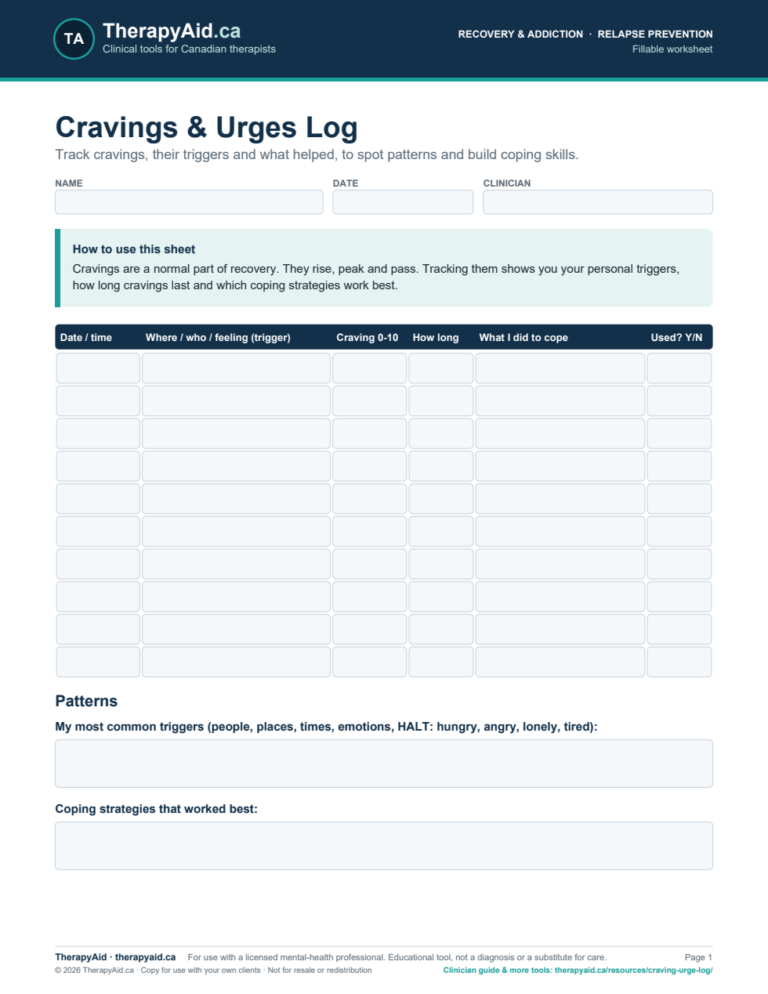
A mindfulness skill where cravings are observed as waves that rise, peak and pass, without acting on them.
References
Marlatt, G. A., & Donovan, D. M. (Eds.). (2005). Relapse prevention: Maintenance strategies in the treatment of addictive behaviors (2nd ed.). Guilford Press.
Witkiewitz, K., & Marlatt, G. A. (2004). Relapse prevention for alcohol and drug problems: That was Zen, this is Tao. American Psychologist, 59(4), 224-235.
Bowen, S., Witkiewitz, K., Clifasefi, S. L., Grow, J., Chawla, N., Hsu, S. H., Carroll, H. A., Harrop, E., Collins, S. E., Lustyk, M. K., & Larimer, M. E. (2014). Relative efficacy of mindfulness-based relapse prevention, standard relapse prevention, and treatment as usual for substance use disorders: A randomized clinical trial. JAMA Psychiatry, 71(5), 547-556.
This worksheet is an educational tool for use by, or under the guidance of, a licensed or registered mental-health professional. It is not a diagnostic instrument or a substitute for clinical judgement. If a client is in crisis in Canada, call or text 9-8-8 or call 9-1-1.