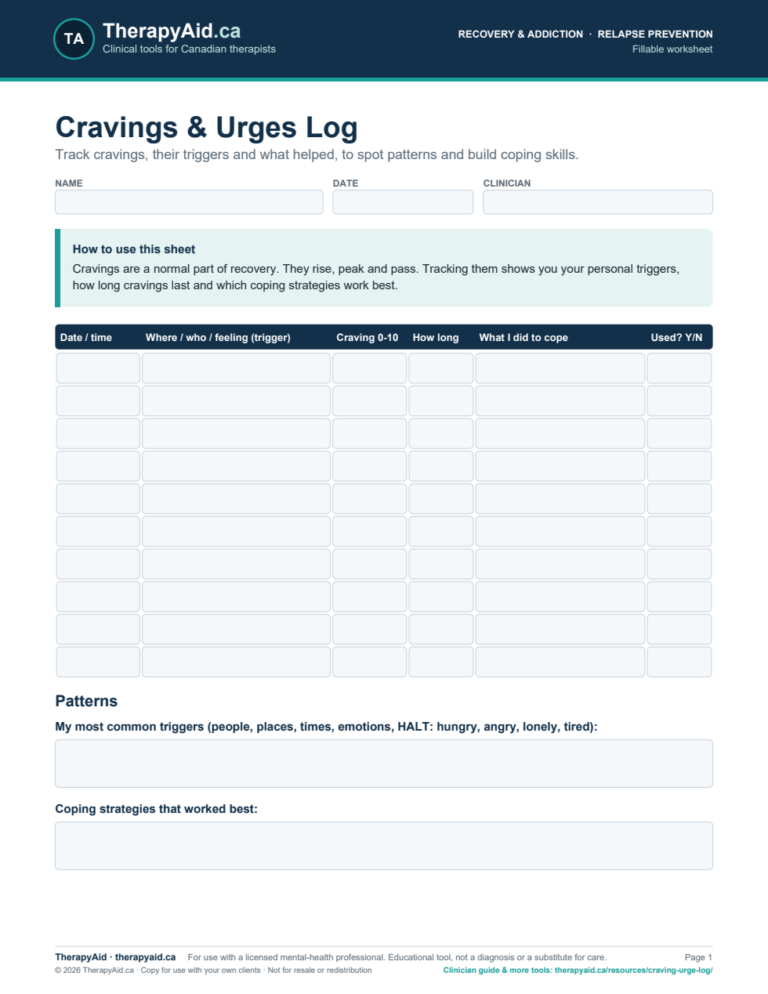
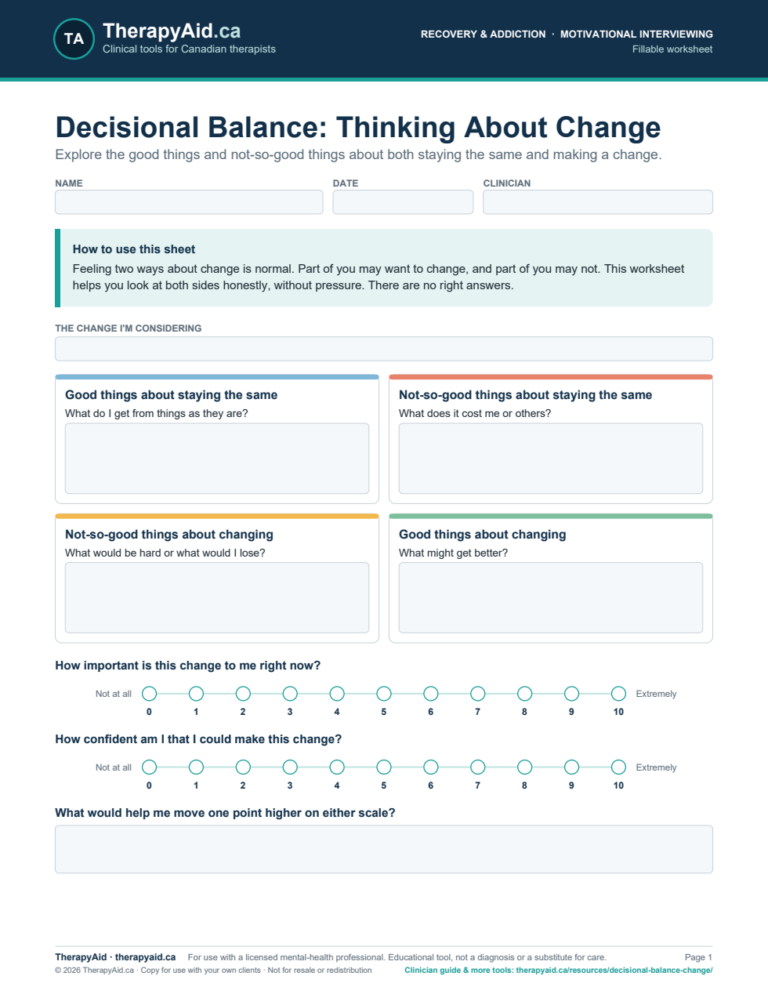
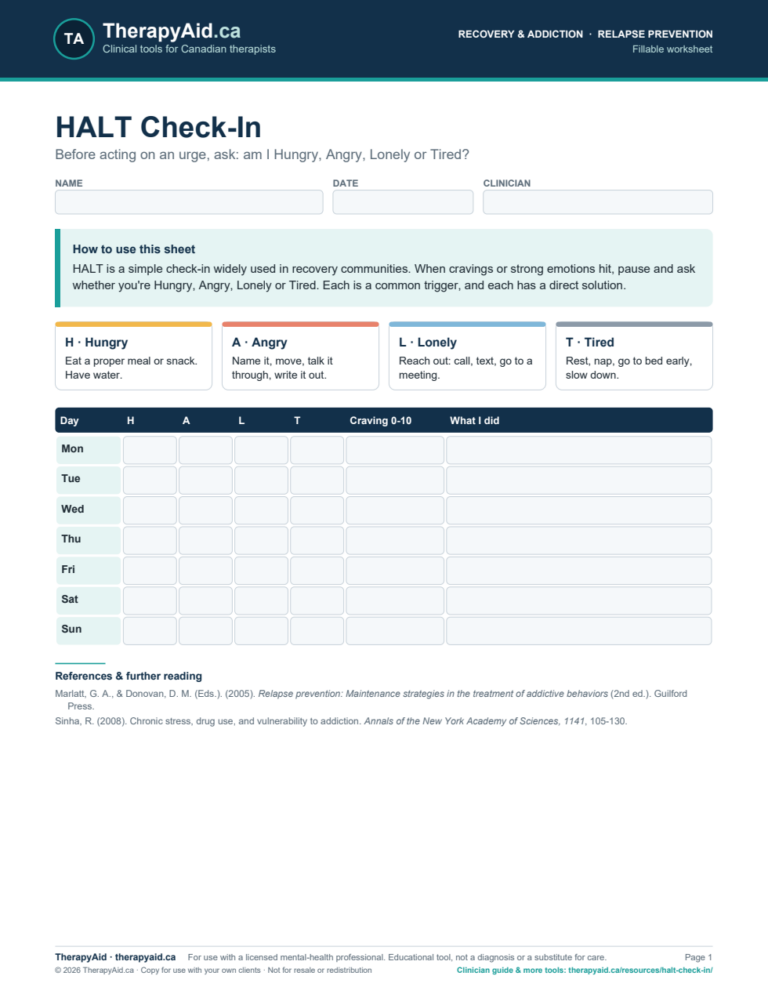
Recovery Values Compass
An ACT-informed recovery worksheet clarifying values across life areas, how use affects them and small values-based steps, with a connection rating.
1-page fillable PDF · US Letter (prints on A4) · ACT for addictions
- Approach / concern
- Recovery & Addiction
- Technique
- ACT for addictions
- Format
- Fillable PDF, 1 page (US Letter / A4)
- Access
- Pro and Advanced plans (3-day free trial)
- For
- Licensed clinicians to use with clients
- Updated
- October 2026
Key facts
What is the Recovery Values Compass?
Values-based approaches in addiction treatment help clients identify meaningful directions that motivate and sustain recovery beyond avoiding use.
Why it works
ACT emphasizes values and committed action to build meaningful lives (Hayes et al., 2012). Exploring values and discrepancy is a key motivational interviewing strategy (Miller & Rollnick, 2013).
When to use it
- Ambivalence about recovery
- Early and long-term recovery
- ACT groups
- Motivational work
How to use it in session
- Explore values by area.
- Note how use interferes.
- Choose steps.
- Rate connection weekly.
- Revisit regularly.
Clinician tips
- Use the client’s own values.
- Highlight discrepancy gently.
- Celebrate value-consistent action.
Worked example
Sharing with clients
Members can download the PDF to print or email, or copy a private client link from the download box. Your client opens the link and downloads the worksheet on any device. No client account is needed, and nothing your client writes is stored on TherapyAid.
Frequently asked questions
Why focus on values in recovery?
Values give direction and motivation beyond just stopping use.
What if I don’t know my values?
Start by noticing what you care about or admire in others.
References
Hayes, S. C., Strosahl, K. D., & Wilson, K. G. (2012). Acceptance and commitment therapy: The process and practice of mindful change (2nd ed.). Guilford Press.
Miller, W. R., & Rollnick, S. (2013). Motivational interviewing: Helping people change (3rd ed.). Guilford Press.
This worksheet is an educational tool for use by, or under the guidance of, a licensed or registered mental-health professional. It is not a diagnostic instrument or a substitute for clinical judgement. If a client is in crisis in Canada, call or text 9-8-8 or call 9-1-1.