Panic Attack Record
A CBT panic diary for recording each attack's triggers, first sensations, catastrophic interpretations, intensity, coping behaviours and actual outcomes, plus common sensation checklist.
2-page fillable PDF · US Letter (prints on A4) · CBT for panic
- Approach / concern
- Anxiety & Panic
- Technique
- CBT for panic
- Format
- Fillable PDF, 2 pages (US Letter / A4)
- Access
- Pro and Advanced plans (3-day free trial)
- For
- Licensed clinicians to use with clients
- Updated
- October 2026
Key facts
What is the Panic Attack Record?
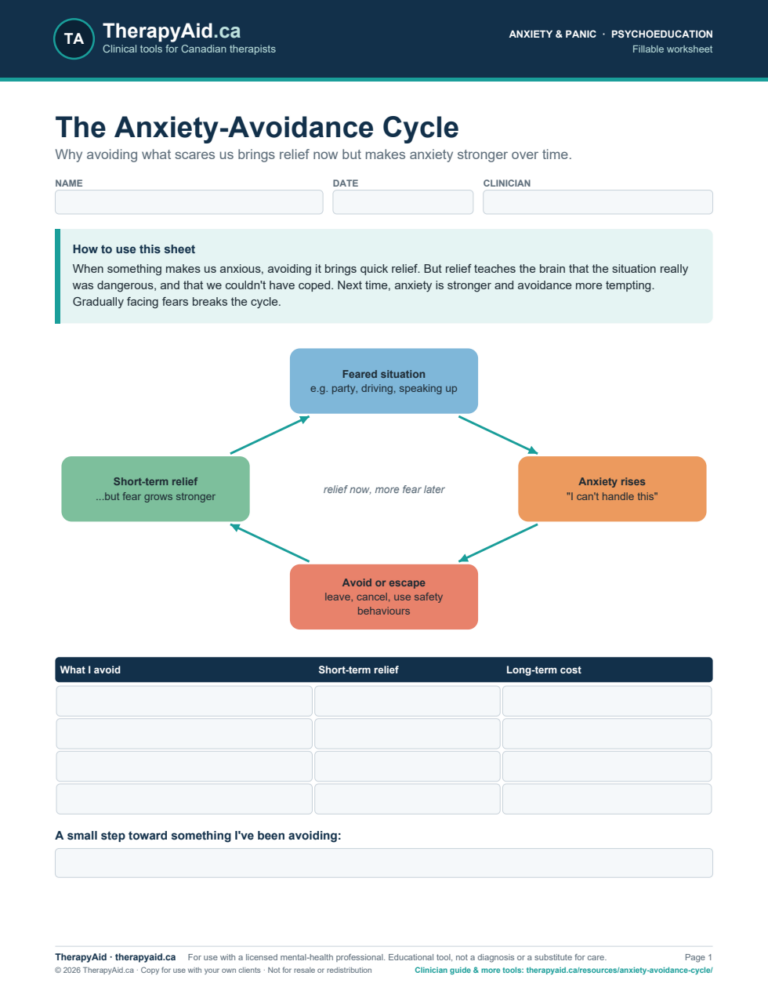
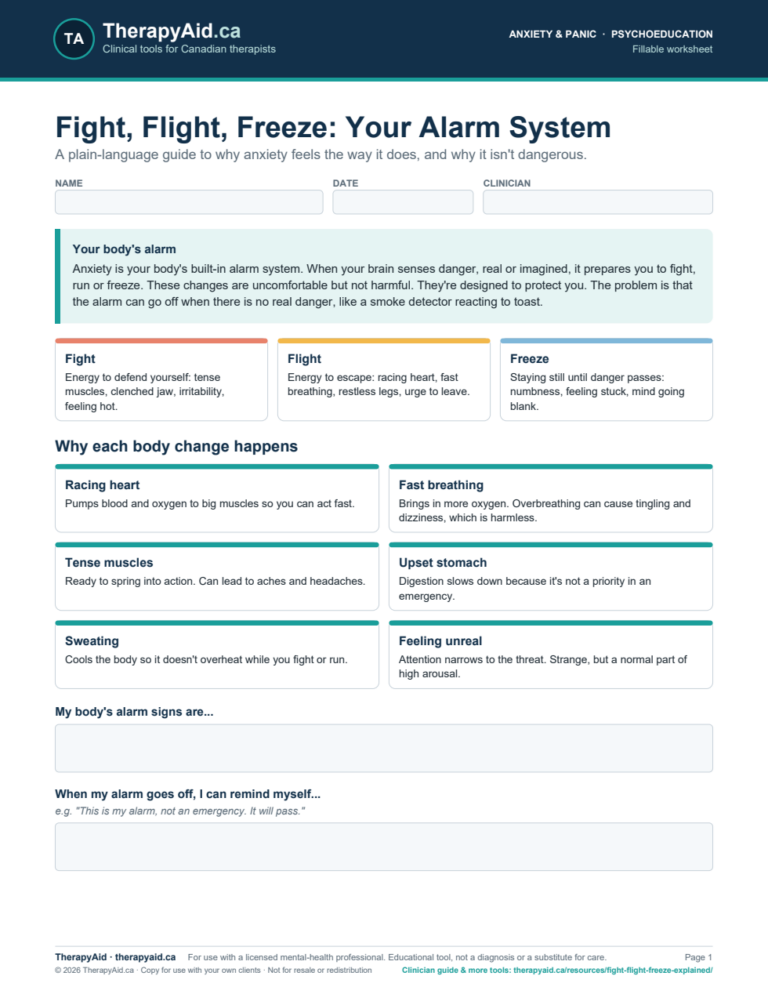
In the cognitive model of panic, attacks result from catastrophic misinterpretation of normal bodily sensations, such as reading a racing heart as a heart attack (Clark, 1986). A panic record captures these sequences so they can be examined and tested in treatment.
Why it works
Self-monitoring of panic attacks is a standard component of CBT for panic disorder, one of the most effective treatments available (Craske & Barlow, 2006). Comparing feared outcomes with what actually happened weakens catastrophic beliefs.
When to use it
- Panic disorder with or without agoraphobia
- Panic attacks in other anxiety disorders
- Health anxiety about physical symptoms
- Before interoceptive exposure
How to use it in session
- Provide psychoeducation on the panic cycle.
- Ask the client to record attacks soon after they happen.
- Look for sensation-thought patterns.
- Identify safety behaviours.
- Use records to plan interoceptive exposure and behavioural experiments.
Clinician tips
- Ensure medical causes have been checked once.
- Note safety behaviours such as sitting down or carrying water.
- Celebrate shorter or less intense attacks.
Worked example
Sharing with clients
Members can download the PDF to print or email, or copy a private client link from the download box. Your client opens the link and downloads the worksheet on any device. No client account is needed, and nothing your client writes is stored on TherapyAid.
Frequently asked questions
Can a panic attack make me faint?
Fainting during panic is very rare because blood pressure usually rises. Most people feel faint without actually fainting.
Why record attacks if it makes me think about them?
Recording gives you and your therapist accurate information and helps you see that attacks always end and feared outcomes don’t happen.
References
Clark, D. M. (1986). A cognitive approach to panic. Behaviour Research and Therapy, 24(4), 461-470.
Craske, M. G., & Barlow, D. H. (2006). Mastery of your anxiety and panic: Therapist guide (4th ed.). Oxford University Press.
This worksheet is an educational tool for use by, or under the guidance of, a licensed or registered mental-health professional. It is not a diagnostic instrument or a substitute for clinical judgement. If a client is in crisis in Canada, call or text 9-8-8 or call 9-1-1.