Daily Mood, Sleep & Routine Chart
A weekly mood chart for bipolar and other mood disorders tracking mood on a -3 to +3 scale, sleep, daily rhythm anchors, anxiety, medication and personal early warning signs.
2-page fillable PDF · US Letter (prints on A4) · Mood charting · IPSRT-informed
- Approach / concern
- Bipolar & Mood
- Technique
- Mood charting · IPSRT-informed
- Format
- Fillable PDF, 2 pages (US Letter / A4)
- Access
- Pro and Advanced plans (3-day free trial)
- For
- Licensed clinicians to use with clients
- Updated
- October 2026
Key facts
What is the Daily Mood, Sleep & Routine Chart?
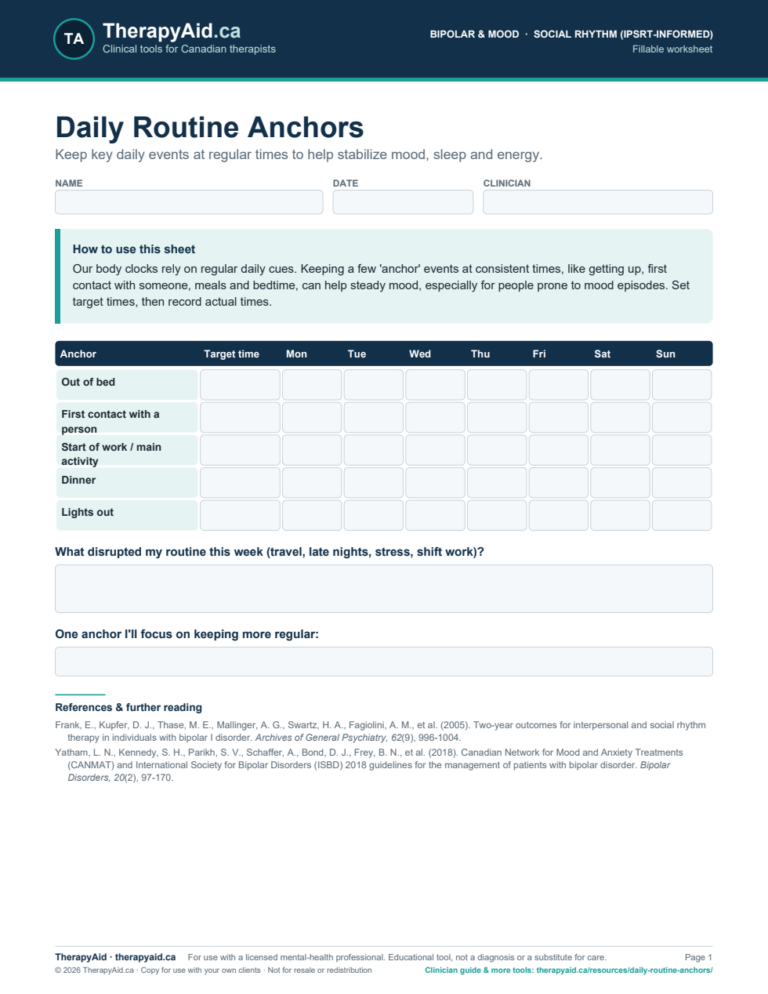
Mood charting is a standard self-monitoring tool in the management of bipolar disorder. This chart combines daily mood ratings with sleep and social-rhythm anchors, such as getting out of bed and first contact with another person, drawing on interpersonal and social rhythm therapy (IPSRT).
Why it works
Disrupted sleep and daily routines can trigger mood episodes, and stabilizing social rhythms is a core goal of IPSRT (Frank, 2005). Canadian guidelines recommend psychoeducation and self-monitoring, including identifying early warning signs, as part of bipolar disorder management (Yatham et al., 2018).
When to use it
- Bipolar I and II disorder
- Cyclothymia and recurrent depression
- Medication changes
- Relapse prevention planning
How to use it in session
- Explain the mood scale and each column.
- Encourage completion at the same time each evening.
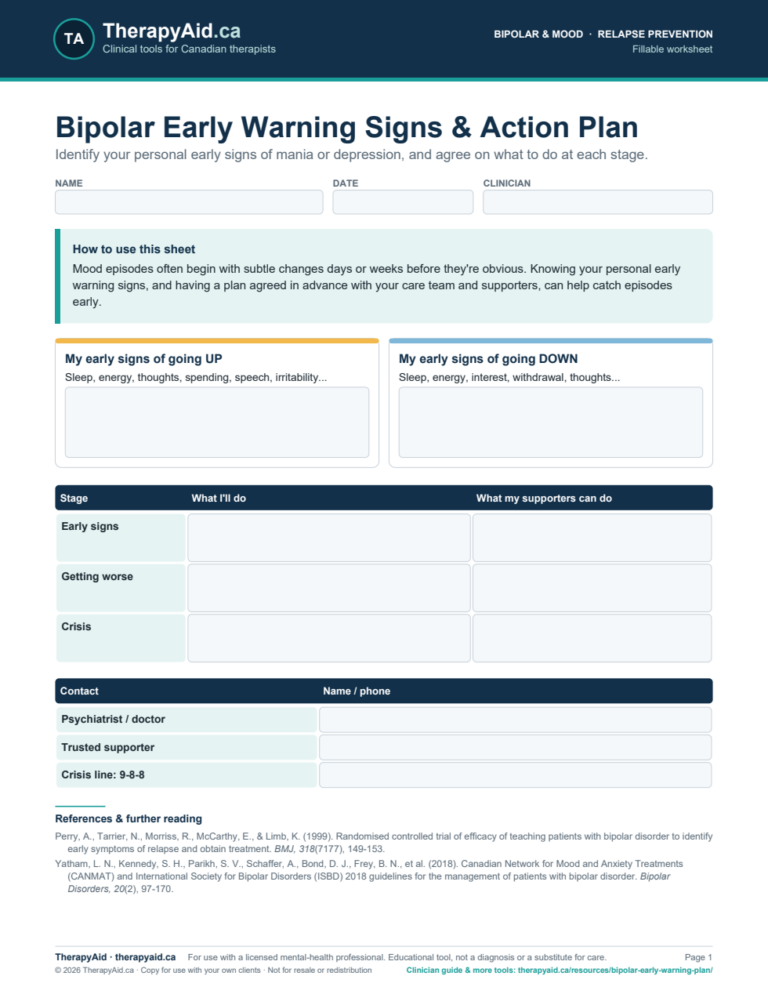
- Identify personal early warning signs together.
- Review charts each session, looking for patterns.
- Share with the prescribing physician with consent.
Clinician tips
- Keep the chart simple to support adherence.
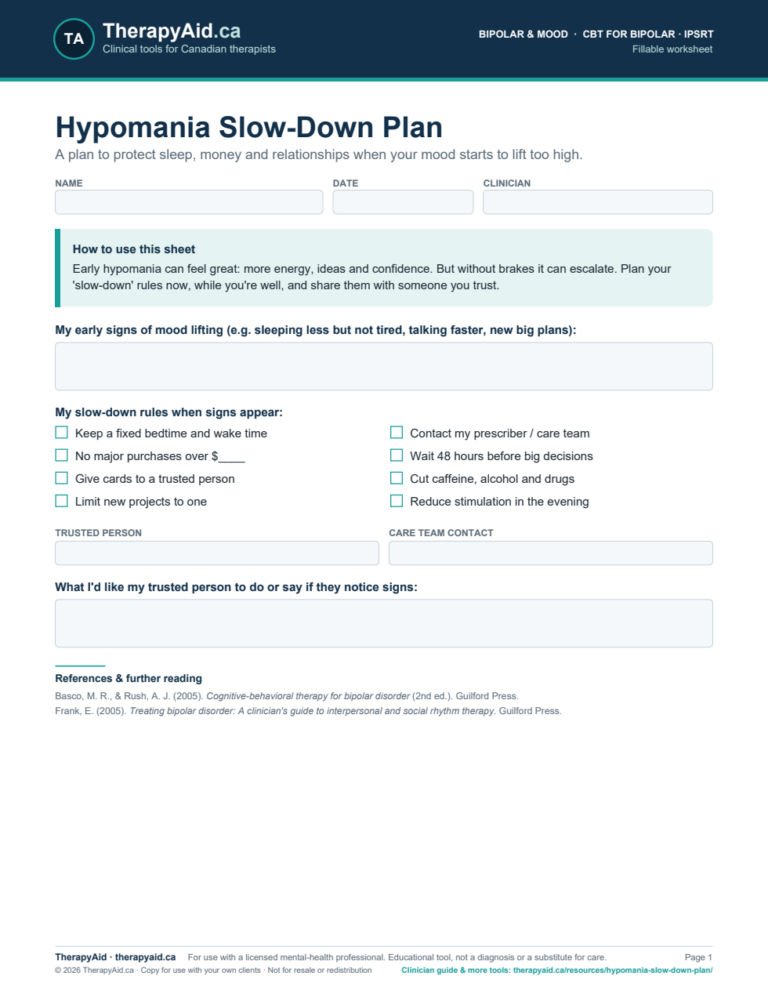
- Pay attention to reduced need for sleep as an early sign of elevation.
- Involve trusted supports in recognizing warning signs.
Worked example
Sharing with clients
Members can download the PDF to print or email, or copy a private client link from the download box. Your client opens the link and downloads the worksheet on any device. No client account is needed, and nothing your client writes is stored on TherapyAid.
Frequently asked questions
How long should someone keep a mood chart?
Ideally ongoing, especially during medication changes or stressful periods. Many people chart for months to learn their patterns.
Can this be used for depression only?
Yes. The elevated side of the scale can simply be left unused.
References
Frank, E. (2005). Treating bipolar disorder: A clinician’s guide to interpersonal and social rhythm therapy. Guilford Press.
Yatham, L. N., Kennedy, S. H., Parikh, S. V., Schaffer, A., Bond, D. J., Frey, B. N., et al. (2018). Canadian Network for Mood and Anxiety Treatments (CANMAT) and International Society for Bipolar Disorders (ISBD) 2018 guidelines for the management of patients with bipolar disorder. Bipolar Disorders, 20(2), 97-170.
This worksheet is an educational tool for use by, or under the guidance of, a licensed or registered mental-health professional. It is not a diagnostic instrument or a substitute for clinical judgement. If a client is in crisis in Canada, call or text 9-8-8 or call 9-1-1.