Life Transition Map
A transition counselling worksheet that maps the endings, uncertain middle and new beginnings of a major life change, and assesses resources using the situation, self, supports and strategies framework.
1-page fillable PDF · US Letter (prints on A4) · Transition counselling
- Approach / concern
- Life Transitions
- Technique
- Transition counselling
- Format
- Fillable PDF, 1 page (US Letter / A4)
- Access
- Pro and Advanced plans (3-day free trial)
- For
- Licensed clinicians to use with clients
- Updated
- October 2026
Key facts
What is the Life Transition Map?
Transitions are the internal process of adapting to external change. William Bridges described three phases: endings, a ‘neutral zone’ and new beginnings. Nancy Schlossberg’s model highlights four factors that shape how people cope: situation, self, support and strategies. This worksheet combines both frameworks.
Why it works
Understanding transitions as a process normalizes grief and uncertainty during change and helps clients identify resources and gaps (Bridges, 2004; Schlossberg, 1981). It is useful across many kinds of change, both chosen and unchosen.
When to use it
- Divorce and separation
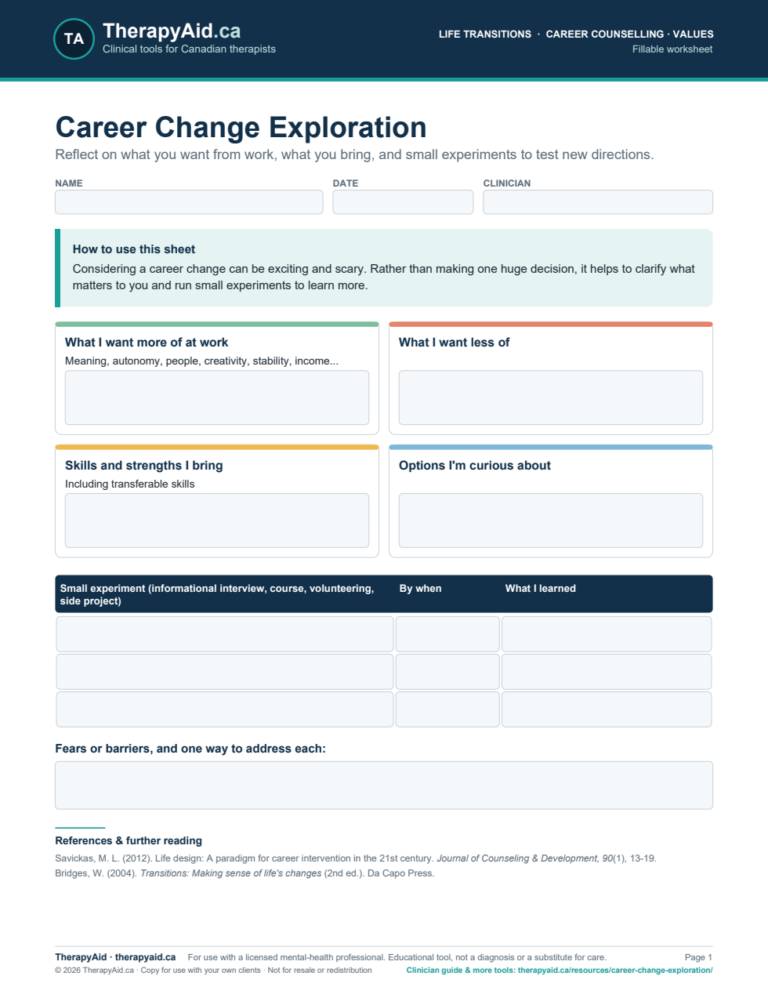
- Retirement or career change
- Relocation and immigration
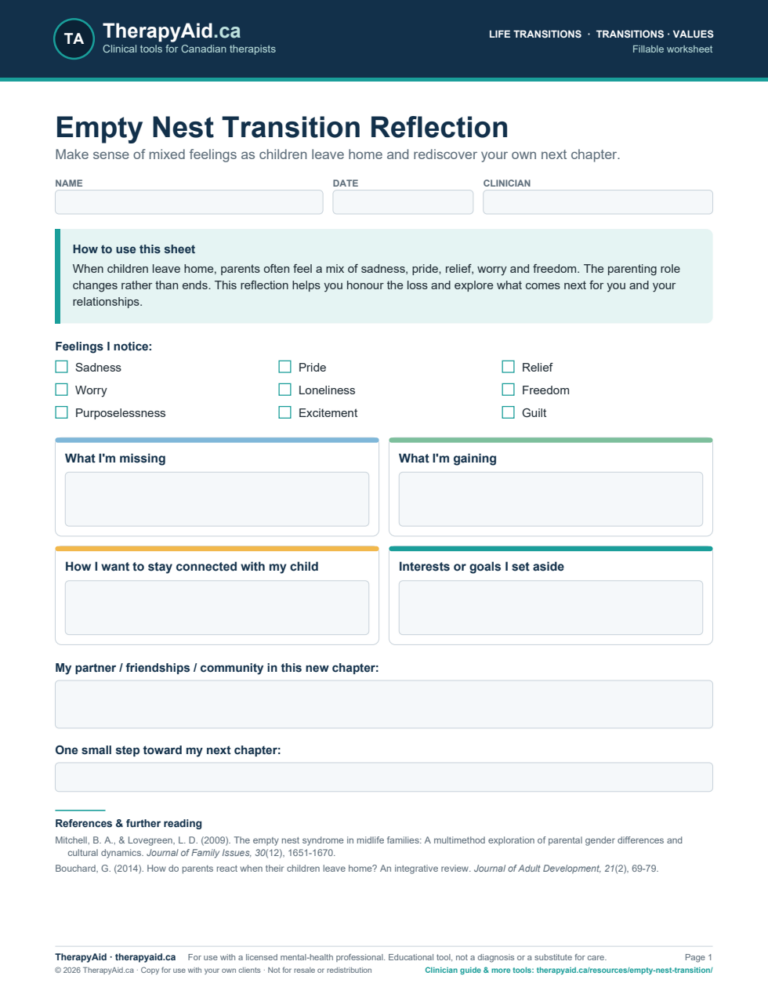
- Becoming a parent, empty nest, or midlife reappraisal
How to use it in session
- Name the transition and its timeline.
- Explore endings, in-between and beginnings in any order.
- Assess the four S’s together.
- Identify one supportive step.
- Revisit the map as the client moves through the change.
Clinician tips
- Even positive changes involve endings that may need grieving.
- Normalize the discomfort of the in-between.
- Pair with values work to guide new beginnings.
Worked example
Sharing with clients
Members can download the PDF to print or email, or copy a private client link from the download box. Your client opens the link and downloads the worksheet on any device. No client account is needed, and nothing your client writes is stored on TherapyAid.
Frequently asked questions
How long do transitions take?
It varies widely, from months to years. The in-between phase often takes longer than people expect.
Can this help with immigration stress?
Yes. The framework fits migration well and can be combined with exploration of cultural identity and belonging.
References
Bridges, W. (2004). Transitions: Making sense of life’s changes (2nd ed.). Da Capo Press.
Schlossberg, N. K. (1981). A model for analyzing human adaptation to transition. The Counseling Psychologist, 9(2), 2-18.
This worksheet is an educational tool for use by, or under the guidance of, a licensed or registered mental-health professional. It is not a diagnostic instrument or a substitute for clinical judgement. If a client is in crisis in Canada, call or text 9-8-8 or call 9-1-1.