Getting Through Holidays and Special Days While Grieving
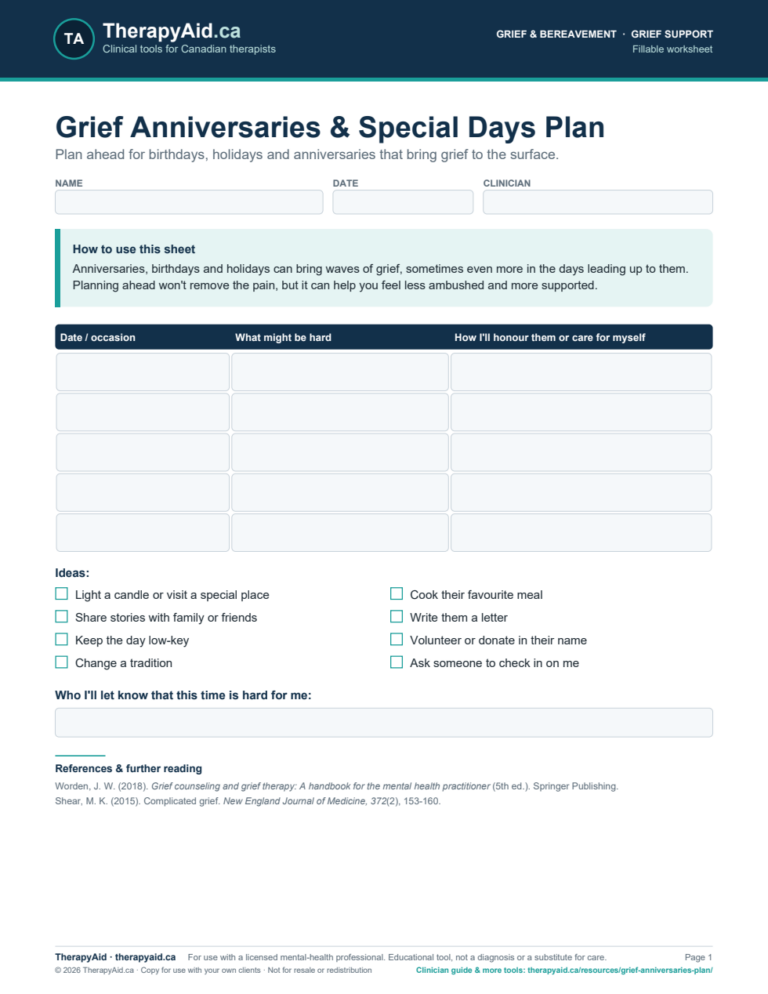
A grief coping plan for holidays and special days covering traditions to keep or change, ways to remember the person and support and exit plans.
1-page fillable PDF · US Letter (prints on A4) · Coping planning
- Approach / concern
- Grief & Bereavement
- Technique
- Coping planning
- Format
- Fillable PDF, 1 page (US Letter / A4)
- Access
- Pro and Advanced plans (3-day free trial)
- For
- Licensed clinicians to use with clients
- Updated
- October 2026
Key facts
What is the Getting Through Holidays and Special Days While Grieving?
Holidays and anniversaries often intensify grief. Planning helps bereaved people balance remembrance, rest and connection.
Why it works
Worden (2018) discusses anniversary and holiday reactions in grief. Shear (2015) notes reminders can trigger intense grief.
When to use it
- First holidays after a death
- Anniversaries and birthdays
- Families grieving together
- Grief groups
How to use it in session
- Choose the occasion.
- Decide what to keep or change.
- Plan remembrance.
- Arrange support.
- Debrief afterwards.
Clinician tips
- There’s no wrong choice.
- Involve family where helpful.
- Allow mixed feelings.
Worked example
Sharing with clients
Members can download the PDF to print or email, or copy a private client link from the download box. Your client opens the link and downloads the worksheet on any device. No client account is needed, and nothing your client writes is stored on TherapyAid.
Frequently asked questions
Should I celebrate holidays while grieving?
Do what feels right; many people choose a mix of tradition and change.
Is it okay to feel happy on the day?
Yes. Joy and grief can coexist.
References
Worden, J. W. (2018). Grief counseling and grief therapy: A handbook for the mental health practitioner (5th ed.). Springer.
Shear, M. K. (2015). Complicated grief. New England Journal of Medicine, 372(2), 153-160.
This worksheet is an educational tool for use by, or under the guidance of, a licensed or registered mental-health professional. It is not a diagnostic instrument or a substitute for clinical judgement. If a client is in crisis in Canada, call or text 9-8-8 or call 9-1-1.