Gambling Urge and Spending Log
A CBT gambling log tracking triggers, urge strength, gambling and amounts, gambling-related thoughts and coping, with protective steps.
1-page fillable PDF · US Letter (prints on A4) · CBT for gambling
- Approach / concern
- Recovery & Addiction
- Technique
- CBT for gambling
- Format
- Fillable PDF, 1 page (US Letter / A4)
- Access
- Pro and Advanced plans (3-day free trial)
- For
- Licensed clinicians to use with clients
- Updated
- October 2026
Key facts
What is the Gambling Urge and Spending Log?
CBT for gambling targets triggers, cognitive distortions such as the gambler’s fallacy and access to money and venues.
Why it works
Petry (2005) describes CBT approaches to pathological gambling, including cognitive distortions and stimulus control. Relapse prevention strategies apply to behavioural addictions (Marlatt & Donovan, 2005).
When to use it
- Problem gambling
- Online and sports betting
- Financial crises
- Co-occurring substance use
How to use it in session
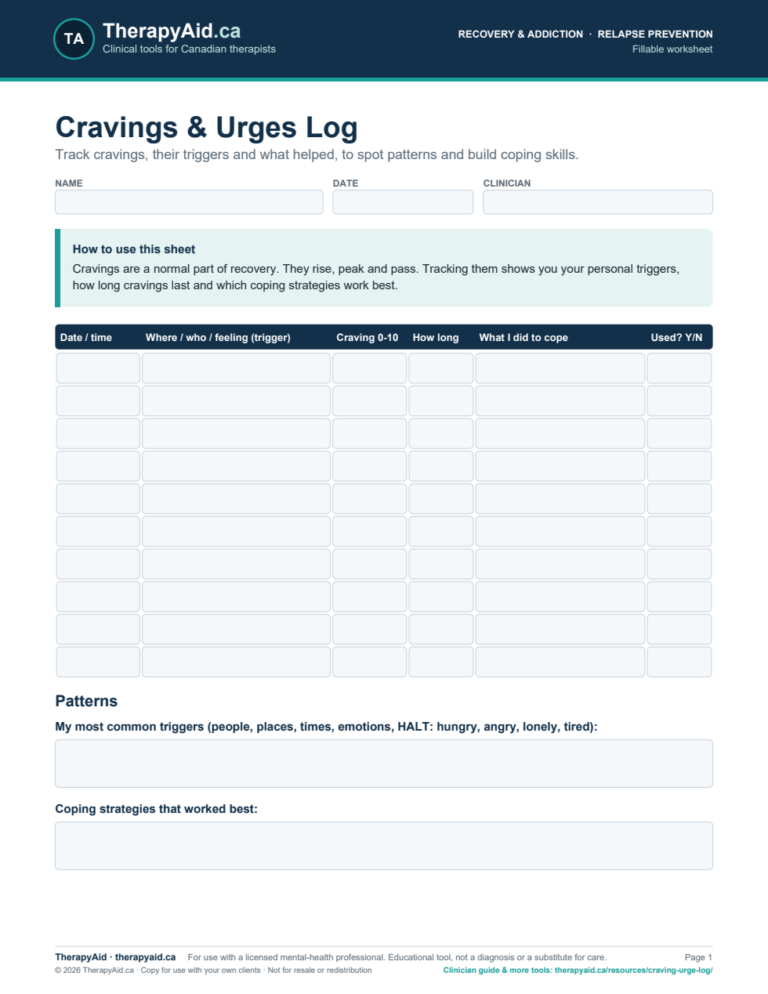
- Log urges daily.
- Note thoughts.
- Track spending.
- Choose protective steps.
- Review weekly.
Clinician tips
- Address gambling-related distortions.
- Screen for suicide risk with financial crisis.
- Know provincial self-exclusion programs.
Worked example
Sharing with clients
Members can download the PDF to print or email, or copy a private client link from the download box. Your client opens the link and downloads the worksheet on any device. No client account is needed, and nothing your client writes is stored on TherapyAid.
Frequently asked questions
Why do I keep thinking I’m due a win?
Each bet is independent; the ‘due a win’ thought is a common gambling distortion.
Can I self-exclude in Canada?
Yes. Provinces offer voluntary self-exclusion programs for casinos and online gambling.
References
Petry, N. M. (2005). Pathological gambling: Etiology, comorbidity, and treatment. American Psychological Association.
Marlatt, G. A., & Donovan, D. M. (Eds.). (2005). Relapse prevention: Maintenance strategies in the treatment of addictive behaviors (2nd ed.). Guilford Press.
This worksheet is an educational tool for use by, or under the guidance of, a licensed or registered mental-health professional. It is not a diagnostic instrument or a substitute for clinical judgement. If a client is in crisis in Canada, call or text 9-8-8 or call 9-1-1.