Family Routines and Expectations
A family worksheet setting step-by-step routines for morning, after school, dinner and bedtime, with helpers, praise and shared expectations.
1-page fillable PDF · US Letter (prints on A4) · Behavioural parenting
- Approach / concern
- Family Therapy
- Technique
- Behavioural parenting
- Format
- Fillable PDF, 1 page (US Letter / A4)
- Access
- Pro and Advanced plans (3-day free trial)
- For
- Licensed clinicians to use with clients
- Updated
- October 2026
Key facts
What is the Family Routines and Expectations?
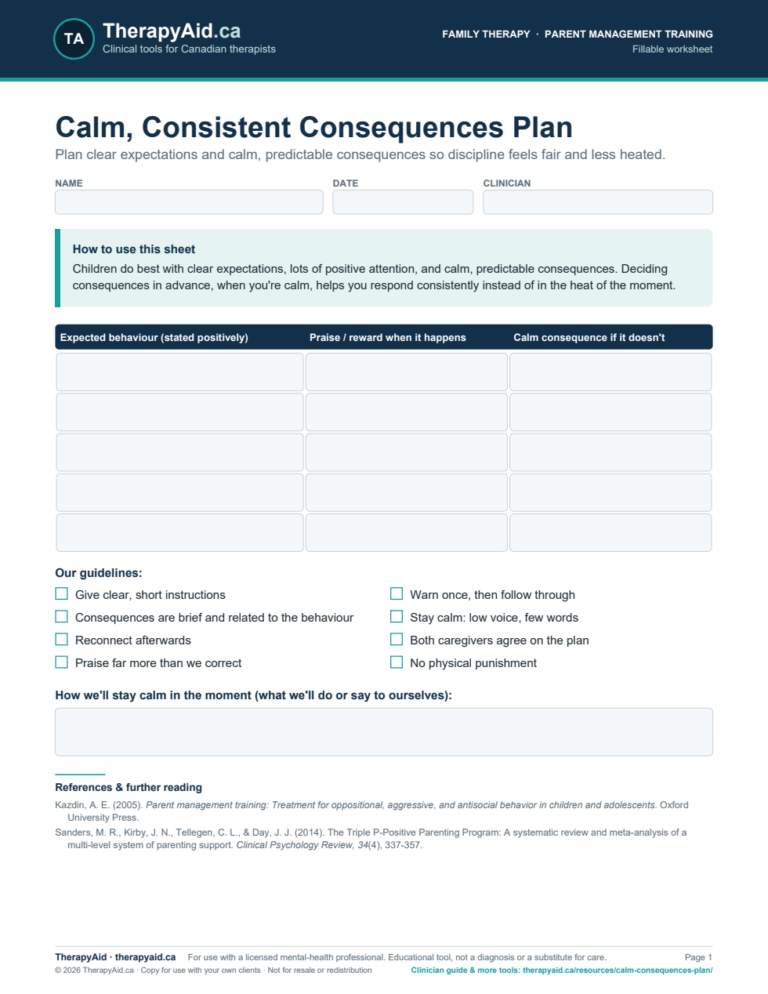
Consistent routines and clear expectations are core components of behavioural parenting, reducing conflict and supporting children’s self-regulation.
Why it works
Parent management training uses clear expectations and positive reinforcement (Kazdin, 2005). Triple P promotes predictable routines and positive parenting (Sanders et al., 2014).
When to use it
- Chaotic mornings or bedtimes
- ADHD and young children
- Blended families
- Family therapy
How to use it in session
- Agree routines together.
- List steps.
- Assign helpers.
- Add praise.
- Post visibly and review.
Clinician tips
- Keep steps few and clear.
- Use pictures for young children.
- Praise more than correct.
Worked example
Sharing with clients
Members can download the PDF to print or email, or copy a private client link from the download box. Your client opens the link and downloads the worksheet on any device. No client account is needed, and nothing your client writes is stored on TherapyAid.
Frequently asked questions
Why do routines help children?
Predictability reduces anxiety and arguments and builds independence.
How many expectations should we have?
A few clear ones work better than many rules.
References
Kazdin, A. E. (2005). Parent management training: Treatment for oppositional, aggressive, and antisocial behavior in children and adolescents. Oxford University Press.
Sanders, M. R., Kirby, J. N., Tellegen, C. L., & Day, J. J. (2014). The Triple P-Positive Parenting Program: A systematic review and meta-analysis of a multi-level system of parenting support. Clinical Psychology Review, 34(4), 337-357.
This worksheet is an educational tool for use by, or under the guidance of, a licensed or registered mental-health professional. It is not a diagnostic instrument or a substitute for clinical judgement. If a client is in crisis in Canada, call or text 9-8-8 or call 9-1-1.