When Desire Levels Differ
A couples worksheet exploring each partner's experience of desire, common feelings on both sides of a discrepancy and mutually acceptable forms of intimacy.
1-page fillable PDF · US Letter (prints on A4) · Couples sex therapy
- Approach / concern
- Sex Therapy
- Technique
- Couples sex therapy
- Format
- Fillable PDF, 1 page (US Letter / A4)
- Access
- Advanced plan
- For
- Licensed clinicians to use with clients
- Updated
- October 2026
Key facts
What is the When Desire Levels Differ?
Desire discrepancy is one of the most common sexual concerns in couples. Context, stress, responsive desire and relational dynamics influence desire, and pressure tends to reduce it.
Why it works
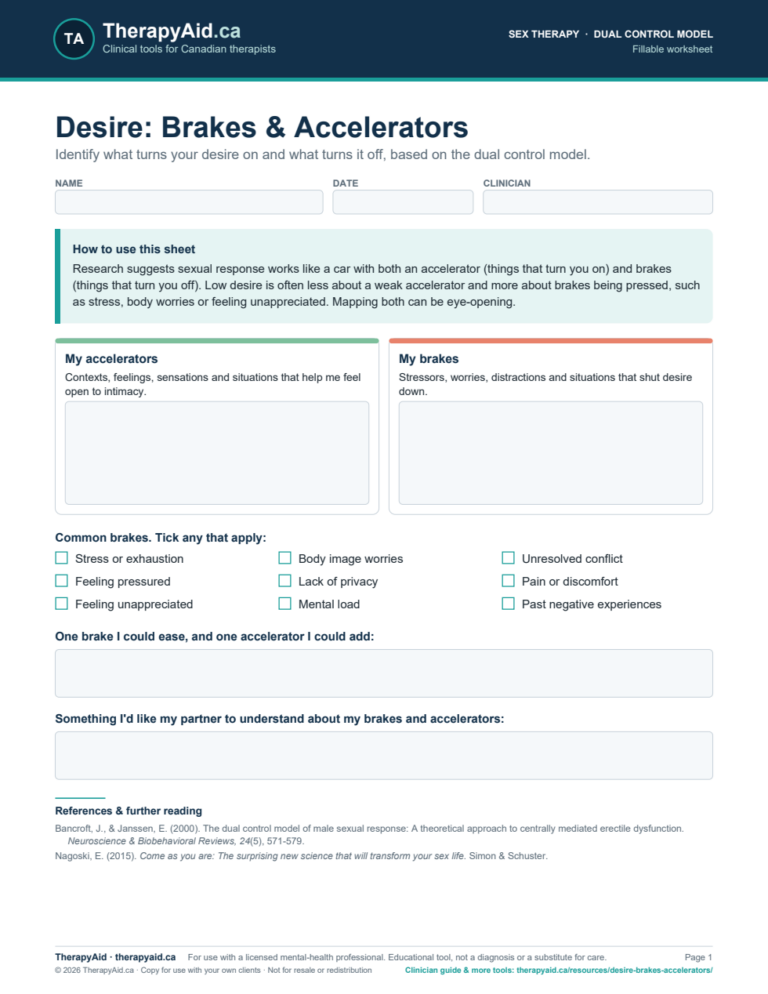
Nagoski (2021) describes contextual and responsive desire and the role of brakes and accelerators. Approach-oriented sexual motivation is associated with greater desire and satisfaction (Muise et al., 2013).
When to use it
- Mismatched desire
- Pursue-withdraw around sex
- Long-term relationships
- After children or illness
How to use it in session
- Each partner describes their desire.
- Share without blame.
- Name feelings on both sides.
- Brainstorm options.
- Review regularly.
Clinician tips
- Normalize discrepancy.
- Remove pressure.
- Sexual concerns can have medical causes; consider a medical check-up alongside therapy.
Worked example
Sharing with clients
Members can download the PDF to print or email, or copy a private client link from the download box. Your client opens the link and downloads the worksheet on any device. No client account is needed, and nothing your client writes is stored on TherapyAid.
Frequently asked questions
Is one of us broken?
No. Desire differences are common and usually about context, not a defect.
Can desire increase?
Often, when pressure decreases and helpful contexts increase.
References
Nagoski, E. (2021). Come as you are: The surprising new science that will transform your sex life (Rev. ed.). Simon & Schuster.
Muise, A., Impett, E. A., & Desmarais, S. (2013). Getting it on versus getting it over with: Sexual motivation, desire, and satisfaction in intimate bonds. Personality and Social Psychology Bulletin, 39(10), 1320-1332.
This worksheet is an educational tool for use by, or under the guidance of, a licensed or registered mental-health professional. It is not a diagnostic instrument or a substitute for clinical judgement. If a client is in crisis in Canada, call or text 9-8-8 or call 9-1-1.