Pause and Breathe Through a Craving
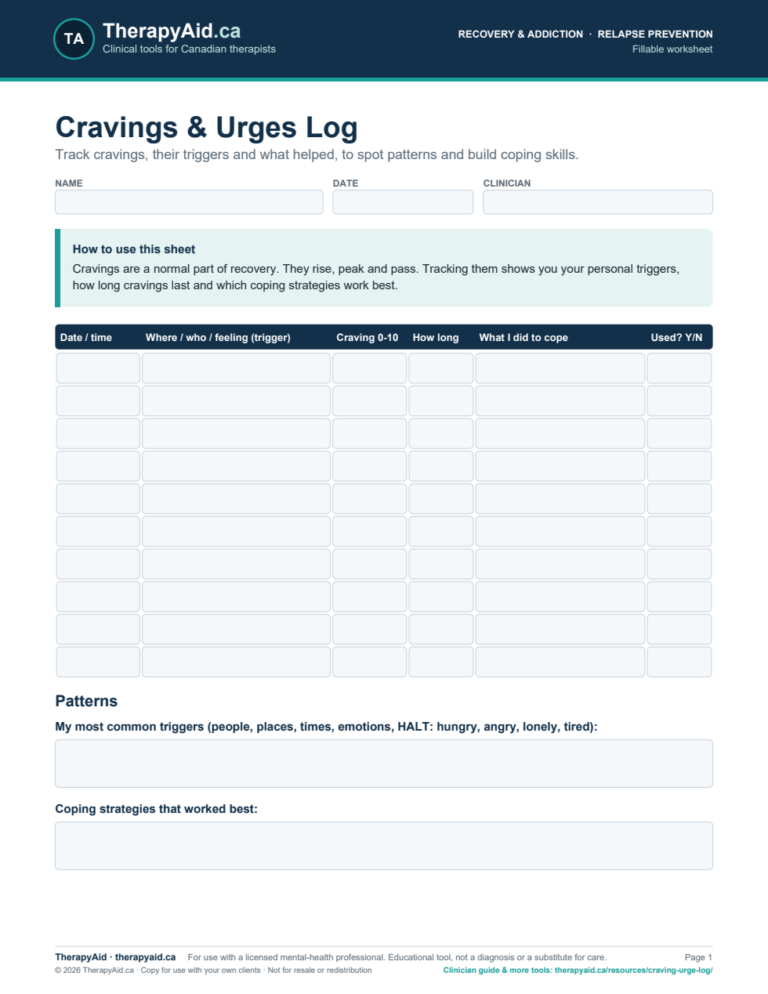
A mindfulness-based relapse prevention practice for cravings (stop, notice, breathe, choose) with a log of cravings before and after and choices made.
1-page fillable PDF · US Letter (prints on A4) · Mindfulness-based relapse prevention
- Approach / concern
- Recovery & Addiction
- Technique
- Mindfulness-based relapse prevention
- Format
- Fillable PDF, 1 page (US Letter / A4)
- Access
- Pro and Advanced plans (3-day free trial)
- For
- Licensed clinicians to use with clients
- Updated
- October 2026
Key facts
What is the Pause and Breathe Through a Craving?
Mindfulness-based relapse prevention teaches people to observe cravings non-judgementally, reducing automatic reactivity and the likelihood of use.
Why it works
A randomized trial found mindfulness-based relapse prevention reduced substance use and heavy drinking over longer follow-up (Bowen et al., 2014). Mindfulness approaches complement cognitive-behavioural relapse prevention (Witkiewitz & Marlatt, 2004).
When to use it
- Cravings in early recovery
- Behavioural addictions
- MBRP groups
- Between-session practice
How to use it in session
- Teach the four steps.
- Practise in session.
- Use during cravings.
- Log outcomes.
- Review patterns.
Clinician tips
- Practise first when calm.
- Combine with other coping.
- Celebrate each ride-out.
Worked example
Sharing with clients
Members can download the PDF to print or email, or copy a private client link from the download box. Your client opens the link and downloads the worksheet on any device. No client account is needed, and nothing your client writes is stored on TherapyAid.
Frequently asked questions
Does noticing the craving make it worse?
It may feel stronger briefly, but most cravings pass within minutes when you don’t act on them.
Is this like urge surfing?
Yes, it’s closely related.
References
Bowen, S., Witkiewitz, K., Clifasefi, S. L., Grow, J., Chawla, N., Hsu, S. H., et al. (2014). Relative efficacy of mindfulness-based relapse prevention, standard relapse prevention, and treatment as usual for substance use disorders: A randomized clinical trial. JAMA Psychiatry, 71(5), 547-556.
Witkiewitz, K., & Marlatt, G. A. (2004). Relapse prevention for alcohol and drug problems: That was Zen, this is Tao. American Psychologist, 59(4), 224-235.
This worksheet is an educational tool for use by, or under the guidance of, a licensed or registered mental-health professional. It is not a diagnostic instrument or a substitute for clinical judgement. If a client is in crisis in Canada, call or text 9-8-8 or call 9-1-1.