Mood Life Chart
A life chart worksheet mapping past mood episodes by date, type and severity, with life events, triggers and treatment changes, and noted patterns.
1-page fillable PDF · US Letter (prints on A4) · Psychoeducation · Life charting
- Approach / concern
- Bipolar & Mood
- Technique
- Psychoeducation · Life charting
- Format
- Fillable PDF, 1 page (US Letter / A4)
- Access
- Pro and Advanced plans (3-day free trial)
- For
- Licensed clinicians to use with clients
- Updated
- October 2026
Key facts
What is the Mood Life Chart?
The life chart method graphically represents the course of mood disorders, helping identify patterns, triggers and treatment effects.
Why it works
Post et al. (1988) introduced graphic life charting for affective illness. Psychoeducation includes identifying personal triggers and patterns (Colom & Vieta, 2006).
When to use it
- Bipolar disorder
- Recurrent depression
- Treatment planning
- Family psychoeducation
How to use it in session
- Recall episodes.
- Add life events.
- Note treatments.
- Look for patterns.
- Use for prevention planning.
Clinician tips
- Involve family memories with consent.
- Approximate dates are fine.
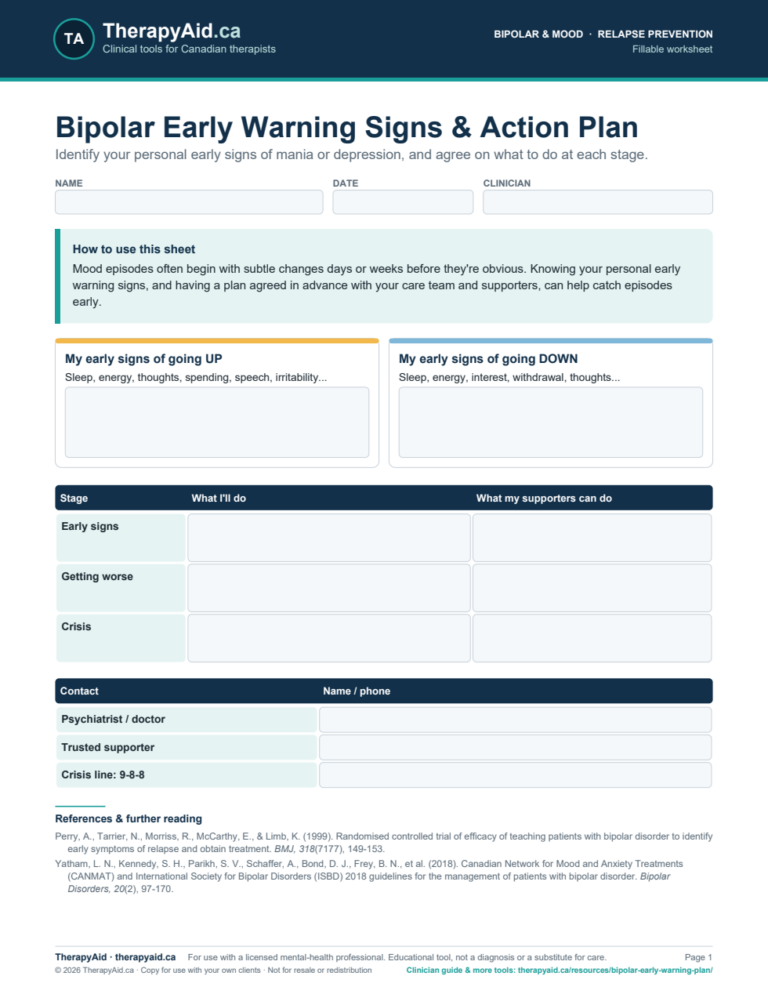
- Link to early warning plan.
Worked example
Sharing with clients
Members can download the PDF to print or email, or copy a private client link from the download box. Your client opens the link and downloads the worksheet on any device. No client account is needed, and nothing your client writes is stored on TherapyAid.
Frequently asked questions
What is a life chart?
A timeline of mood episodes alongside life events and treatment.
What if I can’t remember dates exactly?
Approximate dates and seasons are still useful.
References
Post, R. M., Roy-Byrne, P. P., & Uhde, T. W. (1988). Graphic representation of the life course of illness in patients with affective disorder. American Journal of Psychiatry, 145(7), 844-848.
Colom, F., & Vieta, E. (2006). Psychoeducation manual for bipolar disorder. Cambridge University Press.
This worksheet is an educational tool for use by, or under the guidance of, a licensed or registered mental-health professional. It is not a diagnostic instrument or a substitute for clinical judgement. If a client is in crisis in Canada, call or text 9-8-8 or call 9-1-1.