Gaming, Scrolling and Other Behaviours: Balance Check
A behavioural addiction check-in for gaming, shopping, social media or porn, rating signs of loss of control and weighing benefits, costs and changes.
1-page fillable PDF · US Letter (prints on A4) · Behavioural addictions · Motivational
- Approach / concern
- Recovery & Addiction
- Technique
- Behavioural addictions · Motivational
- Format
- Fillable PDF, 1 page (US Letter / A4)
- Access
- Pro and Advanced plans (3-day free trial)
- For
- Licensed clinicians to use with clients
- Updated
- October 2026
Key facts
What is the Gaming, Scrolling and Other Behaviours: Balance Check?
Behavioural addictions share features with substance use disorders, including loss of control, preoccupation and continued engagement despite harm. Gaming disorder is recognized in ICD-11.
Why it works
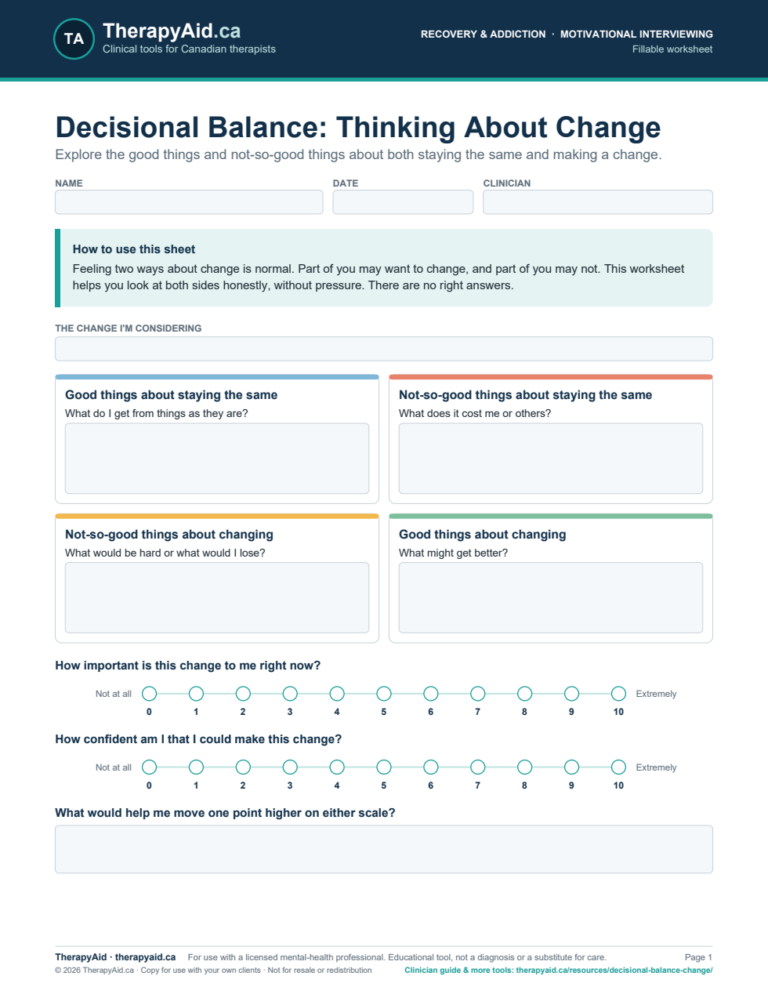
Relapse prevention principles apply to behavioural addictions (Marlatt & Donovan, 2005). Motivational interviewing supports exploring ambivalence (Miller & Rollnick, 2013).
When to use it
- Problematic gaming, shopping, porn or social media
- Teens and young adults
- Couples conflict over behaviours
- Self-referral
How to use it in session
- Name the behaviour.
- Check signs.
- Weigh benefits and costs.
- Choose a change.
- Review.
Clinician tips
- Avoid moral judgement, especially with porn.
- Explore underlying needs.
- Use blocking tools where helpful.
Worked example
Sharing with clients
Members can download the PDF to print or email, or copy a private client link from the download box. Your client opens the link and downloads the worksheet on any device. No client account is needed, and nothing your client writes is stored on TherapyAid.
Frequently asked questions
Is gaming addiction real?
Gaming disorder is recognized by the WHO in ICD-11, though most gamers don’t develop it.
How do I know if it’s a problem?
Look for loss of control and harm to other areas of life.
References
Marlatt, G. A., & Donovan, D. M. (Eds.). (2005). Relapse prevention: Maintenance strategies in the treatment of addictive behaviors (2nd ed.). Guilford Press.
Miller, W. R., & Rollnick, S. (2013). Motivational interviewing: Helping people change (3rd ed.). Guilford Press.
This worksheet is an educational tool for use by, or under the guidance of, a licensed or registered mental-health professional. It is not a diagnostic instrument or a substitute for clinical judgement. If a client is in crisis in Canada, call or text 9-8-8 or call 9-1-1.