My ADHD Strengths
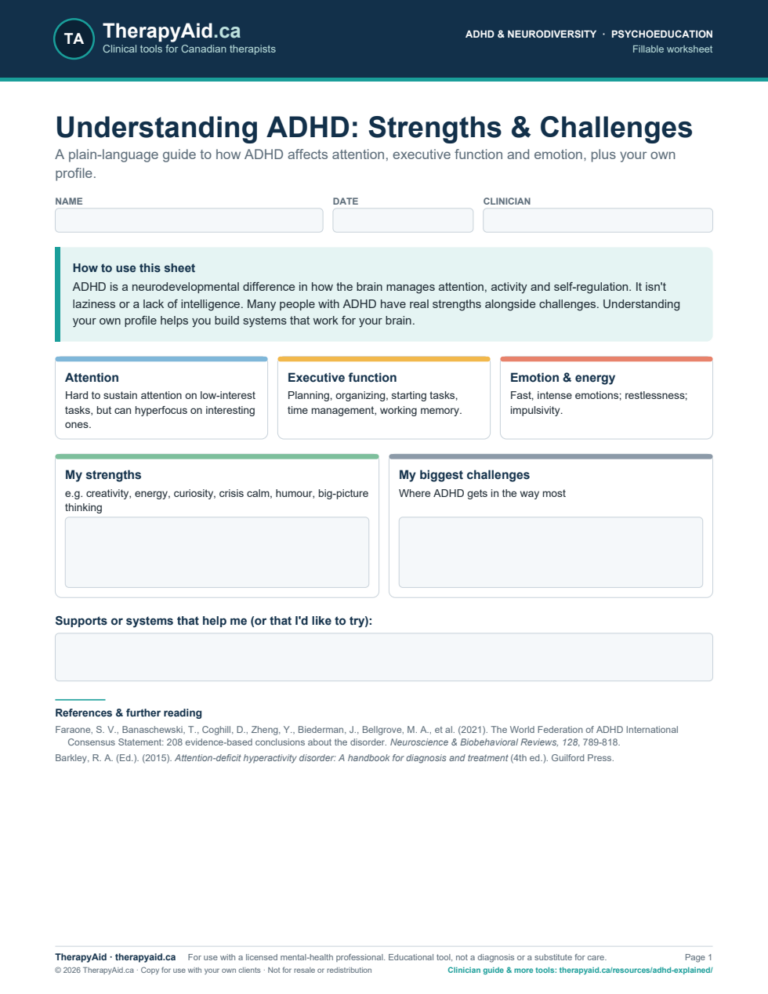
A strengths-based ADHD worksheet identifying common ADHD-associated strengths, examples of when they helped and where to use them more.
1-page fillable PDF · US Letter (prints on A4) · Strengths-based
- Approach / concern
- ADHD & Neurodiversity
- Technique
- Strengths-based
- Format
- Fillable PDF, 1 page (US Letter / A4)
- Access
- Pro and Advanced plans (3-day free trial)
- For
- Licensed clinicians to use with clients
- Updated
- October 2026
Key facts
What is the My ADHD Strengths?
Strengths-based approaches to ADHD complement skills training, improving self-esteem and helping people design environments and roles that fit their profile.
Why it works
CBT for adult ADHD addresses self-esteem and negative beliefs built from years of difficulties (Ramsay & Rostain, 2015). Canadian guidelines emphasize individualized, holistic care (CADDRA, 2020).
When to use it
- New ADHD diagnosis
- Low self-esteem with ADHD
- Career planning
- Teens and adults
How to use it in session
- Review strengths.
- Find examples.
- Plan wider use.
- Revisit after setbacks.
- Pair with skills work.
Clinician tips
- Balance strengths with real challenges.
- Avoid ‘superpower’ minimization.
- Use examples from the client’s life.
Worked example
Sharing with clients
Members can download the PDF to print or email, or copy a private client link from the download box. Your client opens the link and downloads the worksheet on any device. No client account is needed, and nothing your client writes is stored on TherapyAid.
Frequently asked questions
Does ADHD have strengths?
Many people with ADHD report strengths such as creativity and energy alongside challenges.
Isn’t this ignoring the difficulties?
No. It balances skills work with recognition of what you do well.
References
Ramsay, J. R., & Rostain, A. L. (2015). Cognitive-behavioral therapy for adult ADHD: An integrative psychosocial and medical approach (2nd ed.). Routledge.
Canadian ADHD Resource Alliance. (2020). Canadian ADHD practice guidelines (4.1 ed.). CADDRA.
This worksheet is an educational tool for use by, or under the guidance of, a licensed or registered mental-health professional. It is not a diagnostic instrument or a substitute for clinical judgement. If a client is in crisis in Canada, call or text 9-8-8 or call 9-1-1.