ADHD Daily Routine Builder
An ADHD worksheet for designing short morning and evening routines with cues, external supports and a weekly completion log.
1-page fillable PDF · US Letter (prints on A4) · CBT for adult ADHD
- Approach / concern
- ADHD & Neurodiversity
- Technique
- CBT for adult ADHD
- Format
- Fillable PDF, 1 page (US Letter / A4)
- Access
- Pro and Advanced plans (3-day free trial)
- For
- Licensed clinicians to use with clients
- Updated
- October 2026
Key facts
What is the ADHD Daily Routine Builder?
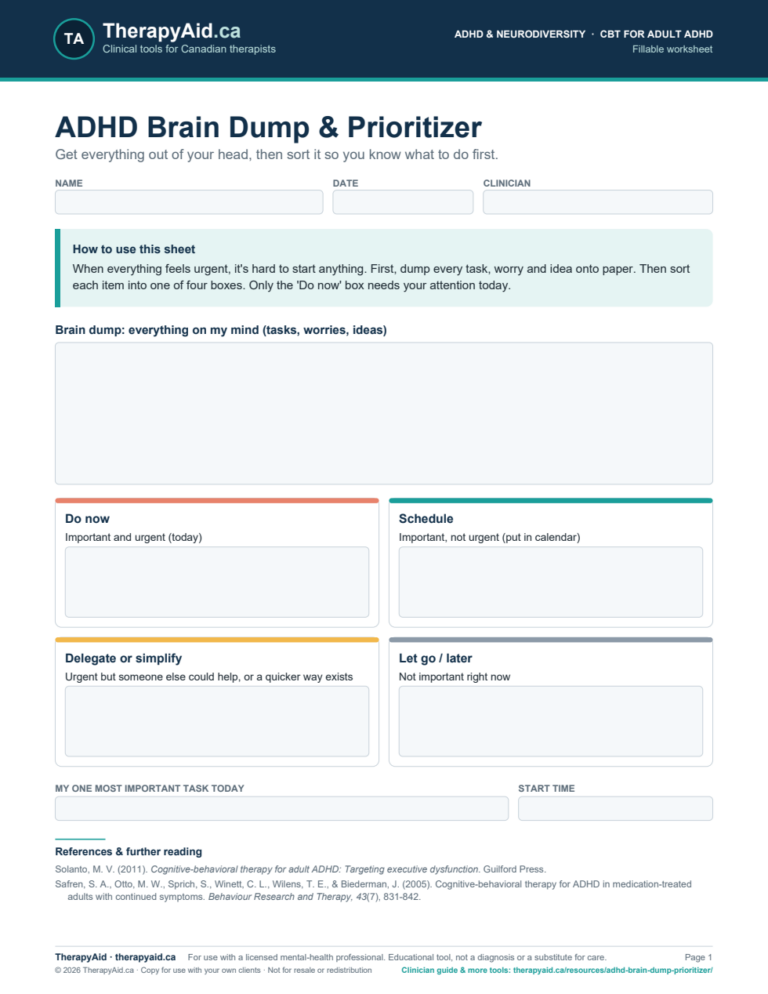
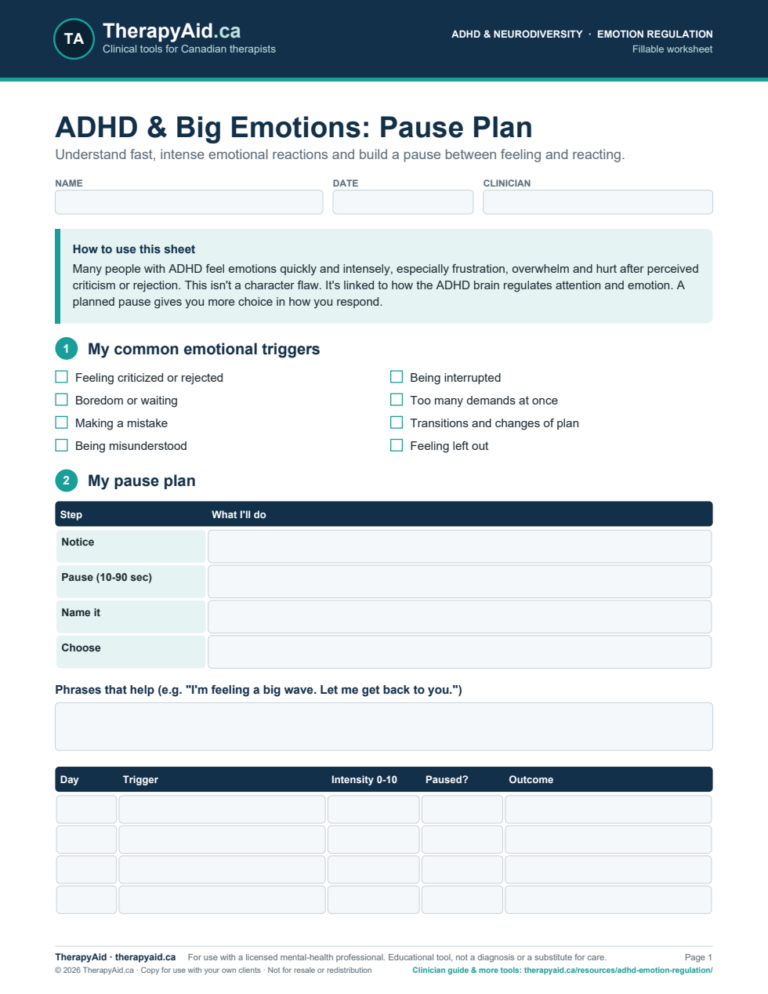
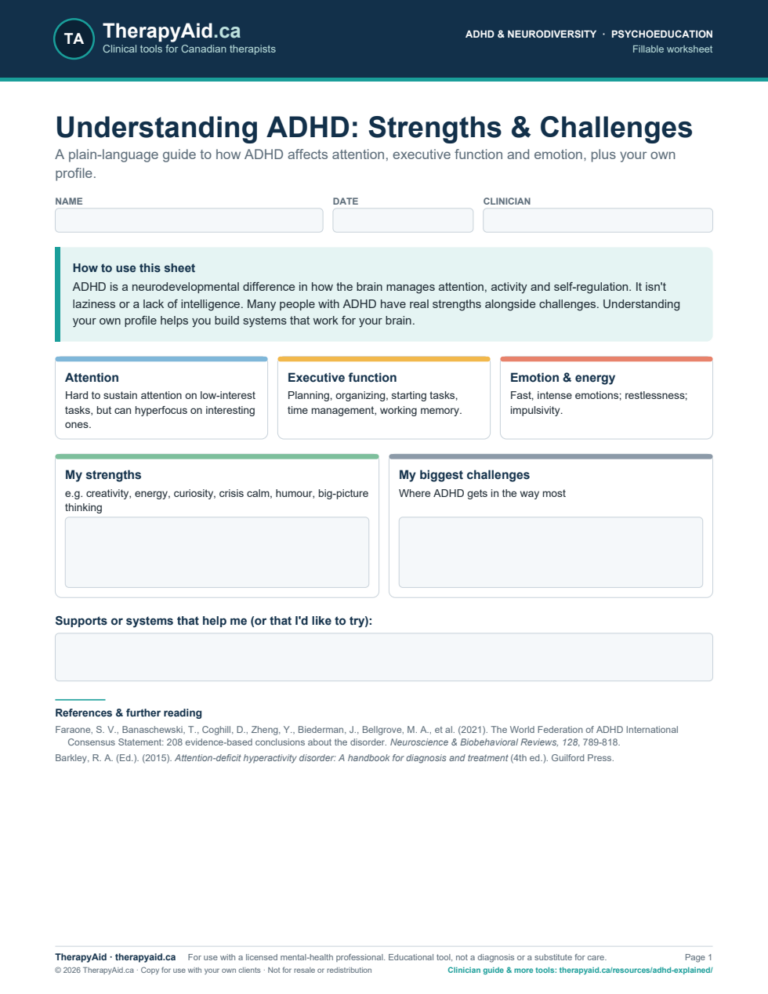
Routines reduce reliance on working memory and decision-making, which are often challenging with ADHD. Short, cued, visible routines with external supports are a common strategy in CBT for adult ADHD.
Why it works
CBT for adult ADHD targeting organization and planning reduces symptoms (Safren et al., 2005), and executive-function-focused CBT emphasizes external structure and habits (Solanto, 2011).
When to use it
- Adults and teens with ADHD
- Chaotic mornings and lateness
- Bedtime procrastination
- Parents supporting children with ADHD (adapted)
How to use it in session
- Choose short routines with 3-6 steps.
- Link each routine to an existing cue.
- Make steps visible.
- Add supports and rewards.
- Track and adjust weekly.
Clinician tips
- Start with one routine, not both.
- Expect imperfection; consistency over perfection.
- Simplify steps that keep getting skipped.
Worked example
Sharing with clients
Members can download the PDF to print or email, or copy a private client link from the download box. Your client opens the link and downloads the worksheet on any device. No client account is needed, and nothing your client writes is stored on TherapyAid.
Frequently asked questions
Why are routines hard with ADHD?
ADHD affects working memory, time perception and task initiation, which makes remembering and starting sequences harder.
How long until a routine becomes a habit?
It varies, often several weeks or more. External supports help in the meantime.
References
Safren, S. A., Otto, M. W., Sprich, S., Winett, C. L., Wilens, T. E., & Biederman, J. (2005). Cognitive-behavioral therapy for ADHD in medication-treated adults with continued symptoms. Behaviour Research and Therapy, 43(7), 831-842.
Solanto, M. V. (2011). Cognitive-behavioral therapy for adult ADHD: Targeting executive dysfunction. Guilford Press.
This worksheet is an educational tool for use by, or under the guidance of, a licensed or registered mental-health professional. It is not a diagnostic instrument or a substitute for clinical judgement. If a client is in crisis in Canada, call or text 9-8-8 or call 9-1-1.