Family Communication and Bipolar Disorder
A family-focused worksheet teaching communication skills (appreciation, positive requests, active listening, gentle concerns) and planning how family will raise early warning signs.
1-page fillable PDF · US Letter (prints on A4) · Family-focused therapy
- Approach / concern
- Bipolar & Mood
- Technique
- Family-focused therapy
- Format
- Fillable PDF, 1 page (US Letter / A4)
- Access
- Pro and Advanced plans (3-day free trial)
- For
- Licensed clinicians to use with clients
- Updated
- October 2026
Key facts
What is the Family Communication and Bipolar Disorder?
Family-focused therapy for bipolar disorder includes psychoeducation, communication enhancement and problem-solving, reducing relapse risk.
Why it works
Miklowitz (2010) describes family-focused treatment for bipolar disorder. CANMAT/ISBD guidelines recommend family-focused therapy as an adjunctive treatment (Yatham et al., 2018).
When to use it
- Bipolar disorder in families
- After an episode
- Teens with mood disorders
- Family sessions
How to use it in session
- Learn the skills.
- Identify common situations.
- Plan new responses.
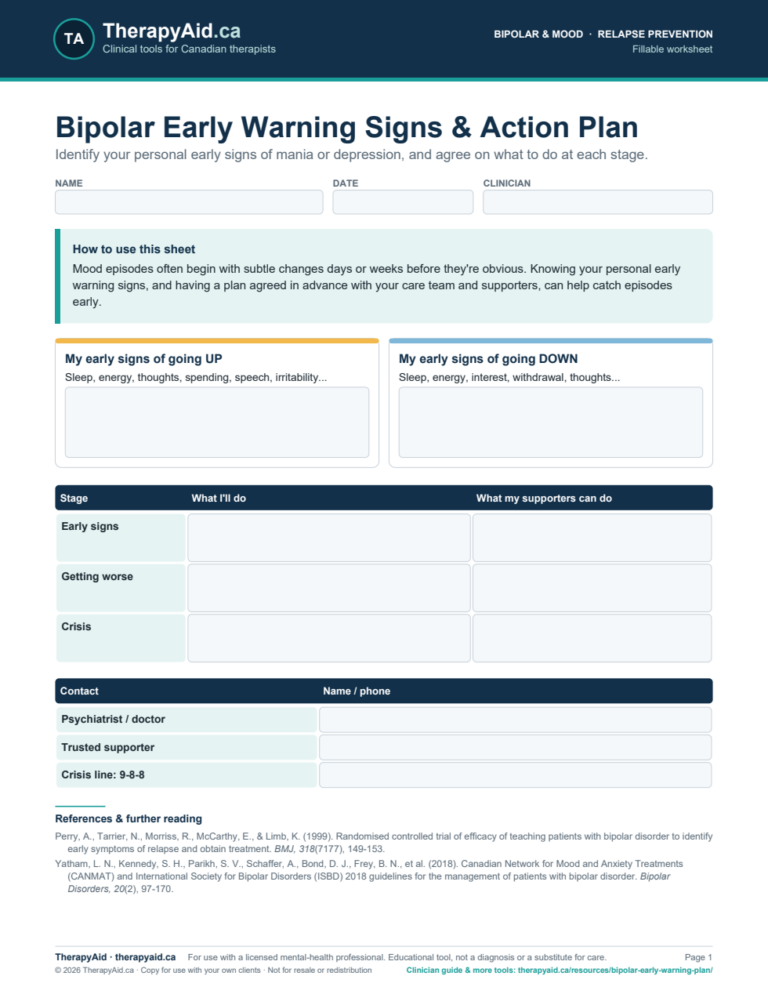
- Agree how to raise warning signs.
- Practise.
Clinician tips
- Reduce blame and criticism.
- Involve the person in agreeing how family raises concerns.
- Practise in session.
Worked example
Sharing with clients
Members can download the PDF to print or email, or copy a private client link from the download box. Your client opens the link and downloads the worksheet on any device. No client account is needed, and nothing your client writes is stored on TherapyAid.
Frequently asked questions
Can family communication affect bipolar disorder?
Yes. Calmer, supportive communication is linked to better outcomes.
How should family raise warning signs?
Gently, using an agreed approach decided during a well period.
References
Miklowitz, D. J. (2010). Bipolar disorder: A family-focused treatment approach (2nd ed.). Guilford Press.
Yatham, L. N., Kennedy, S. H., Parikh, S. V., Schaffer, A., Bond, D. J., Frey, B. N., et al. (2018). Canadian Network for Mood and Anxiety Treatments (CANMAT) and International Society for Bipolar Disorders (ISBD) 2018 guidelines for the management of patients with bipolar disorder. Bipolar Disorders, 20(2), 97-170.
This worksheet is an educational tool for use by, or under the guidance of, a licensed or registered mental-health professional. It is not a diagnostic instrument or a substitute for clinical judgement. If a client is in crisis in Canada, call or text 9-8-8 or call 9-1-1.