Coping With a Depressive Phase
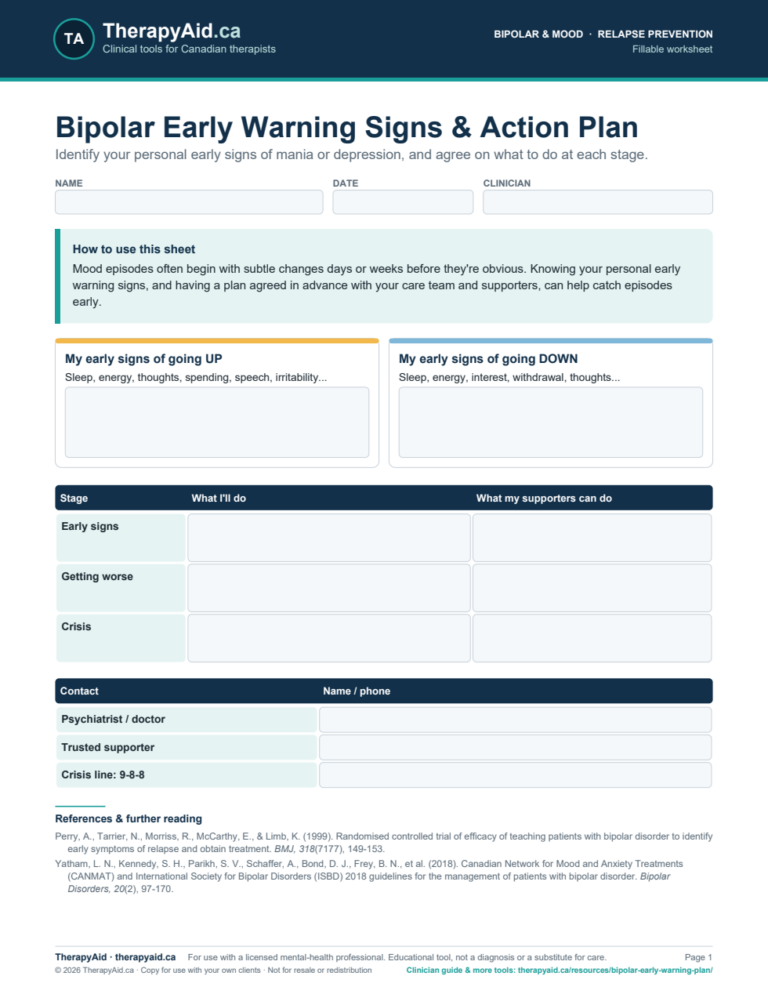
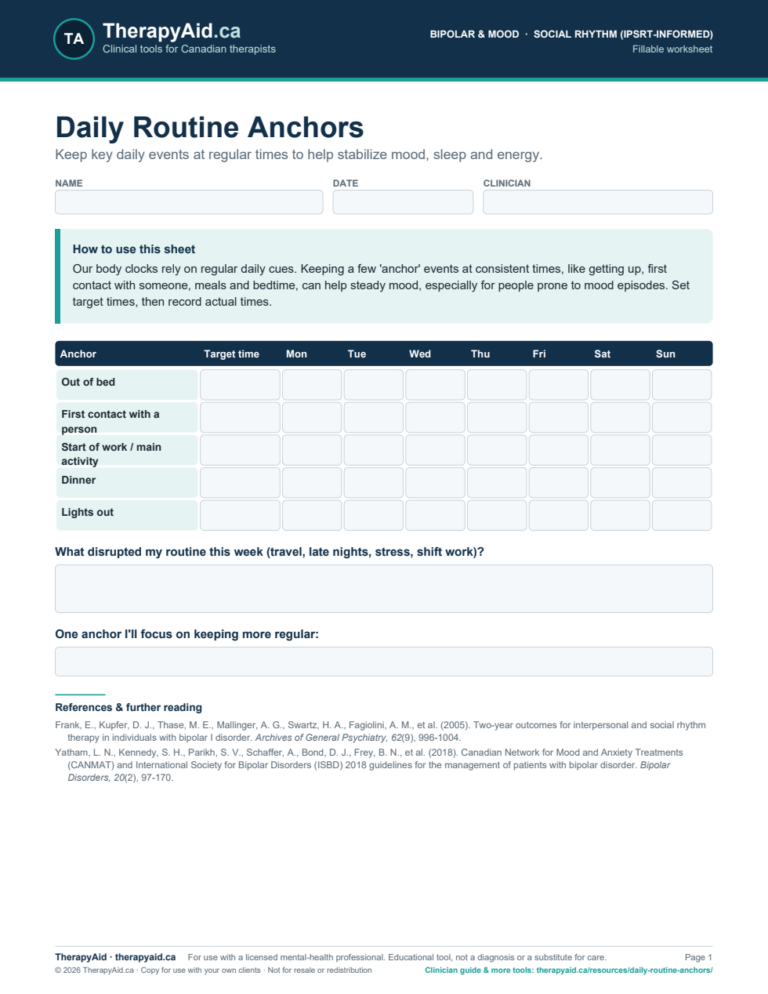
A coping plan for depressive phases listing early signs, daily anchors, supports, when to contact the care team and gentle activation ideas.
1-page fillable PDF · US Letter (prints on A4) · CBT for bipolar · Behavioural activation
- Approach / concern
- Bipolar & Mood
- Technique
- CBT for bipolar · Behavioural activation
- Format
- Fillable PDF, 1 page (US Letter / A4)
- Access
- Pro and Advanced plans (3-day free trial)
- For
- Licensed clinicians to use with clients
- Updated
- October 2026
Key facts
What is the Coping With a Depressive Phase?
Behavioural activation and routine maintenance are helpful during bipolar depression, alongside medical treatment. Planning ahead supports action when motivation is low.
Why it works
Behavioural activation is effective for depression (Martell et al., 2010). CANMAT/ISBD guidelines outline treatments for bipolar depression and psychosocial adjuncts (Yatham et al., 2018).
When to use it
- Bipolar depression
- Recurrent depression
- Relapse prevention
- Care coordination
How to use it in session
- Write the plan when well.
- Identify early signs.
- Choose anchors.
- List supports.
- Know when to seek help.
Clinician tips
- Monitor for mood switching.
- Keep sleep regular.
- Screen for suicidal thoughts.
Worked example
Sharing with clients
Members can download the PDF to print or email, or copy a private client link from the download box. Your client opens the link and downloads the worksheet on any device. No client account is needed, and nothing your client writes is stored on TherapyAid.
Frequently asked questions
Should I push myself hard when depressed?
Gentle, steady steps help most; pushing too hard can backfire.
When should I get urgent help?
If you have thoughts of suicide, call or text 9-8-8 or contact emergency services.
References
Martell, C. R., Dimidjian, S., & Herman-Dunn, R. (2010). Behavioral activation for depression: A clinician’s guide. Guilford Press.
Yatham, L. N., Kennedy, S. H., Parikh, S. V., Schaffer, A., Bond, D. J., Frey, B. N., et al. (2018). Canadian Network for Mood and Anxiety Treatments (CANMAT) and International Society for Bipolar Disorders (ISBD) 2018 guidelines for the management of patients with bipolar disorder. Bipolar Disorders, 20(2), 97-170.
This worksheet is an educational tool for use by, or under the guidance of, a licensed or registered mental-health professional. It is not a diagnostic instrument or a substitute for clinical judgement. If a client is in crisis in Canada, call or text 9-8-8 or call 9-1-1.