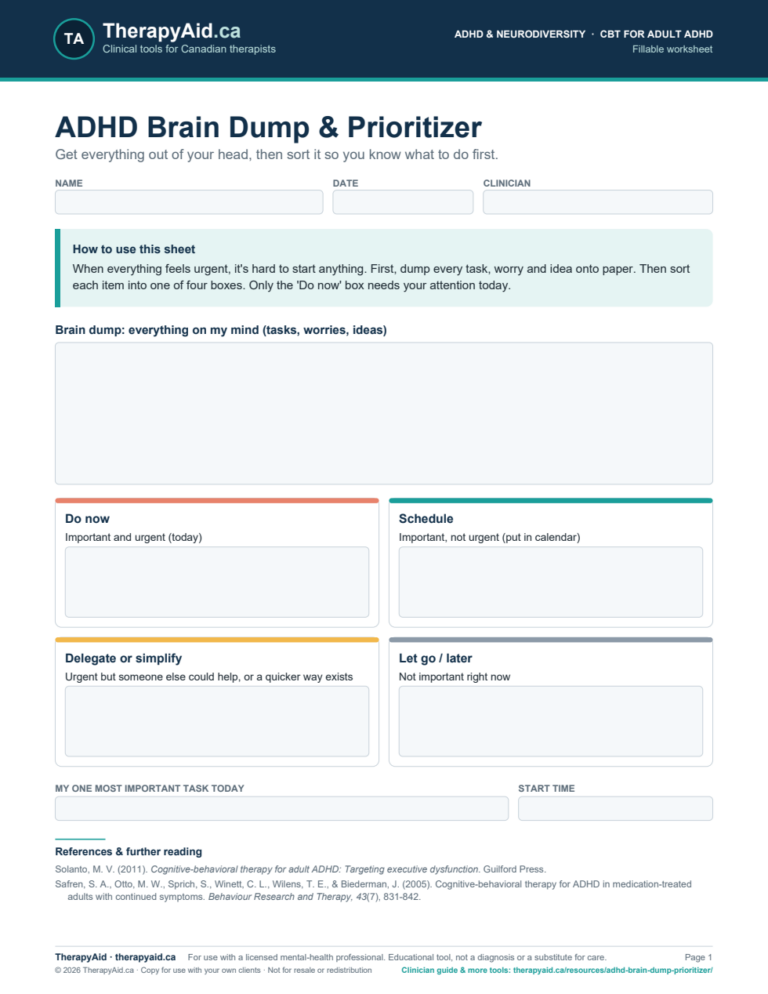
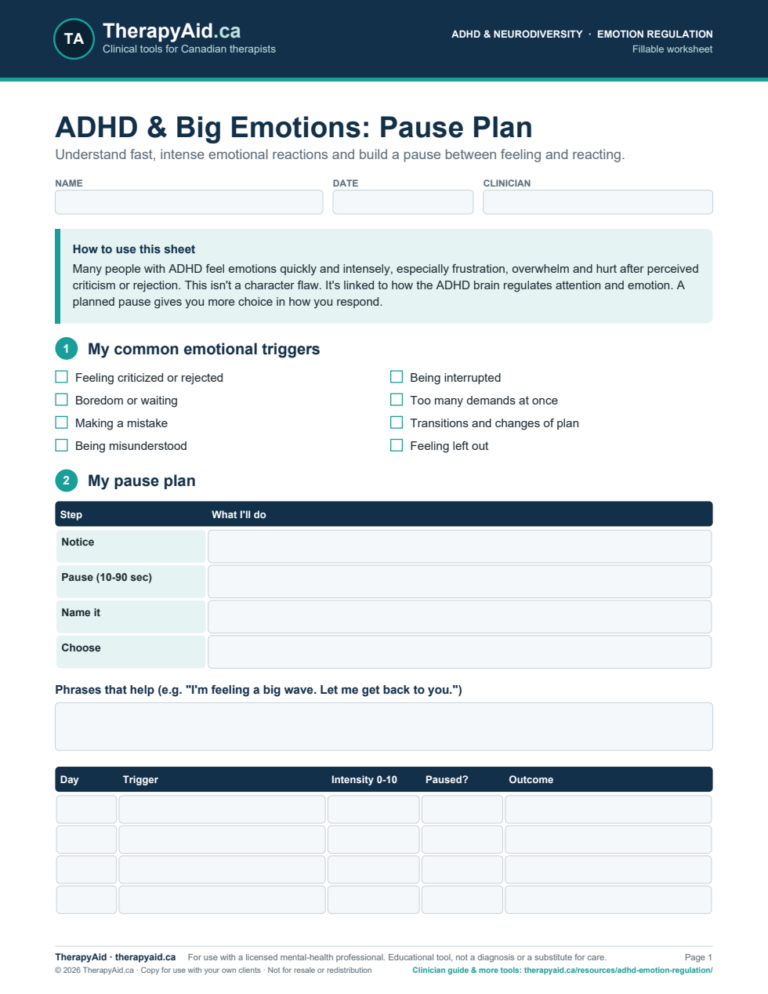
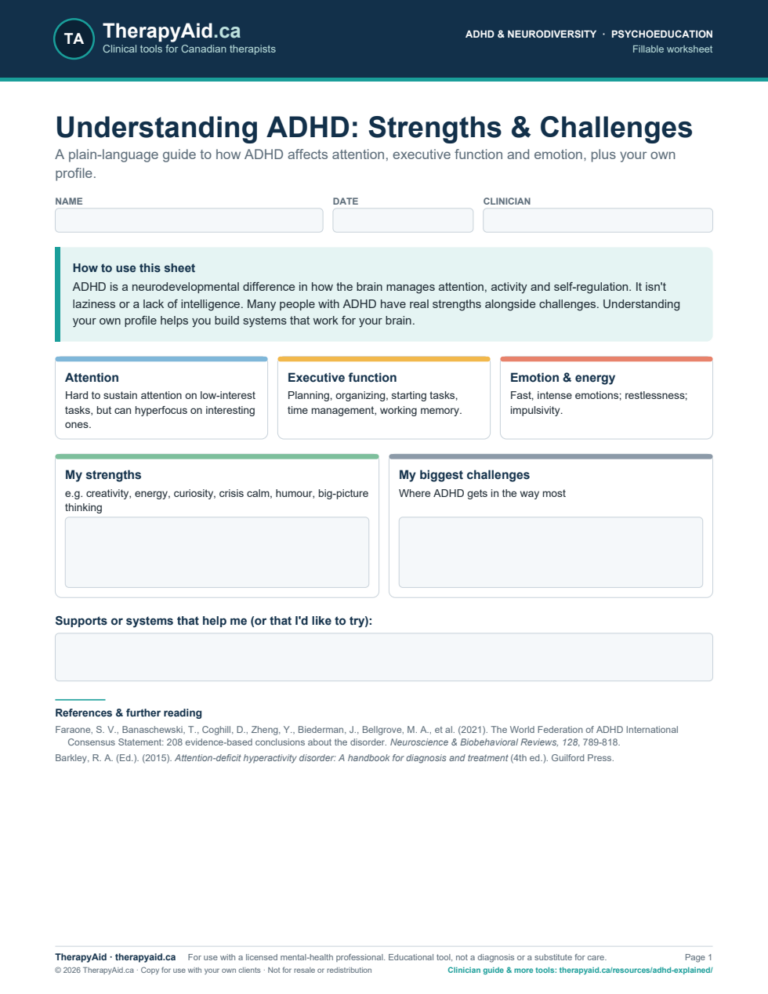
ADHD and Money: Impulse Spending Plan
An ADHD money worksheet with friction-adding and automation strategies, and a log of impulse purchases, feelings, costs and alternatives.
1-page fillable PDF · US Letter (prints on A4) · CBT for adult ADHD
- Approach / concern
- ADHD & Neurodiversity
- Technique
- CBT for adult ADHD
- Format
- Fillable PDF, 1 page (US Letter / A4)
- Access
- Pro and Advanced plans (3-day free trial)
- For
- Licensed clinicians to use with clients
- Updated
- October 2026
Key facts
What is the ADHD and Money: Impulse Spending Plan?
Impulsivity and delay aversion in ADHD contribute to financial difficulties. Environmental strategies that add friction and automate saving are practical supports.
Why it works
Barkley (2010) describes self-regulation challenges in adult ADHD, including impulsive spending. CBT for adult ADHD includes strategies for impulsive behaviour (Ramsay & Rostain, 2015).
When to use it
- Impulse spending and debt
- Online shopping
- Couples conflict over money
- Young adults
How to use it in session
- Choose strategies.
- Set up automation.
- Log impulse buys.
- Notice feelings.
- Review weekly.
Clinician tips
- Avoid shame; focus on systems.
- Consider a trusted helper.
- Address emotional spending triggers.
Worked example
Sharing with clients
Members can download the PDF to print or email, or copy a private client link from the download box. Your client opens the link and downloads the worksheet on any device. No client account is needed, and nothing your client writes is stored on TherapyAid.
Frequently asked questions
Why do people with ADHD struggle with money?
Impulsivity and difficulty with delayed rewards make spending decisions harder.
What’s the most effective step?
Automating savings and adding friction to spending often help most.
References
Ramsay, J. R., & Rostain, A. L. (2015). Cognitive-behavioral therapy for adult ADHD: An integrative psychosocial and medical approach (2nd ed.). Routledge.
Barkley, R. A. (2010). Taking charge of adult ADHD. Guilford Press.
This worksheet is an educational tool for use by, or under the guidance of, a licensed or registered mental-health professional. It is not a diagnostic instrument or a substitute for clinical judgement. If a client is in crisis in Canada, call or text 9-8-8 or call 9-1-1.