Motivational Interviewing at a Glance: Quick Guide
A one-page clinician quick guide to motivational interviewing covering spirit, the four processes, OARS skills and change talk.
1-page fillable PDF · US Letter (prints on A4) · Clinician quick guide
- Approach / concern
- Recovery & Addiction
- Technique
- Clinician quick guide
- Format
- Fillable PDF, 1 page (US Letter / A4)
- Access
- Pro and Advanced plans (3-day free trial)
- For
- Licensed clinicians to use with clients
- Updated
- October 2026
Key facts
What is the Motivational Interviewing at a Glance: Quick Guide?
Motivational interviewing is an evidence-based, person-centred counselling style for resolving ambivalence and evoking intrinsic motivation for change.
Why it works
Miller and Rollnick (2013) describe MI’s spirit, processes and skills. A meta-analysis found MI produces small but significant effects across many problem areas (Lundahl et al., 2010).
When to use it
- Substance use and addictions
- Health behaviour change
- Ambivalent or mandated clients
- Medication adherence
How to use it in session
- Engage with OARS.
- Agree a focus.
- Evoke change talk.
- Plan when ready.
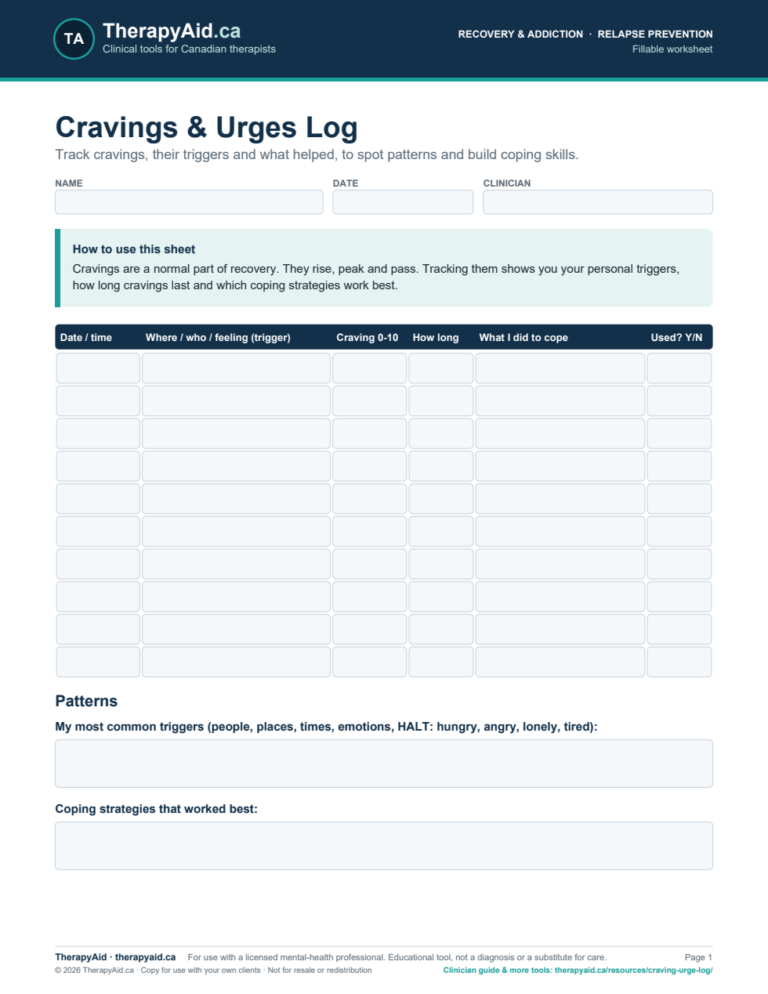
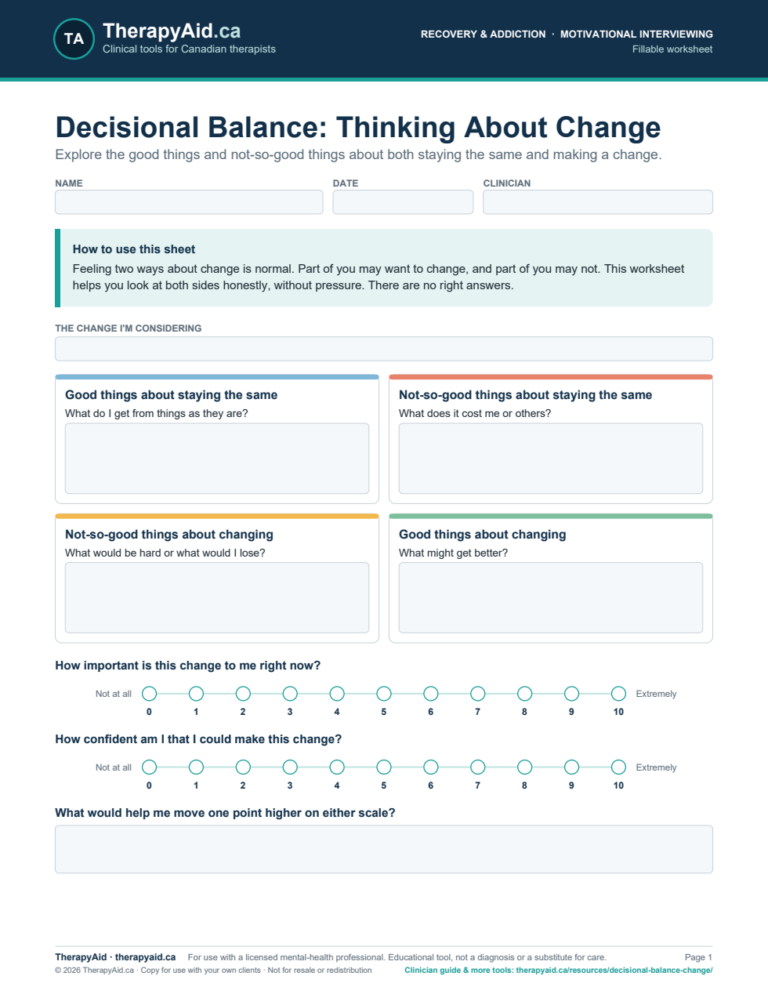
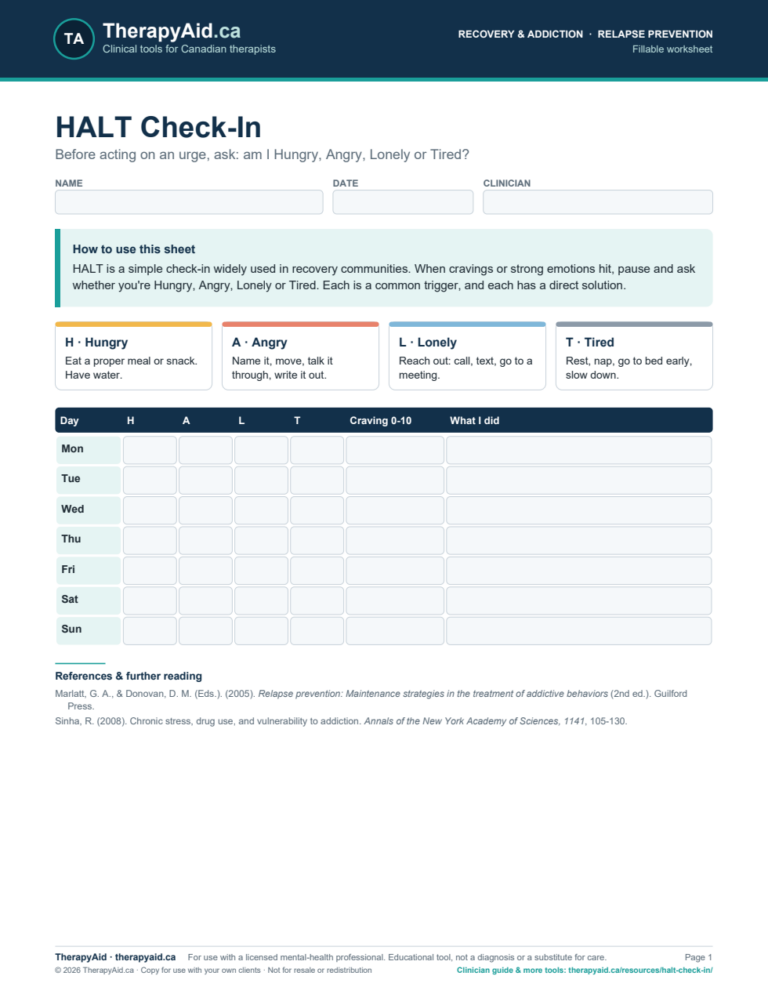
- Link to change worksheets.
Clinician tips
- Resist the righting reflex.
- Reflect more than you question.
- Roll with sustain talk.
Worked example
Sharing with clients
Members can download the PDF to print or email, or copy a private client link from the download box. Your client opens the link and downloads the worksheet on any device. No client account is needed, and nothing your client writes is stored on TherapyAid.
Frequently asked questions
What is change talk?
Client statements in favour of change, such as desire, ability, reasons, need and commitment.
Is MI only for addiction?
No. It’s used for many types of behaviour change.
References
Miller, W. R., & Rollnick, S. (2013). Motivational interviewing: Helping people change (3rd ed.). Guilford Press.
Lundahl, B. W., Kunz, C., Brownell, C., Tollefson, D., & Burke, B. L. (2010). A meta-analysis of motivational interviewing: Twenty-five years of empirical studies. Research on Social Work Practice, 20(2), 137-160.
This worksheet is an educational tool for use by, or under the guidance of, a licensed or registered mental-health professional. It is not a diagnostic instrument or a substitute for clinical judgement. If a client is in crisis in Canada, call or text 9-8-8 or call 9-1-1.