Family Therapy Models: Clinician Quick Guide
A one-page clinician quick guide comparing structural, Bowenian, strategic and experiential family therapy models, concepts and tools.
1-page fillable PDF · US Letter (prints on A4) · Clinician quick guide
- Approach / concern
- Family Therapy
- Technique
- Clinician quick guide
- Format
- Fillable PDF, 1 page (US Letter / A4)
- Access
- Pro and Advanced plans (3-day free trial)
- For
- Licensed clinicians to use with clients
- Updated
- October 2026
Key facts
What is the Family Therapy Models: Clinician Quick Guide?
Family therapy approaches view problems as embedded in relational systems. Major models differ in their focus on structure, multigenerational processes, interaction patterns and emotional experience.
Why it works
Nichols and Davis (2020) provide a comprehensive overview of family therapy models. Minuchin (1974) established structural family therapy.
When to use it
- Choosing a family therapy approach
- Training and supervision
- Case conceptualization
- Integrative practice
How to use it in session
- Review models.
- Match to the family’s presenting issue.
- Use genograms and maps.
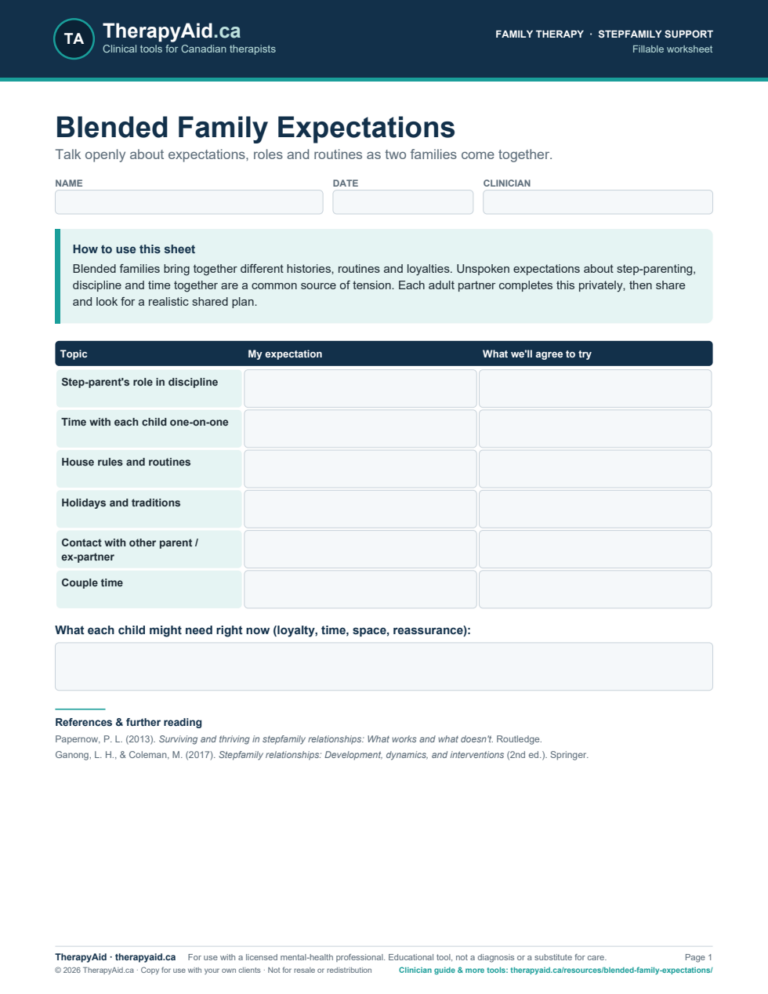
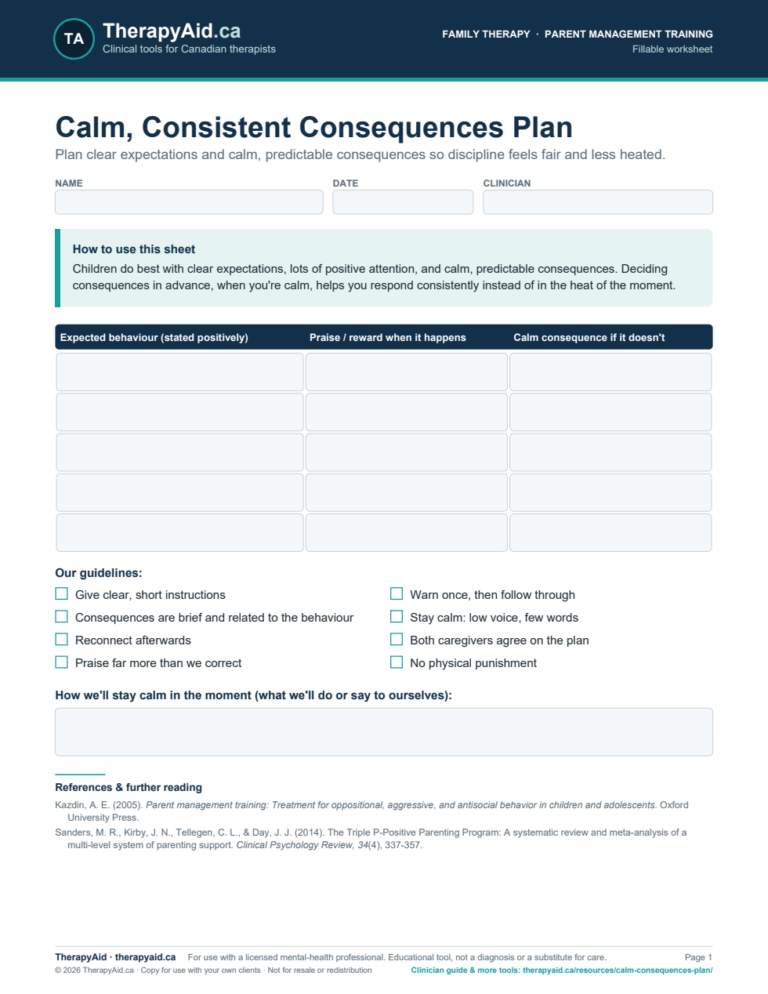
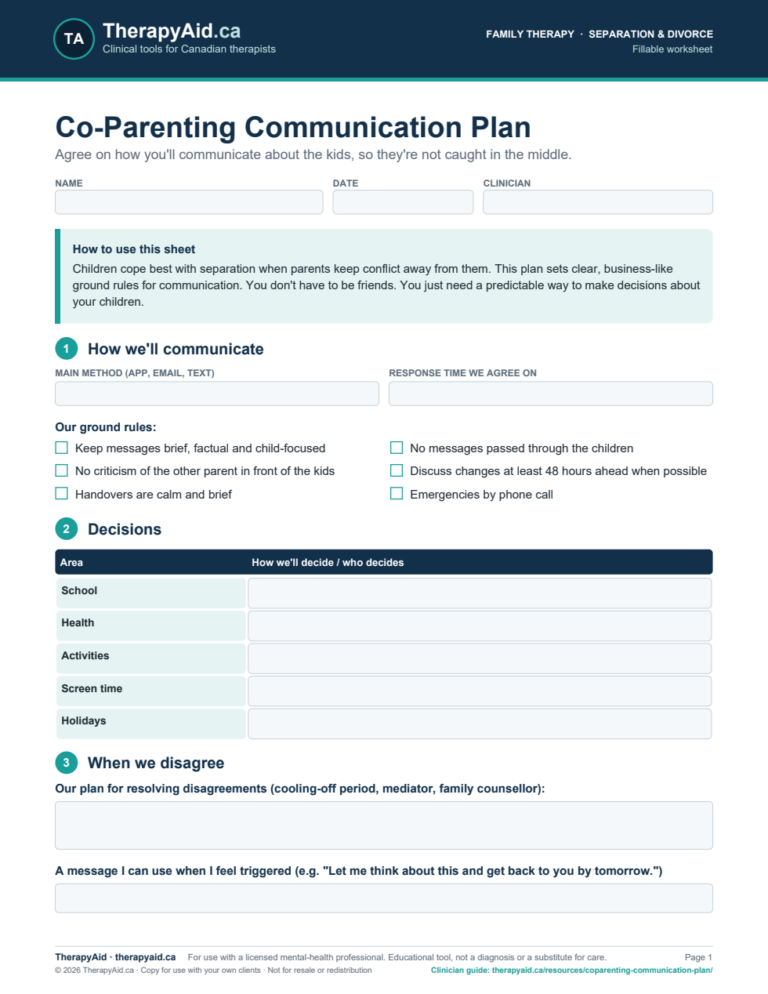
- Link to family worksheets.
- Integrate as appropriate.
Clinician tips
- Joining comes first in any model.
- Be culturally humble about family norms.
- Watch for safety issues and abuse.
Worked example
Sharing with clients
Members can download the PDF to print or email, or copy a private client link from the download box. Your client opens the link and downloads the worksheet on any device. No client account is needed, and nothing your client writes is stored on TherapyAid.
Frequently asked questions
Which family therapy model is best?
It depends on the family and problem; many clinicians integrate models.
Do all family members need to attend?
Not always; systemic work can be done with part of the family or individuals.
References
Nichols, M. P., & Davis, S. D. (2020). Family therapy: Concepts and methods (12th ed.). Pearson.
Minuchin, S. (1974). Families and family therapy. Harvard University Press.
This worksheet is an educational tool for use by, or under the guidance of, a licensed or registered mental-health professional. It is not a diagnostic instrument or a substitute for clinical judgement. If a client is in crisis in Canada, call or text 9-8-8 or call 9-1-1.