Hypomania Slow-Down Plan
A bipolar relapse prevention worksheet listing early signs of hypomania, pre-agreed slow-down rules, a trusted person and care contacts, and how others can help.
1-page fillable PDF · US Letter (prints on A4) · CBT for bipolar · IPSRT
- Approach / concern
- Bipolar & Mood
- Technique
- CBT for bipolar · IPSRT
- Format
- Fillable PDF, 1 page (US Letter / A4)
- Access
- Pro and Advanced plans (3-day free trial)
- For
- Licensed clinicians to use with clients
- Updated
- October 2026
Key facts
What is the Hypomania Slow-Down Plan?
A hypomania slow-down plan is a pre-agreed set of behavioural rules activated at the first signs of elevated mood. It protects sleep and routines and limits risky decisions while the client seeks support.
Why it works
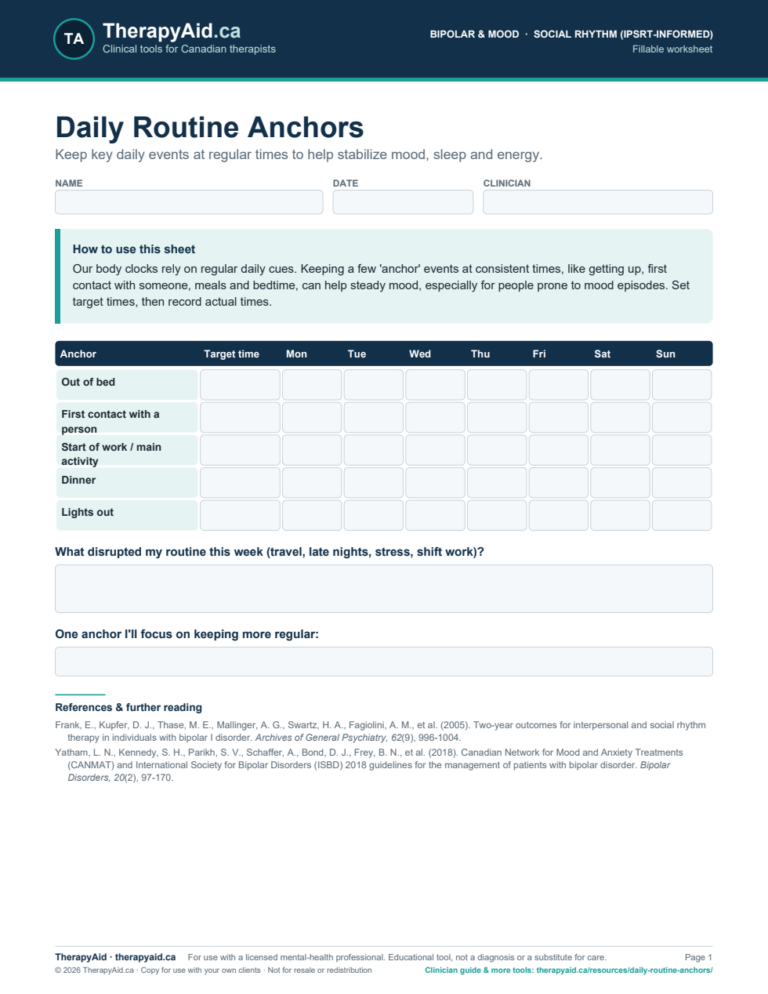
CBT for bipolar disorder teaches clients to recognize early symptoms and use behavioural strategies to prevent escalation (Basco & Rush, 2005). Interpersonal and social rhythm therapy emphasizes regular sleep and routines to stabilize mood (Frank, 2005).
When to use it
- Bipolar I and II
- After a hypomanic or manic episode
- Relapse prevention planning
- Family involvement in care
How to use it in session
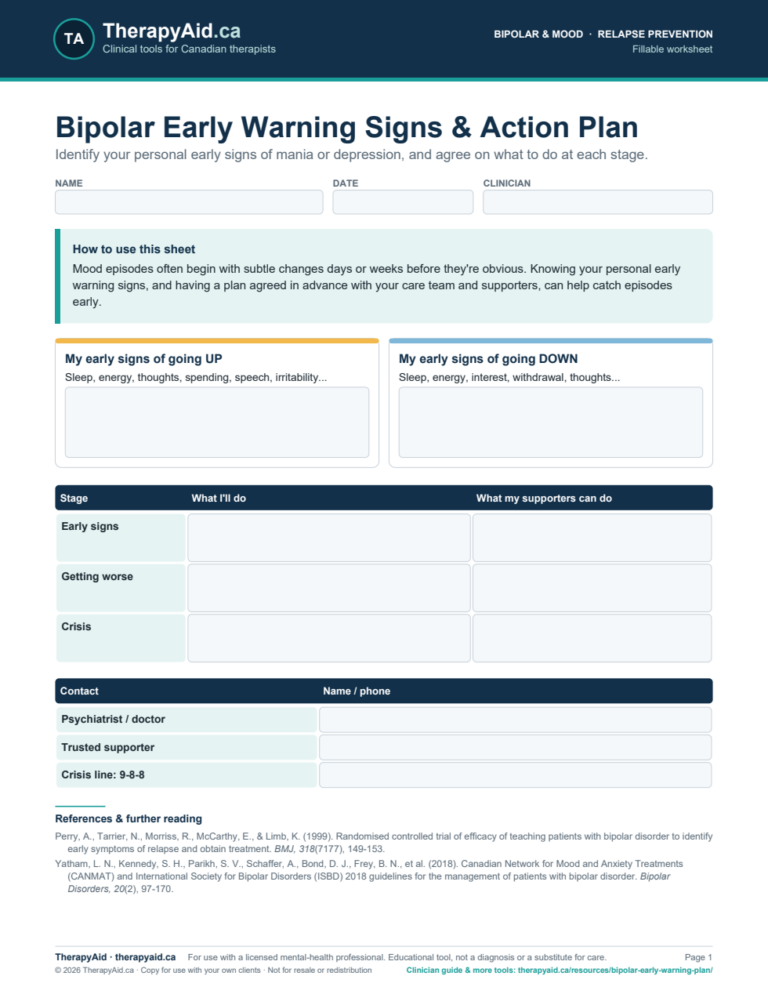
- Identify personal early signs.
- Choose concrete slow-down rules.
- Name a trusted person.
- Agree how they’ll help.
- Share with the care team.
Clinician tips
- Write the plan when euthymic.
- Respect autonomy while planning supports.
- Pair with mood and sleep charting.
Worked example
Sharing with clients
Members can download the PDF to print or email, or copy a private client link from the download box. Your client opens the link and downloads the worksheet on any device. No client account is needed, and nothing your client writes is stored on TherapyAid.
Frequently asked questions
Why limit something that feels good?
Hypomania can escalate into mania or crash into depression. Early brakes protect your wellbeing.
What if I don’t want to follow the plan when I’m high?
That’s common, which is why sharing it with a trusted person in advance helps.
References
Basco, M. R., & Rush, A. J. (2005). Cognitive-behavioral therapy for bipolar disorder (2nd ed.). Guilford Press.
Frank, E. (2005). Treating bipolar disorder: A clinician’s guide to interpersonal and social rhythm therapy. Guilford Press.
This worksheet is an educational tool for use by, or under the guidance of, a licensed or registered mental-health professional. It is not a diagnostic instrument or a substitute for clinical judgement. If a client is in crisis in Canada, call or text 9-8-8 or call 9-1-1.