ADHD Focus Environment Plan
An ADHD worksheet listing distractions and fixes, selecting environmental and time-based focus supports, and describing a personal focus set-up.
1-page fillable PDF · US Letter (prints on A4) · CBT for adult ADHD
- Approach / concern
- ADHD & Neurodiversity
- Technique
- CBT for adult ADHD
- Format
- Fillable PDF, 1 page (US Letter / A4)
- Access
- Pro and Advanced plans (3-day free trial)
- For
- Licensed clinicians to use with clients
- Updated
- October 2026
Key facts
What is the ADHD Focus Environment Plan?
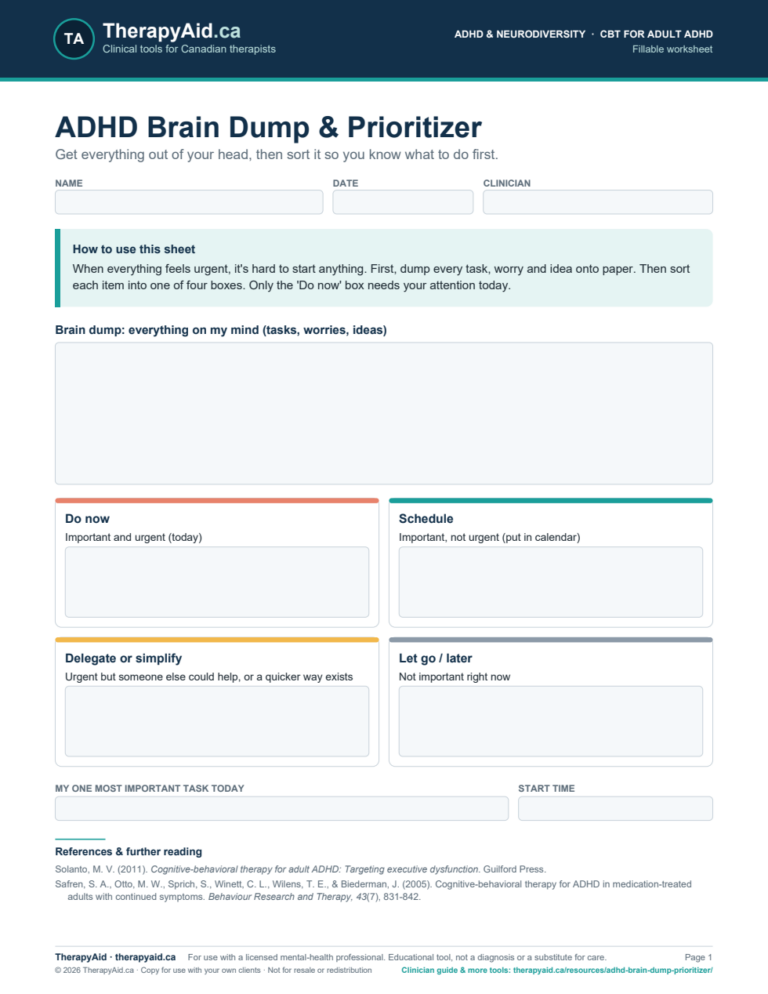
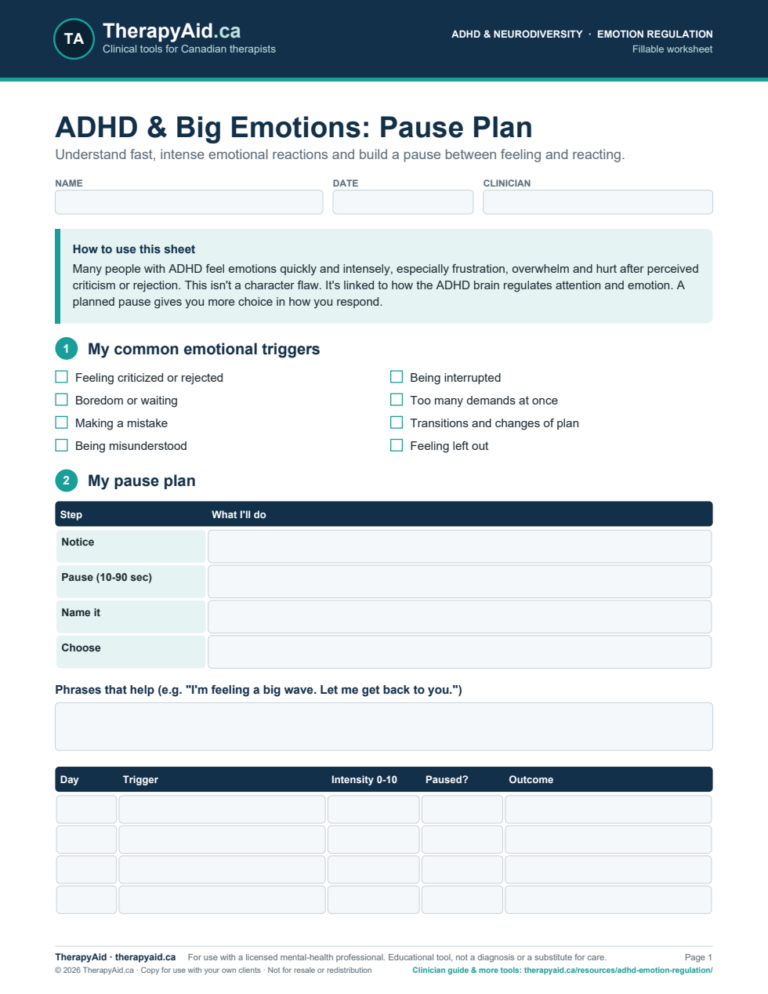
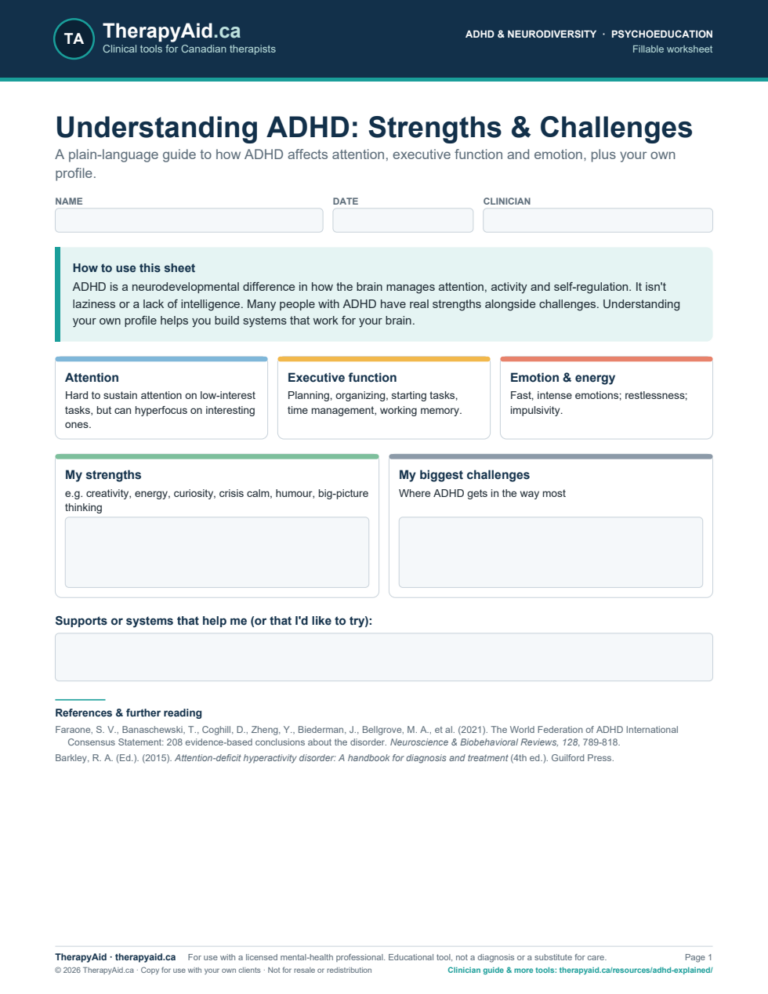
Environmental modification is a core strategy in CBT for adult ADHD. Reducing distractions, externalizing tasks and structuring time compensates for attention and executive function difficulties.
Why it works
CBT for adult ADHD includes a module on reducing distractibility through environmental strategies (Safren et al., 2005). Executive-function-focused CBT emphasizes external supports over effort alone (Solanto, 2011).
When to use it
- Adults and students with ADHD
- Work-from-home difficulties
- Studying and exams
- Workplace accommodations planning
How to use it in session
- List common distractions.
- Choose a fix for each.
- Select focus supports.
- Design a focus set-up.
- Test for a week and adjust.
Clinician tips
- Start with the biggest distraction.
- Body doubling can be virtual.
- Link to workplace accommodations if needed.
Worked example
Sharing with clients
Members can download the PDF to print or email, or copy a private client link from the download box. Your client opens the link and downloads the worksheet on any device. No client account is needed, and nothing your client writes is stored on TherapyAid.
Frequently asked questions
Why can’t I just focus harder?
ADHD affects attention regulation; environmental changes reduce the load on willpower.
What is body doubling?
Working alongside another person, in person or online, which helps many people with ADHD stay on task.
References
Safren, S. A., Otto, M. W., Sprich, S., Winett, C. L., Wilens, T. E., & Biederman, J. (2005). Cognitive-behavioral therapy for ADHD in medication-treated adults with continued symptoms. Behaviour Research and Therapy, 43(7), 831-842.
Solanto, M. V. (2011). Cognitive-behavioral therapy for adult ADHD: Targeting executive dysfunction. Guilford Press.
This worksheet is an educational tool for use by, or under the guidance of, a licensed or registered mental-health professional. It is not a diagnostic instrument or a substitute for clinical judgement. If a client is in crisis in Canada, call or text 9-8-8 or call 9-1-1.