Spontaneous & Responsive Desire
A sex therapy psychoeducation worksheet explaining spontaneous and responsive desire, identifying helpful contexts and brakes, and preparing a message for a partner.
1-page fillable PDF · US Letter (prints on A4) · Psychoeducation · Sex therapy
- Approach / concern
- Sex Therapy
- Technique
- Psychoeducation · Sex therapy
- Format
- Fillable PDF, 1 page (US Letter / A4)
- Access
- Advanced plan
- For
- Licensed clinicians to use with clients
- Updated
- October 2026
Key facts
What is the Spontaneous & Responsive Desire?
Basson’s circular model of sexual response proposes that, for many people, desire may follow rather than precede arousal, emerging in response to intimacy and sexual stimuli. This is known as responsive desire.
Why it works
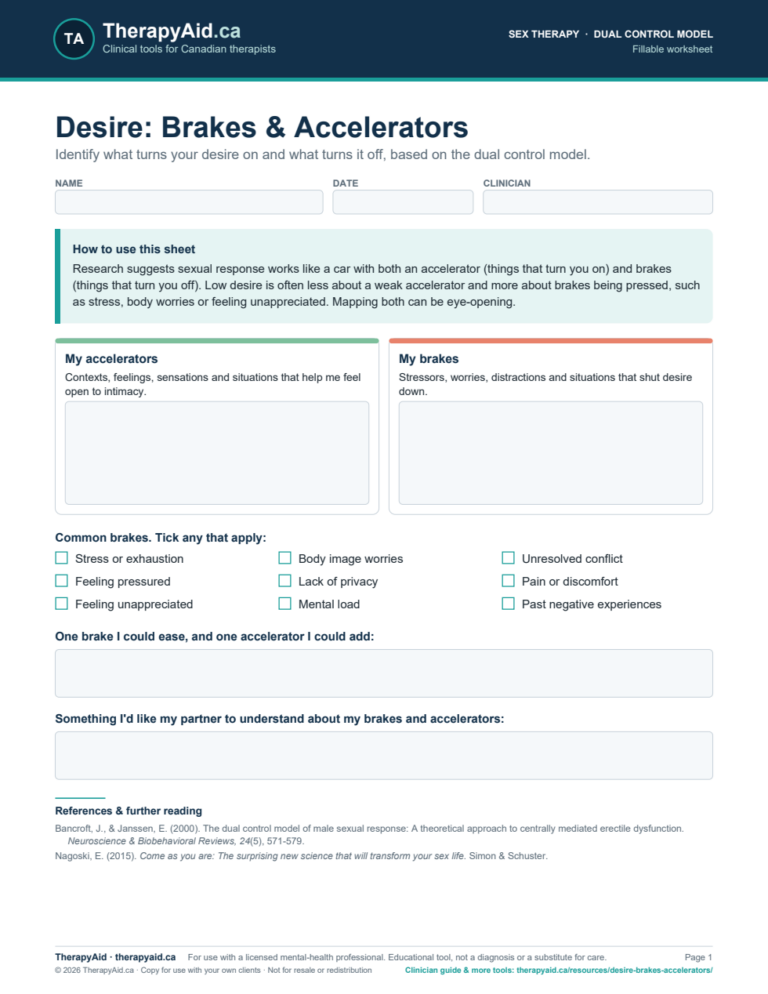
Basson (2000) proposed a non-linear model in which emotional intimacy and receptivity can trigger arousal and responsive desire. Reframing responsive desire as normal reduces pathologizing and shame (Nagoski, 2021).
When to use it
- Desire discrepancy in couples
- Low desire concerns
- Sexual shame or pressure
- Couples sex therapy
How to use it in session
- Explain both desire styles.
- Normalize responsive desire.
- Identify helpful contexts.
- Identify brakes.
- Plan communication with partner.
Clinician tips
- Emphasize consent; willingness is never obligation.
- Rule out medical causes when relevant.
- Address relationship factors.
Worked example
Sharing with clients
Members can download the PDF to print or email, or copy a private client link from the download box. Your client opens the link and downloads the worksheet on any device. No client account is needed, and nothing your client writes is stored on TherapyAid.
Frequently asked questions
Is responsive desire a problem?
No. It’s a normal way of experiencing desire, especially in long-term relationships.
Does this mean I should have sex when I don’t want to?
No. Responsive desire is about creating conditions that feel good, never about pressure or obligation.
References
Basson, R. (2000). The female sexual response: A different model. Journal of Sex & Marital Therapy, 26(1), 51-65.
Nagoski, E. (2021). Come as you are: The surprising new science that will transform your sex life (Rev. ed.). Simon & Schuster.
This worksheet is an educational tool for use by, or under the guidance of, a licensed or registered mental-health professional. It is not a diagnostic instrument or a substitute for clinical judgement. If a client is in crisis in Canada, call or text 9-8-8 or call 9-1-1.