My Change Plan
A motivational interviewing change plan worksheet covering the change, key reasons, steps, supports, signs of success, potential barriers and confidence.
1-page fillable PDF · US Letter (prints on A4) · Motivational interviewing
- Approach / concern
- Recovery & Addiction
- Technique
- Motivational interviewing
- Format
- Fillable PDF, 1 page (US Letter / A4)
- Access
- Pro and Advanced plans (3-day free trial)
- For
- Licensed clinicians to use with clients
- Updated
- October 2026
Key facts
What is the My Change Plan?
A change plan is a classic motivational interviewing tool used in the planning process, when a person has decided to change. It consolidates reasons, steps and supports into a concrete, client-owned plan.
Why it works
MI is effective across many behaviours, with meta-analytic support across 25 years of studies (Lundahl et al., 2010). Planning is one of the four processes of MI (Miller & Rollnick, 2023).
When to use it
- Clients in preparation or action stages
- Substance use and health behaviours
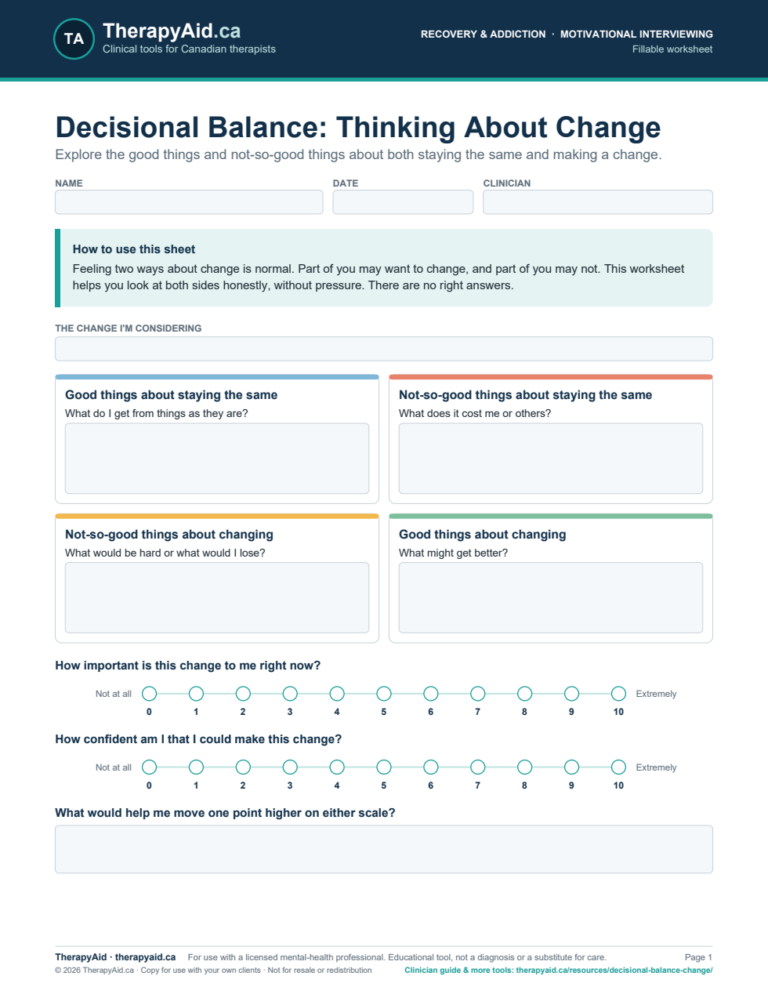
- After decisional balance work
- Discharge planning
How to use it in session
- Confirm readiness to plan.
- Elicit reasons in the client’s words.
- Break change into small steps.
- Identify supports and barriers.
- Rate confidence and refine the plan.
Clinician tips
- Keep the client in the driver’s seat.
- If confidence is low, make steps smaller.
- Review the plan in subsequent sessions.
Worked example
Sharing with clients
Members can download the PDF to print or email, or copy a private client link from the download box. Your client opens the link and downloads the worksheet on any device. No client account is needed, and nothing your client writes is stored on TherapyAid.
Frequently asked questions
When should I use a change plan?
When someone has decided to change and is ready to plan, usually in the preparation or action stage.
What if the plan doesn’t work?
Revisit it together, learn from what happened and adjust; change often takes several attempts.
References
Miller, W. R., & Rollnick, S. (2023). Motivational interviewing: Helping people change and grow (4th ed.). Guilford Press.
Lundahl, B. W., Kunz, C., Brownell, C., Tollefson, D., & Burke, B. L. (2010). A meta-analysis of motivational interviewing: Twenty-five years of empirical studies. Research on Social Work Practice, 20(2), 137-160.
This worksheet is an educational tool for use by, or under the guidance of, a licensed or registered mental-health professional. It is not a diagnostic instrument or a substitute for clinical judgement. If a client is in crisis in Canada, call or text 9-8-8 or call 9-1-1.