3-Minute Breathing Space
A guide to the MBCT 3-minute breathing space in three steps (awareness, gathering, expanding) with a 7-day log.
1-page fillable PDF · US Letter (prints on A4) · MBCT practice
- Approach / concern
- Meditation & Mindfulness
- Technique
- MBCT practice
- Format
- Fillable PDF, 1 page (US Letter / A4)
- Access
- Pro and Advanced plans (3-day free trial)
- For
- Licensed clinicians to use with clients
- Updated
- October 2026
Key facts
What is the 3-Minute Breathing Space?
The 3-minute breathing space is a brief, structured mindfulness practice from Mindfulness-Based Cognitive Therapy (MBCT). It moves from broad awareness of current experience, to focused attention on the breath, to expanded awareness of the body.
Why it works
MBCT reduces the risk of depressive relapse compared with usual care, according to an individual patient data meta-analysis (Kuyken et al., 2016). The breathing space is a core everyday practice in MBCT (Segal et al., 2013).
When to use it
- Depression relapse prevention
- Stress and rumination
- Busy clients who can’t do long meditations
- Transitions between tasks
How to use it in session
- Guide the three steps in session.
- Use the hourglass image to explain the shape.
- Practise at set times, such as before meals.
- Use it during stress as well.
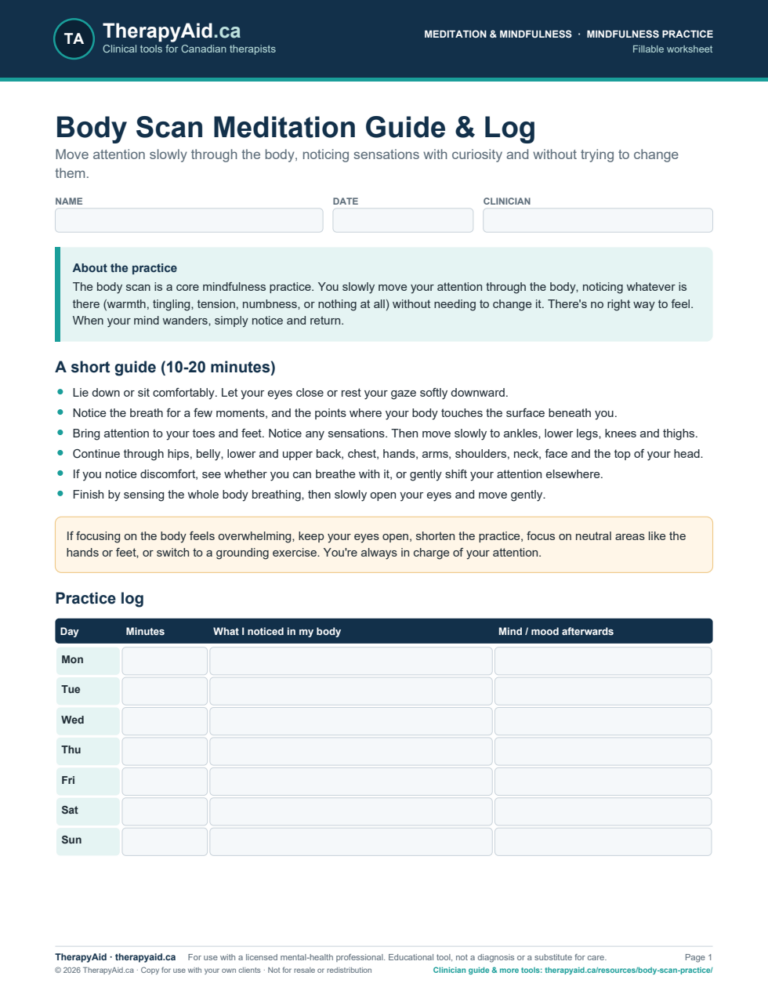
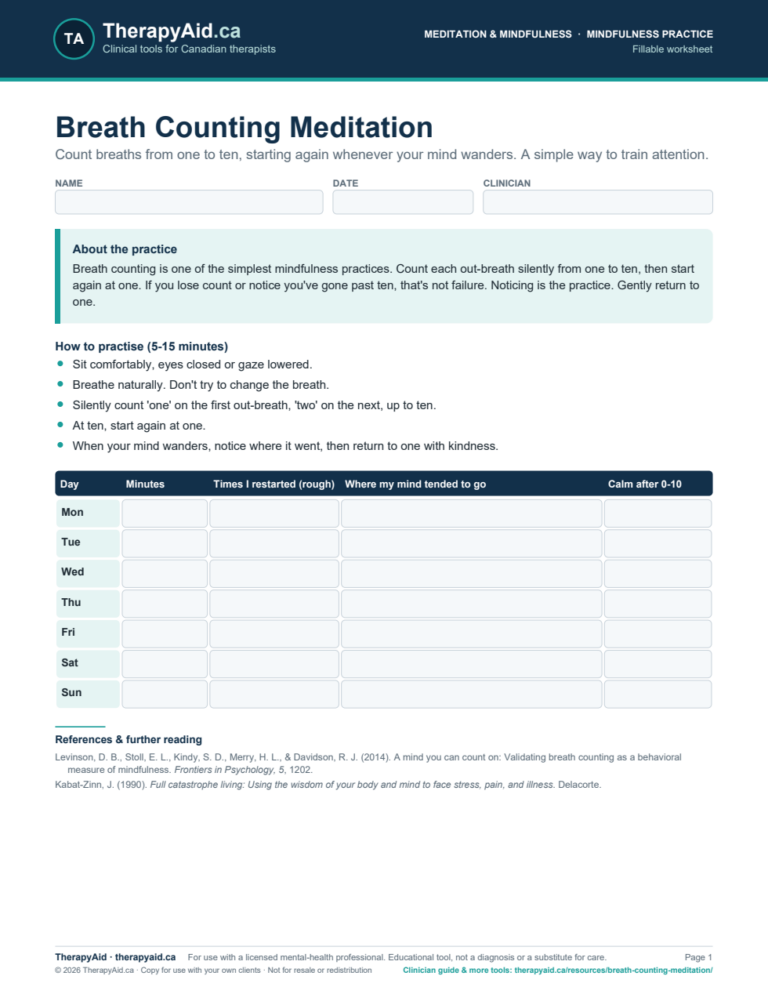
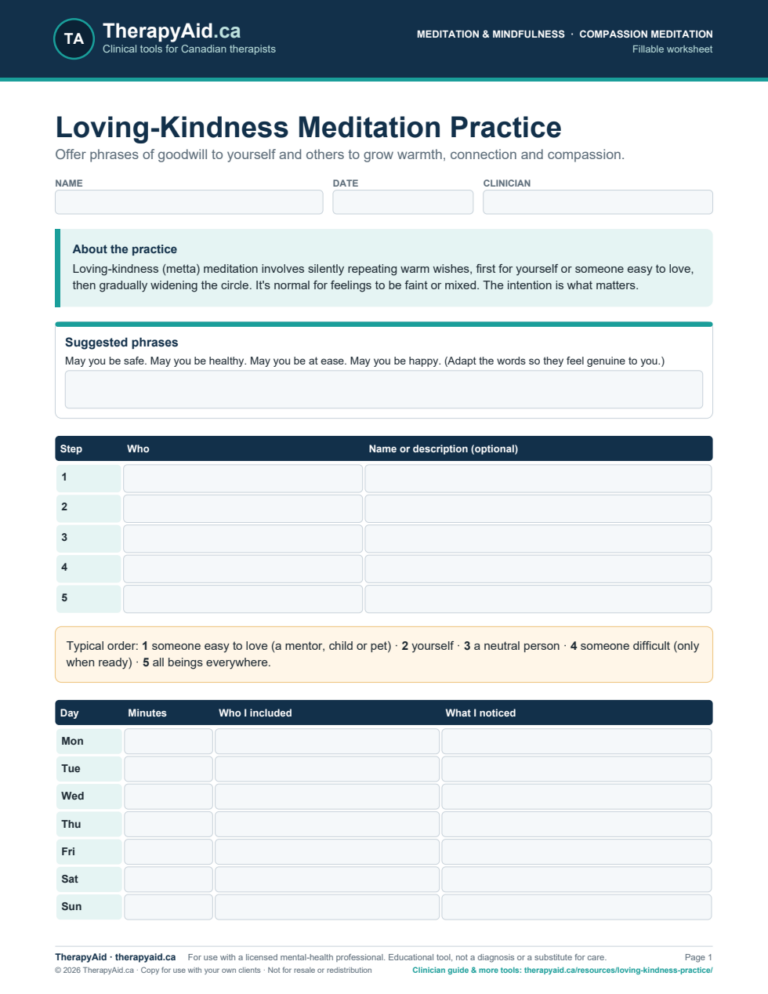
- Log practice and observations.
Clinician tips
- Timing is flexible; it’s the shape that matters.
- Use it as a bridge to skillful action.
- Pair with longer practices if possible.
Worked example
Sharing with clients
Members can download the PDF to print or email, or copy a private client link from the download box. Your client opens the link and downloads the worksheet on any device. No client account is needed, and nothing your client writes is stored on TherapyAid.
Frequently asked questions
Does it have to take exactly three minutes?
No. It can be shorter or longer. The three-step shape is what matters.
What is MBCT?
Mindfulness-Based Cognitive Therapy, an 8-week program combining mindfulness and CBT to prevent depressive relapse.
References
Segal, Z. V., Williams, J. M. G., & Teasdale, J. D. (2013). Mindfulness-based cognitive therapy for depression (2nd ed.). Guilford Press.
Kuyken, W., Warren, F. C., Taylor, R. S., Whalley, B., Crane, C., Bondolfi, G., et al. (2016). Efficacy of mindfulness-based cognitive therapy in prevention of depressive relapse: An individual patient data meta-analysis from randomized trials. JAMA Psychiatry, 73(6), 565-574.
This worksheet is an educational tool for use by, or under the guidance of, a licensed or registered mental-health professional. It is not a diagnostic instrument or a substitute for clinical judgement. If a client is in crisis in Canada, call or text 9-8-8 or call 9-1-1.