Intimacy After Life Changes
A sexual wellbeing worksheet for couples after major life changes, reflecting on what has changed, what is missed, what feels good now and what is needed, plus helpful options.
1-page fillable PDF · US Letter (prints on A4) · Sexual wellbeing
- Approach / concern
- Sex Therapy
- Technique
- Sexual wellbeing
- Format
- Fillable PDF, 1 page (US Letter / A4)
- Access
- Advanced plan
- For
- Licensed clinicians to use with clients
- Updated
- October 2026
Key facts
What is the Intimacy After Life Changes?
Major life events, such as childbirth, illness, surgery, menopause, medication changes and grief, commonly affect sexual desire, comfort and intimacy. A broadened, responsive view of intimacy and open communication help couples reconnect.
Why it works
Basson’s model describes how desire can be responsive and influenced by context, intimacy and emotional satisfaction (Basson, 2000). Better sexual communication is associated with greater sexual satisfaction (Mallory et al., 2019).
When to use it
- After childbirth
- Chronic illness, cancer or surgery
- Menopause and hormonal changes
- After a period of relationship stress or grief
How to use it in session
- Normalize changes in intimacy.
- Each partner reflects privately.
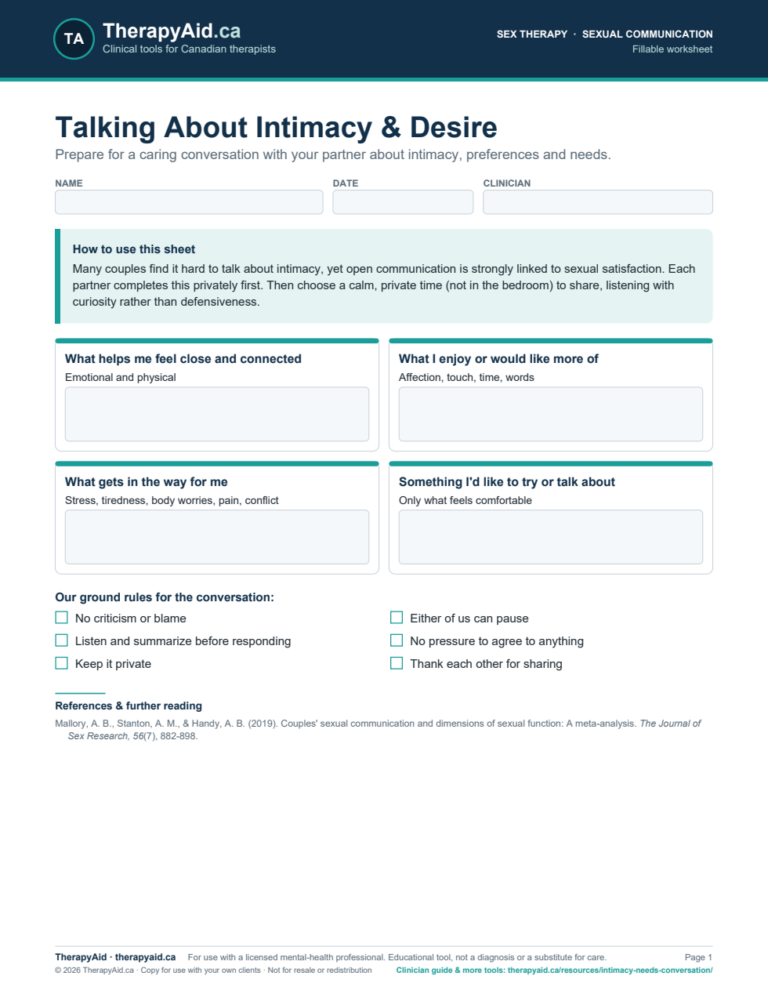
- Share needs and what feels okay now.
- Explore helpful options, including medical review.
- Plan small, pressure-free steps.
Clinician tips
- Rule out pain and medical causes.
- Widen intimacy beyond intercourse.
- Refer to pelvic health or sex therapy specialists as needed.
Worked example
Sharing with clients
Members can download the PDF to print or email, or copy a private client link from the download box. Your client opens the link and downloads the worksheet on any device. No client account is needed, and nothing your client writes is stored on TherapyAid.
Frequently asked questions
Is it normal for desire to drop after a baby?
Yes. Hormones, exhaustion, body changes and new roles commonly affect desire for months.
When should we seek help?
If pain, distress or conflict about intimacy persists, a doctor, pelvic health physiotherapist or sex therapist can help.
References
Basson, R. (2000). The female sexual response: A different model. Journal of Sex & Marital Therapy, 26(1), 51-65.
Mallory, A. B., Stanton, A. M., & Handy, A. B. (2019). Couples’ sexual communication and dimensions of sexual function: A meta-analysis. The Journal of Sex Research, 56(7), 882-898.
This worksheet is an educational tool for use by, or under the guidance of, a licensed or registered mental-health professional. It is not a diagnostic instrument or a substitute for clinical judgement. If a client is in crisis in Canada, call or text 9-8-8 or call 9-1-1.